

Recover lost revenue for customs and Nigeria with AI
Written by Abdulsalam Mahmood,
In the long and complex story of Nigeria’s public finances, revenue has always been an area of equal parts hope and fear. It is the lifeblood of governance, but also where the deepest questions about efficiency and accountability tend to lie.
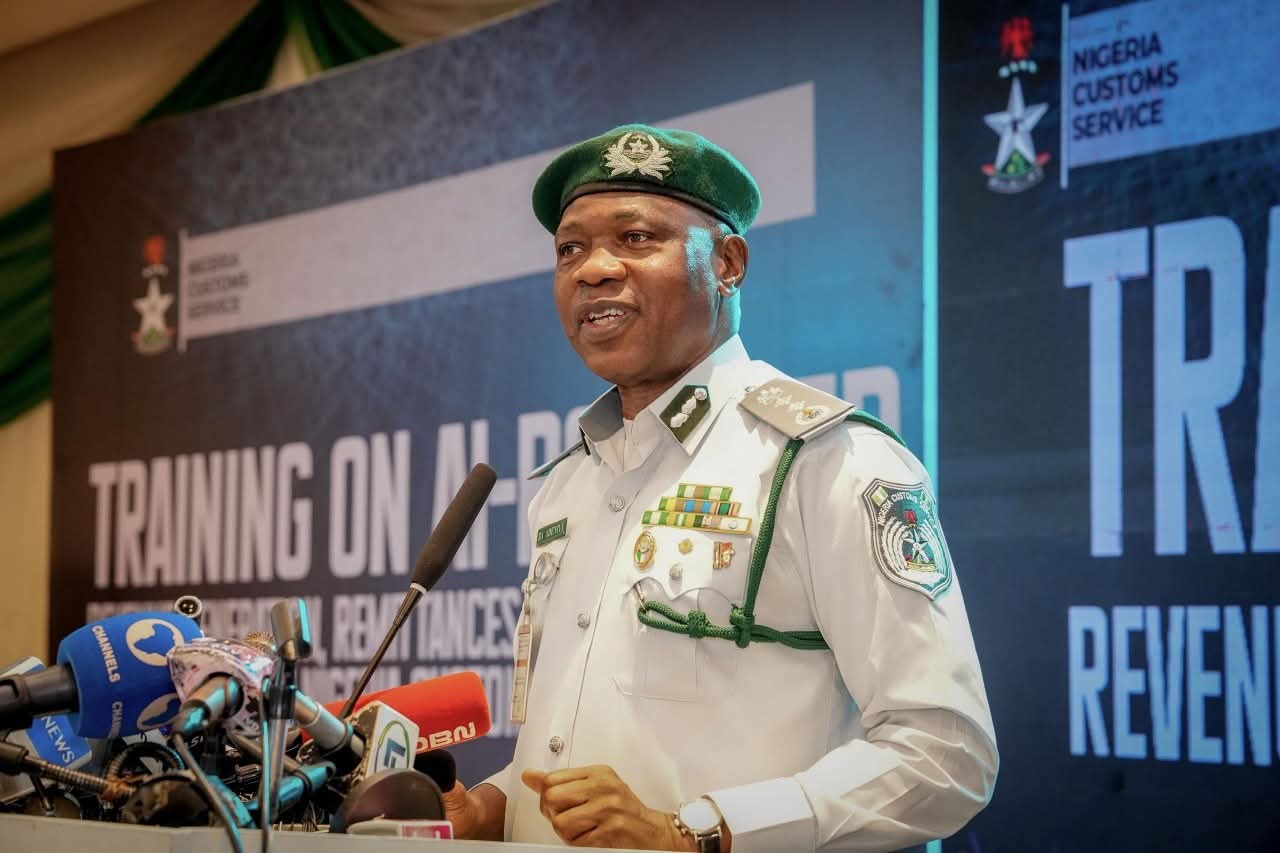
For years, the conversation has revolved around leaks, silent losses that rarely make a sound but steadily weaken the system. There is now a sense that something different is starting to take shape within the Nigeria Customs Service (NCS). Just three days ago on Monday, that change was expressed inside the Ladi Kwari Hall of the Abuja Continental Hotel.
It was not announced in dramatic terms or blanket declarations. Instead, it emerged in the form of training programs that brought together officials, legislators, and experts around common concerns. At its heart was a simple but far-reaching idea: that artificial intelligence could help solve problems that have long resisted easy solutions.
The gathering itself had a quiet significance. Senior customs officials sat next to MPs, and their presence spoke of increased cooperation between enforcement and oversight. This was a reminder that revenue management is not the mandate of a single organization. It’s a chain and every link is important.
What Nigeria Services has chosen to do is start strengthening its connections with technology. This is done in a way that touches on the day-to-day processes of collection, remittance, and adjustment, rather than in the abstract sense often found in policy documents. These are the areas where leaks most comfortably hide.
They thrive on delays, contradictions, and small gaps that no one notices until they become too large to ignore. The Comptroller General of Customs, Bashir Adewale Adeniyi, made a clear statement that reflected both awareness and intent. He presented technology not as a miracle, but as a tool that is already beginning to reshape how customs understands its operations.
Trading patterns that were once buried in large amounts of data are now easier to read. This clarity can potentially lead to better decision-making. There was also a deliberate effort to place customs within the broader system. Revenue doesn’t move in isolation, and neither do the solutions designed to protect it. Banks, auditors, policy bodies and legislative committees all form part of the same journey.
Therefore, any attempt to repair a leak must involve everyone. Artificial intelligence enters this space not as an outsider, but as a bridge. Connect data points, identify anomalies, and provide a level of consistency that is difficult to maintain with manual systems. In a multi-layered process like revenue management, this consistency is not a luxury.
It’s essential. For Adeniyi, the focus was on the collective good. The potential of AI is not contained within a single office or department. To have real impact, it must be shared across the value chain. Therefore, the training was not limited to customs officers only.
There’s something instructive about the tone, which encourages participants to ask questions and engage deeply. This suggests an understanding that technology cannot simply be imposed on people. Those who use it must understand it, test it, and adapt it. Without it, even the most advanced systems will struggle to deliver results.
The Deputy Accountant-General for Finance, Administration and Technical Services, Mr. Kikelomo Adeola, brought further clarity to the conversation. She said the training is not a routine exercise but responds to current needs. In her words, artificial intelligence is already beyond the future. It now belongs to an emergency.
Her emphasis on gaps in the existing system was particularly impressive. Adopting new tools is another thing. It’s another thing to understand exactly what you’re trying to fix. Revenue leakage is not an abstract problem. They are rooted in identifiable weaknesses and require clear direction to address them.
What this training attempts to do is provide that direction. This gives executives and stakeholders the knowledge they need to navigate increasingly data-driven systems. More importantly, it creates a common understanding of future goals. This common understanding is often what distinguishes reform from mere intent.
The presence of parliamentarians also added an element that cannot be overlooked. Being a director is not just about asking what went wrong. It’s also about supporting efforts to make sure things go well. In this sense, cooperation between customs and parliament reflects a change in approach.
Bamidele Salam, chairman of the House of Commons Public Accounts Committee, viewed the change with a mix of praise and alarm. He acknowledged the progress already made by the service, while reminding participants that a system is only as effective as the people who operate it. It was a statement that helped him regain his concentration.
There is a quiet truth to that observation. Technology can enhance processes, but it cannot completely replace the human element. Therefore, training becomes not only important, but essential. It is the bridge between possibility and performance.
Senator Ahmed Aliyu of the Senate Public Accounts Committee expressed a similar opinion. His call for durable systems speaks to concerns that go beyond immediate profits. It’s about building structures that will continue to function long after the excitement of reform has died down.
This idea of perseverance is central to conversations about AI. Introducing new tools is not enough. They must be maintained, updated and integrated into broader systems. Without that continuity, the gains achieved today may not be sustained tomorrow. In this sense, reform is a long journey.
A technical presentation by Bamidele Oyedeji provided a glimpse of what that journey will be like. His focus on trade facilitation and operational efficiency brought the discussion back to practical reality. We showed how AI can move from theory to application in customs operations.
Beyond the technical details, there was an underlying message of possibility. With the right tools and the right mindset, the age-old challenge of revenue leakage can be tackled. Perhaps not completely eliminated, but significantly reduced. And when it comes to finances, even small improvements can have big effects.
In fact, revenue leakage is not just a customs issue. They affect the resources available for development, investor confidence, and the credibility of public institutions. Therefore, addressing them has an importance beyond the service itself. In this context, AI becomes more than just a technological option. This is part of a larger effort to restore confidence in public finances.
By increasing transparency and accountability, we can rebuild trust in the system. That confidence is essential to meaningful progress. After all, the story of Nigeria Customs and AI is still unfolding. It’s a story of intention, effort, and gradual change. You may not see immediate results, but it can have a lasting impact.
And in a system that has long been defined by that gap, it’s worth holding on to that potential.
Mahmood, deputy editor of PR Nigeria, writes: [email protected].


