
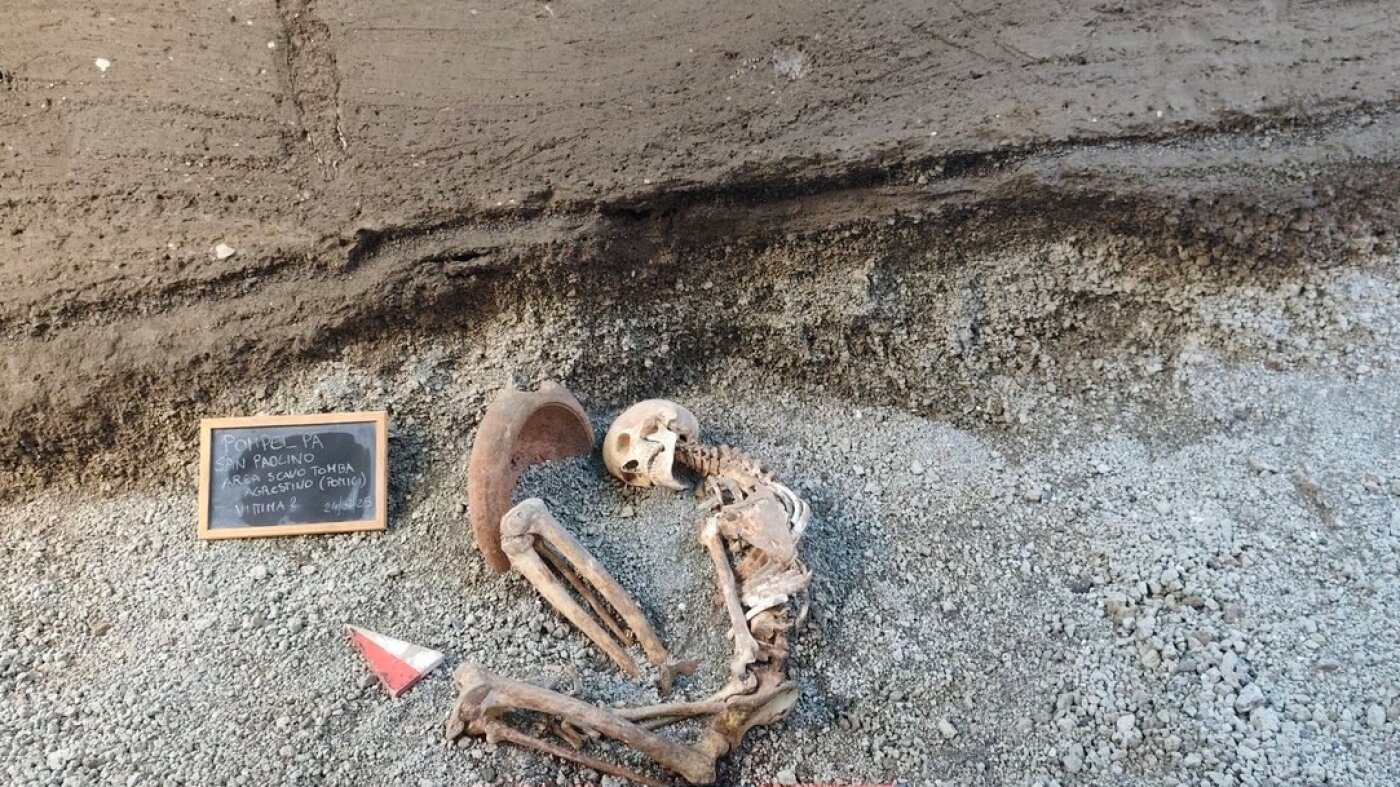

This image released by Italy’s Ministry of Culture on Monday, April 27, 2026, shows victims of the eruption of Mount Vesuvius at the ruins of Pompeii, near Naples in southern Italy, in 79 AD.
AP/Italian Ministry of Culture
hide caption
toggle caption
AP/Italian Ministry of Culture
ROME — Archaeologists and researchers at the ancient Roman site of Pompeii have used artificial intelligence for the first time to digitally reconstruct the face of a man who died in the eruption of Mount Vesuvius that blanketed the city in 79 AD, providing a new way to understand one of history’s most famous natural disasters.
This digital portrait depicts a man who was found with the remains of another person while attempting to flee the city for the coast of present-day Italy during a volcanic eruption. Researchers believe the man died in the early stages of the disaster, during a heavy fall of volcanic debris.
The reconstruction was developed by the Archaeological Park of Pompeii, which announced on its website that it was carried out in collaboration with the University of Padua and based on archaeological data obtained from excavations near the Porta Stavia cemetery, just outside the ancient city’s walls.

FILE – Dec. 14, 2022 A view of the Pompeii Archaeological Park near Naples, southern Italy.
Andrew Medichini/AP
hide caption
toggle caption
Andrew Medichini/AP
The presentation showed an illustration of a male figure generated by AI. He is shown running along a rough road covered in rubble, holding a large shallow bowl over his head to use as a shield, as Mount Vesuvius erupts in the background.
Pompeii, a UNESCO World Heritage Site near Naples, was buried in ash and pumice when Mount Vesuvius erupted nearly 2,000 years ago, preserving the remains of the city and thousands of its inhabitants in amazing detail.
Archaeologists found the man holding a terracotta mortar, which they interpreted as an improvised attempt to protect his head from small volcanic stones that fell during the eruption.
Ancient accounts, including one by the Roman writer Pliny the Younger, describe the residents of Pompeii using objects to protect themselves as ash and rubble covered the city.
The man also carried an oil lamp, a small iron ring, and 10 bronze coins, personal items that give insight into his final moments and daily life in Pompeii before the catastrophe.
The digital portraits were created using AI and photo editing techniques designed to transform skeletal and archaeological data into realistic human figures.
“Archaeological data is now so vast that it can only be properly protected and enhanced with the help of artificial intelligence,” said Pompeii Park Director Gabriel Zustriegel in a statement.
According to the researchers, the project aims to make archaeological research more accessible and emotionally appealing to the public, while maintaining its scientific foundation.


