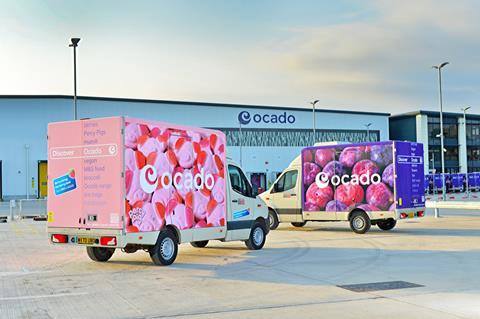
Siobhan Bowie, Ocado’s e-commerce director, claimed that AI will “game change” the way retailers interact with customers, as pure supermarkets increase their use of AI across their operations.
Following a major upgrade to its core technology stack last year, the retailer has rolled out a series of new AI capabilities aimed at improving the customer experience on its website, increasing availability, reducing waste, and improving how it targets new customers.
This includes a new agent AI chatbot to handle customer questions on your website. For now, the feature is only available to about 10% of Ocado users as part of a trial, but Bowie told The Grocer that it will be rolled out further in the coming weeks.
The bot will free up Ocado’s human customer hub team to deal with customers who require a higher level of support, Bowie said.
Ocado is once again the UK’s fastest growing grocer in the four weeks to January 25, according to Worldpanel (formerly Kantar). A key driver of growth was leveraging data and AI to more effectively target and retain new and potential customers, Bowie said.
In July, the retailer completed a five-year project to migrate its entire business to a new technology platform, increasing its functionality and ability to introduce new features.
Following the upgrade, Ocado is now looking at ways to use AI to improve the way customers search for new products on its website and speed up the checkout process, Bowie said. However, there are currently no confirmed plans as to how this will be done.
“Right now, everything has to be a product-driven search,” Bowie said. “How do you go to a place where you’re like, ‘I’d like to have a fancy meal for five people tonight, so let me show you what it looks like and just put those items in your cart?'”
AI will reshape grocery store shelves
Ocado is the latest grocer to confirm plans to significantly enhance the use of AI across its network as the retailer looks for ways to improve its supply chain, cut costs and make its stores more efficient.
Last year’s closure of all Amazon Fresh stores ended the concept of fully AI-powered stores where shoppers could come and go without human intervention, but AI has proven to be a far more effective tool for monitoring and improving inventory status.
Sainsbury’s is incorporating AI into its Blue Yonder predictive tool to improve its sourcing supply chain. Meanwhile, Morrisons has seen a significant improvement in in-store stock availability after a large-scale rollout of Focal Systems’ AI-powered shelf-edge cameras to monitor stock availability.
Tesco is putting AI at the heart of an overhaul of its Clubcard service as part of a new three-year partnership with French large-scale language modeling specialist Mistral AI announced in December. In October, Tesco’s media division launched a new creative studio that uses generative AI to create compliant advertising campaigns for brands.
“This is a game-changer for our industry,” Bowie said when asked what the potential of AI means for grocery shoppers.
“It won’t happen overnight, but while multi-product checkout doesn’t exist yet, the fashion industry seems to be moving faster thanks to tools that allow single product checkout to be performed off-platform.” [in grocery]. But it won’t be for long,” she said in an interview celebrating Ocado’s recent win with online grocer 33.
Ocado’s operating loss fell from £48.5m to £27.5m, despite a £48.1m increase in finance costs revealed in the full-year results published this week. Ocado also confirmed plans to cut 5% of its global workforce by up to 1,000 roles in the restructuring of its Ocado Solutions and Ocado Intelligent Automation divisions.