Kennesaw, Georgia | April 1, 2026
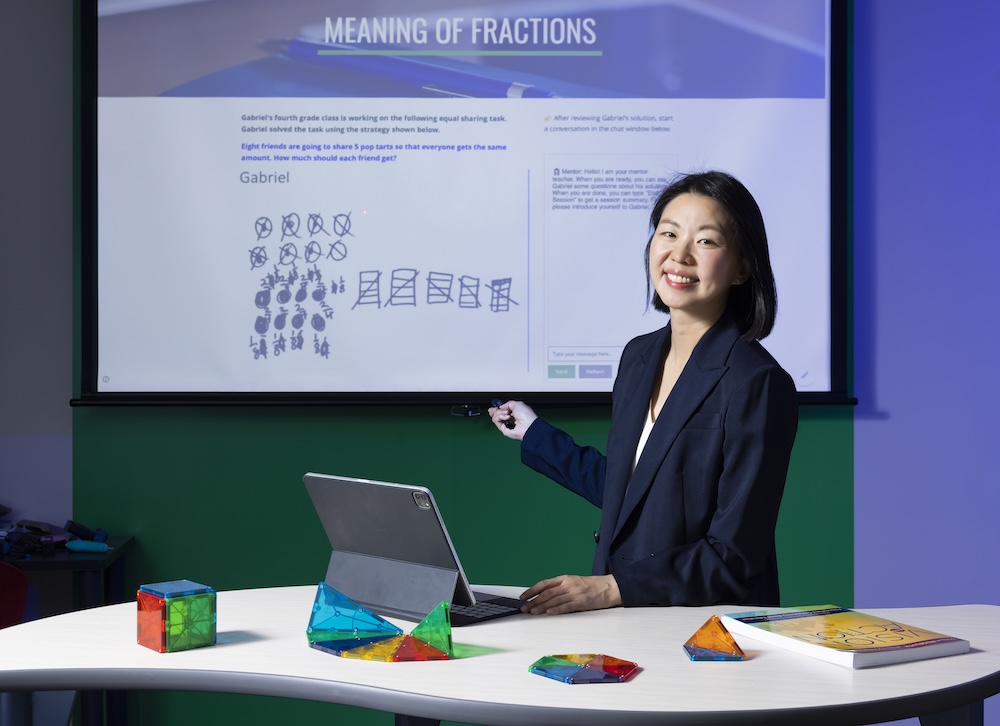
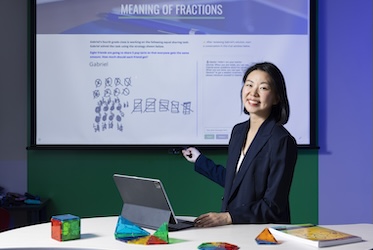
If you were sitting together in an online math class, Gabriel, Noah, and Jiu might sound like real elementary school students interacting in a virtual classroom, asking questions and making mistakes as they try to solve problems. In reality, these are AI agents known as chatbots that can help prepare future teachers to teach mathematics more effectively.
The agent was developed by researchers at Kennesaw State University. The researchers are leveraging artificial intelligence to help future teachers address one of the most challenging aspects of the classroom: thinking about mathematics.
With a three-year, $300,000 National Science Foundation grant, Dabae Lee, associate professor of educational technology, developed an AI-powered agent system that simulates student interactions. Its purpose is to provide in-service teachers with the practice of “responsive teaching.” This is the ability to elicit and interpret student thinking and extend mathematical ideas through questioning.
“The main benefit is that it helps current teachers develop responsive teaching skills,” said Lee, who helps train future teachers. Clarice C. and Leland H. Bagwell College of Education. “In turn, it helps future students develop mathematical reasoning and positive attitudes toward mathematics, an area in which students in the United States have always struggled.”
Professor Lee explained that the idea of simulated agents comes from Swiss psychologist Jean Piaget’s socio-cognitive conflict theory, arguing that students build higher levels of understanding by explaining and negotiating their points of view with others who have different perspectives. For example, students who have different wrong answers to the same problem can arrive at the correct answer by discussing their reasons with each other. Responsive teaching allows teachers to elicit students’ own thinking, sometimes including their misconceptions, and have productive conversations with students to resolve misconceptions without taking over students’ thinking.
Lee noted that student-teacher opportunities to practice responding to student reasoning in real time may be limited. Traditional methods such as peer role-playing do not necessarily reflect authentic classroom interactions.
“What has been done so far is that either an instructor, a trained adult, or a fellow student teacher plays the part of the child,” Lee said. “This is not ideal because adults may not have the same reaction as children.”
AI agents can help solve this challenge by allowing students and teachers to interact with virtual students who independently respond to explanations and questions in real time.
Lee designed the system using three virtual students (Gabriel, Noah, and Ji-woo), each with different personalities and different mathematical skills.
“We all have different personalities and ways of thinking,” Lee says. “Gabriel is a cheerful student who is good at math, while Noah has the same cheerful personality but struggles with this subject. Jiu is articulate but has certain misconceptions about certain math concepts.”
The system recently completed a second implementation in the fall with collaborators in the University of Missouri’s teacher education program and is currently being refined for the next round of testing, scheduled for next fall.
Lee said feedback from students and teachers who have used the system has been positive, with many saying the interactions feel more authentic than traditional exercises.
“Students really appreciated being able to practice responsive instruction with virtual students,” Lee said.
Lee’s work has been published in the following magazines. computers and education journal, computer assisted learning journal, and Mathematics Teacher Education Journal.
The project, which initially used IBM Watsonx technology, caught the attention of IBM and was featured in an IBM article. smart talk Podcast including a featured interview with renowned author and journalist Malcolm Gladwell.
Lee said the goal is eventually to share the technology more widely with teacher education programs.
“Our plan after the third round of testing is to make the agent and education modules accessible to other educators,” Lee said.
– Story by Christine Sr.
Photo by Matt Yong
Related articles
A leader in innovative teaching and learning, Kennesaw State University offers undergraduate, graduate, and doctoral degrees to more than 51,000 students. Kennesaw State University is a member of the University System of Georgia, which has 11 academic colleges. The university’s vibrant campus culture, diverse population, strong international connections, and entrepreneurial spirit attract students from across the country and around the world. Kennesaw State University is a Carnegie-designated doctoral research institution (R2), one of an elite group of only 8 percent of U.S. universities with R1 or R2 status. For more information, visit kennesaw.edu.