Across the United States, hundreds of lands, lakes, and rivers are heavily contaminated with hazardous wastes produced by human activities. Many of these locations designated as Superfund sites by the Environmental Protection Agency are located in Houston, Texas, where my colleagues and I live and work.
These sites are rife with harmful contaminants in the soil and water, such as polycyclic aromatic hydrocarbons (PAHs), which can increase the risk of cancer. Detecting these contaminants is just the first step in cleaning them up and keeping the environment safe.
For example, the EPA’s standard method for analyzing water samples from wells requires expensive technology that must be performed at a separate location and takes several weeks.
Our chemistry research group is developing new, more accessible and portable methods for detecting toxic contaminants in soil, water, and even blood.
My colleagues and I use machine learning techniques to detect individual compounds in mixtures without separating them and automatically identify those compounds by comparing them to digital databases. Machine learning can be used to streamline analysis of contaminated sites, detect hazardous contaminants faster in the field, and provide more efficient environmental monitoring.
nanomaterials are very sensitive
Imagine trying to look directly at the ends of your hair. The width of the small filament is almost invisible. Now imagine a material that is 1/1000th the width of a human hair. You won’t see anything at all. In my research, I use microscopic objects called nanoparticles.
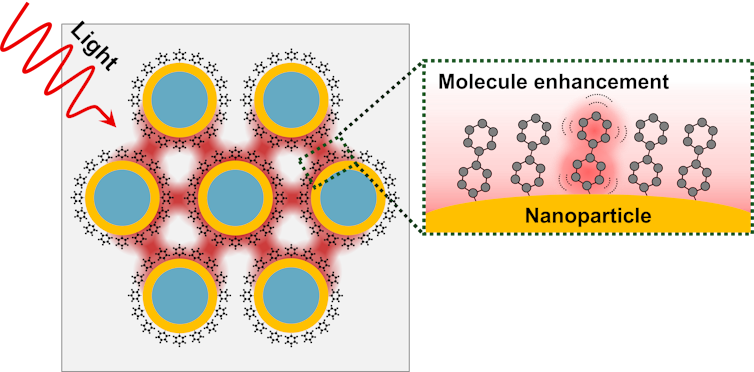
These nanoparticles interact with light in unique ways, similar to how a magnifying glass focuses sunlight. Any material near the nanoparticle is exposed to this focused light. Taking advantage of this property, when a nanoparticle is irradiated with a beam of infrared light, the surrounding material absorbs the strong light and generates a signal. The signal can be detected using a spectrophotometer, an instrument that measures the amount of light at a specific frequency.
Toxic contaminants near the nanoparticles absorb more infrared radiation than normal, enhancing the signal that can be measured. This process only occurs when the contaminant approaches the surface of the nanoparticle. However, if these pollutants are nearby, nanoparticle enhancement can be used to detect even the smallest concentrations.
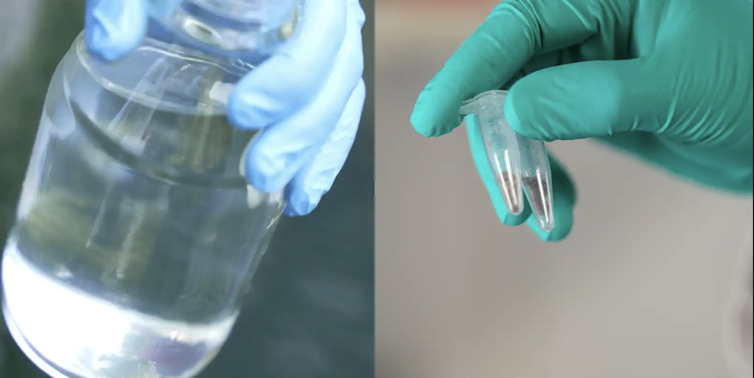
In our lab, we create nanoparticles using solutions of metal salts. They are then dissolved in a liquid to create ink, which is applied to the glass plate of the microscope. After the ink dries, it leaves a cluster of nanoparticles on the glass surface, like the beads in a diamond painting kit.
Brandon Martin/Rice University
When the nanoparticle painting is ready, add a drop of contaminated water onto the colored glass and let it dry again. During this process, pollutant molecules attach to the nanoparticles. Once dry, slide the glass inside a spectrophotometer and measure the light absorbed and emitted by the contaminants on the nanoparticles.
The specific frequencies of light that a compound absorbs and emits are like signatures. Each contaminant has a different signature that can be used to identify them in water.
Andres B. Sanchez Alvarado
Machine learning simplifies analysis
In some cases, contaminated water may contain a mixture of different compounds, complicating analysis. Each compound absorbs light and may absorb similar wavelengths. To prevent this interference, scientists typically have to physically separate each compound using advanced techniques. These techniques can be time-consuming, so our team wanted to find a way around this step.
We partnered with computer scientists who have been designing customized algorithms using machine learning. These programs take data from our measurements and find very subtle patterns that even the most seasoned analysts would miss.
Brandon Martin of Rice University
These methods simplify the data and extract the most important properties from each compound. These unique properties help computers identify the individual compounds present in a mixture, avoiding physical separation steps in the analysis. Computer scientists can make these algorithms so advanced that they don’t even need to train the machine before analyzing a sample.
Nanoparticles are used to measure water or soil contaminated with toxic pollutants, the data is fed into an algorithm, and the machine finds the most important features and matches them against a reference database. This analysis takes just a few hours, making it at least twice as fast as standard methods.
However, our method is far from perfect. One of the biggest challenges we face is optimizing the composition of nanoparticles for different types of pollutants. Different nanoparticles are needed to enhance the detection of different pollutants. We also need to tune our algorithms to better examine different signatures in the data.
This method allows sites to be screened for a broad class of contaminants with similar chemical structures. Then, in the future, it will be possible to use specific types of nanoparticles and more sophisticated models to identify each specific pollutant molecule.
Get the job done with streamlined analytics
Analyzing pollutants in the environment helps detect the presence of harmful pollutants, and doing this efficiently can prevent people from being exposed. The techniques our group uses to detect contaminants and analyze data are used in the field by other researchers using portable equipment. These portable devices are still cheaper than the equipment needed for standard technology.
Our team is currently exploring the use of these machine learning-enhanced techniques in a variety of environmental contexts. We analyzed other types of samples, such as water and air from contaminated sites. We are working to expand the scope of our analysis to include a wider range of hazardous pollutants. We are also collaborating with toxicologists and environmental engineers at the Texas Medical Center, with the goal of transferring this technology as an alternative method for environmental and public health authorities.
To do this, they filed a patent for a method that combines spectroscopy and machine learning to analyze complex samples. Although our team is not currently pursuing commercialization of this technology, it is a possibility in the future.
Still, environmental safety doesn’t end with detection. Once hazardous contaminants are identified, the site must be inspected to determine how to clean them up. Our motivation is to streamline the process of contaminant detection and identification. The sooner we can detect hazardous substances, the sooner we can prevent future emissions and begin cleanup.