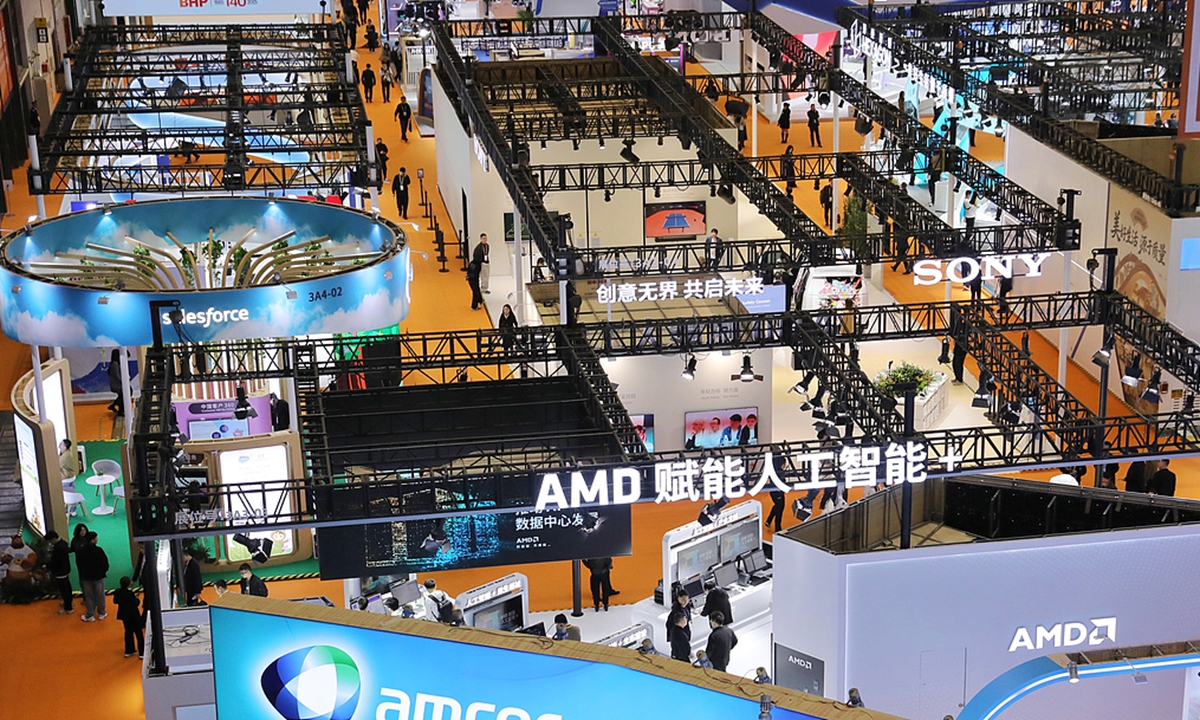
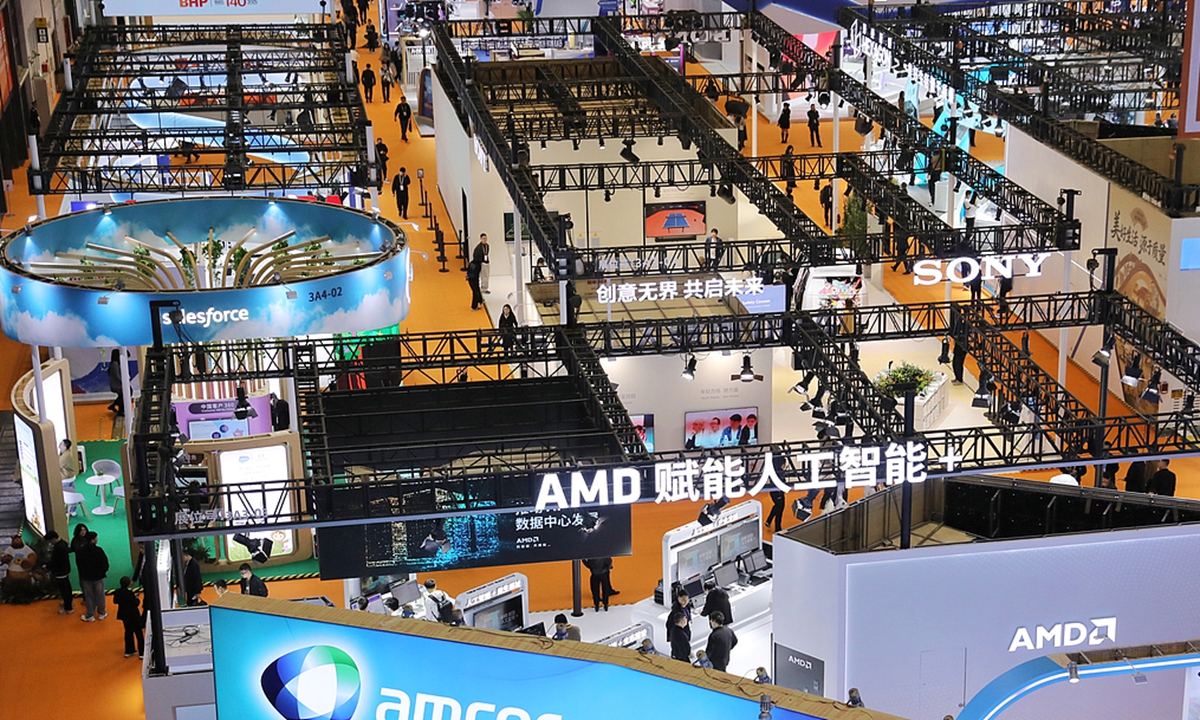
Visitors gather in the AI section of the Equipment and Technology Hall at the 8th CIIE in Shanghai on November 5, 2025. Photo: VCG
Several regions in China, including Shanghai, southwestern China's Sichuan province, and southern China's Guangxi Zhuang Autonomous Region, have further rolled out their “AI Plus” action list, vowing to step up investment and accelerate the adoption of artificial intelligence (AI) across key industries and public services.
At an event held on Sunday, Shanghai's traffic regulator announced its latest achievements in building a smart transportation system and launched several major initiatives simultaneously, according to China Media Group.
Shanghai has also expanded its self-driving test network, adding new roads in Pudong, Minhang and Hongqiao hubs. The city currently has 3,173 pilot roads with a total length of 5,238.82 kilometers, which is approximately one-third of the city's urban area.
Additionally, China's first metropolitan-wide traffic signal data platform was launched, providing real-time data from 7,600 intersections to support the development and deployment of advanced autonomous driving.
At a provincial conference on AI application scenarios held on Friday, Sichuan Province announced a list of 183 items, including 71 application demand scenarios and 112 product supply scenarios. According to a report in Sichuan Daily, the list includes fields such as advanced manufacturing, emergency response and public safety, as well as elderly care and rehabilitation services.
The application demand list includes a “full-process digital twin platform for baijiu production,” which uses AI models to build a digital system that covers the entire lifecycle from starter production and fermentation to distillation, aging, blending and packaging, creating a “digital distillery” that supports the industry's digital transformation, the report said.
On Sunday, Guangxi released recommendations for the 15th Five-Year Plan, outlining a development model of “research and development in Beijing, Shanghai and Guangzhou, integration in Guangxi, and application in ASEAN.” The document calls for strong efforts to expand the intelligent economy, accelerate the clustering of the AI industry, and promote key projects such as the China-ASEAN AI Application Cooperation Center.
Although AI is not given a separate section, the “AI plus” approach runs throughout the plan. It proposes actions such as promoting “AI + manufacturing,” deepening the integration of AI and the industrial Internet, and promoting breakthroughs in key core technologies, including AI.
The “AI Plus” initiative revealed in the 2024 Government Work Report is gaining momentum and emerging as a key priority for China's social and economic development. According to Xinhua News Agency, the Chinese Communist Party's Central Committee's recommendations for the formulation of the 15th Five-Year Plan (2026-2030) recently included a call to “fully advance the 'AI Plus' concept,” emphasizing its importance for the country's future.
Ma Jihua, a veteran industry expert, told the Global Times that China's AI development is supported by two strengthening forces. This is due to expanding infrastructure such as computing power, algorithms, associated software and hardware, and rapidly growing application demands. As more real-world scenarios adopt AI, the technology will iterate faster and move into a “high-speed trajectory of development,” creating a virtuous cycle of innovation and adoption, he said.
He pointed out that the nationwide rollout of the “AI Plus” initiative, which is currently included in the 15th Five-Year Plan and is being actively promoted by states and cities, is giving a strong boost to AI on the demand side. From robotics to manufacturing to public services, more industries are using AI to upgrade their operations, enabling rapid iteration of AI technology and improving the entire ecosystem.
Ma added that China's vast manufacturing base, as well as its large population, rising medical needs and burgeoning new energy vehicle sector, provide a broad base for AI implementation. He hopes that each state will leverage its strengths and that “AI Plus” will form a mosaic of complementary developments across the country. But he cautioned against pushing AI into scenarios where current capabilities remain inadequate, suggesting that investments should be ambitious but calibrated.