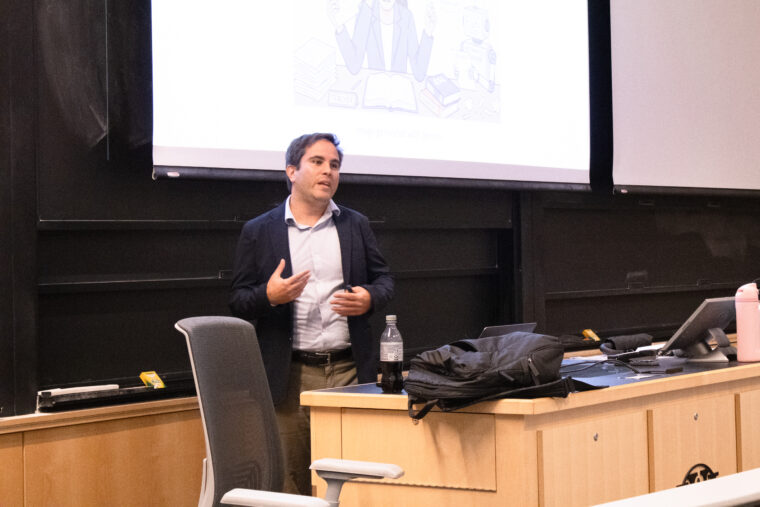
Gabriel Guillen spoke about AI and language education at WashU (Rachel Benitez Borrego | Staff Photographer).
Gabriel Guillen, a professor at the Middlebury Institute of International Studies in Monterey, discussed language learning in the age of artificial intelligence as part of the Ginger Marcus Foreign Language Learning Speaker Series on April 2.
The talk, “Language Education and AI: What We Can Teach When We Stop Fearing,” covered the differences between humans and animals, why humans still need to learn new languages in the age of AI, how AI is different from other tools throughout history, and how AI can complement language learning rather than undermine it.
At the start of the event, Gillen conducted an online survey of the audience, most of them foreign language professors, about how comfortable they were with AI. Most of the audience members were between “cautious about AI” and “interested in AI,” and two professors even felt that “AI is positive.”
Generative language is what makes humans unique, Gillen told the audience.
“With a limited set of sounds, you can create an infinite number of meanings.”
But without passing language from generation to generation, humans could not survive as a species, Gillen said.
“We need to teach language. If we don’t teach language to our children, it doesn’t matter, right? So we can say that teaching language is what makes us human.”
Through data graphs, Gillen showed that even in the age of AI and pre-AI tools like Google Translate, more and more people want to learn more languages. This may be partly due to increased migration for climate and economic reasons.
In the 1970s, 250,000 students were taking Spanish classes in American classrooms. Today, that number has reached 500,000, Gillen graphically showed.
Guillen told the audience that using AI to communicate with people who speak different languages cannot truly replace actual communication in the same language.
“We are languages, and when we move to other places or welcome people from other places, we can establish new identities, create a sense of belonging, and build trusting relationships with other people.”
To demonstrate how AI differs from other tools, Gillen asked the audience to try combining historical tools with what they had “augmented.” A telescope is an extension of the human eye, a hammer is an extension of the hand, and a book is an extension of memory. He then asked the audience if they thought AI was an extension of what, or something else entirely.
A professor in the audience responded that AI is different because it creates things that we don’t have without acknowledging authorship. The professor explained that even though we are the ones driving the AI, what it produces comes not from our own thoughts and knowledge, but rather from collective knowledge programmed by other people.
Another professor said that AI is unique because it can replace some of the roles of humans and act as a personal assistant.
So Gillen asked how professors should adjust their assignments to encourage more learning from students.
“Perhaps you could focus on local events, recent events, audio and video assignments, and focus on process rather than product,” Gillen suggested.
By incorporating AI into the curriculum and telling students at what stages of the assignment they are allowed to use it, professors can teach students not only how to use AI effectively, but also how to spot its limitations and mistakes, Gillen said.
“I’m writing a new AI policy, which I’m sure many of you are doing right now. My policy is based on agency, productive struggle, transparency, and the integrity of voice,” he said. “AI policy should be a process, not just a contract.”
What AI cannot replace, Gillen says, is immersion. Even with AI chatbots that help language learners practice speaking by imitating conversations, they can’t replace the study abroad experience.
Paolo Scartoni, an Italian lecturer and audience member who said he was “cautious about AI” in Guillén’s first poll, told Student Life that he attended the talk to see how his colleagues were dealing with AI.
“I try not to use AI in my classes, so I came here to see if anyone could change my mind,” he said.
After his talk, Scaltoni said he remains skeptical about whether AI will do more good than harm to students in the learning process.
“My sense is that we’re looking to AI to streamline processes in terms of making them faster. And I love taking things slow. I think there’s value in enjoying the journey, and there’s not always value in finding shortcuts,” Scaltoni said.
Scaltoni said the use of AI in the Romance Languages and Literatures Department varies by professor.
“I think it’s great that different people are using different methodologies and exposing students to different forms of instruction.”
However, Scaltoni said he is hesitant to introduce AI into his education because he fears it will eliminate mistakes, which are an essential part of learning.
“The most beautiful thing is that you learn little by little, but it takes a long time. I think our greatest success as language teachers is to make our students passionate about learning the language, because it’s a journey that doesn’t end in four years.”
Since Scaltoni, whose first language is Italian, has started using AI, he has noticed a difference in his English proficiency even just by writing emails.
“I noticed that before AI, I improved my English faster because I had to pay attention to my friends and colleagues giving me feedback. Whereas now I just pass it through the AI and I don’t even pay attention to it, because I know it’s there whenever I need to use it,” he said.
Especially in the classroom, Scartoni said teachers have a responsibility to protect student thinking and learning and to consider what happens when they use AI.
“Some of my concerns are the fact that behind these AI tools there are algorithms, and behind the algorithms there are humans, and that’s scary because we’re entrusting the thinking, learning, and writing to faceless people. [are] It is not a learning institution. They belong to private companies. “Their purpose is to make money. We’re asking you to exist in a space that was designed by someone with special interests that we know nothing about,” he said.