
Model Context Protocol, commonly known as MCP, has become the lingua franca for AI agents.
Salesforce is looking to open standards like this API to expose application data to AI agents as a mechanism to turn Slack into a new interface and, indeed, a platform for Salesforce customers to run their businesses. Co-founder and CEO Marc Benioff has reiterated this idea since 2020, before the company completed its $27.7 billion acquisition of Slack.
The idea is to drive interoperability between all types of AI agents by incorporating integration between MCP and Salesforce’s sales, marketing, e-commerce, and service platforms. We also do this by incorporating agents external to Salesforce, such as Anthropic, OpenAI, and Vercel (an up-and-coming agent development platform), as well as a host of other applications that support this standard.
Ryan Gavin, executive vice president of Salesforce and chief marketing officer of Slack, said this interoperability effort will enable all Salesforce and external agent capabilities within Slack.
You can also think of this as an AI orchestration play, where Slackbot acts as a “super agent” that understands and tracks the functions of all other task-based agents (so no humans need to do it) and executes plain language instructions.
Orchestration has become a competitive arena for enterprise technology vendors, as most generative AI models have become powerful enough to meet the operational needs of typical enterprises.
For companies that have already started moving their sales operations to Slack, these latest MCP integrations reduce the “swivel chair” for sales reps between Slack, Tableau, Salesforce CRM, and other applications, said Rebecca Wettemann, founder of independent research firm Valoir.
Agentic AI also gives sales managers visibility into pipeline progress more often, as automation aggregates data in real-time and forces sales reps to update CRM records more frequently. If an AI agent isn’t informed of things like the outcome of a sales meeting, it can’t explain recent activity.
“Instead of having the most accurate pipeline forecast ever, once a week, at a certain point in time, where a sales manager can specify at any time that the CRM needs to be updated, they actually have it all the time,” Wetman said.
Salesforce claims that this latest Slackbot MCP AI feature set requires little to no engineering improvements. Administrators will now be able to set up agent AI tools, and developers, that previously required many steps to make them work.
“If you can put your phone in airplane mode, you can do it as an administrator,” Gavin said, referring to the integrated list of slider switches that pop up to connect Slackbot to internal Salesforce, external business apps, and even AI tools using MCP.
“MCP client connection completed” [and] MCP server. Therefore, administrators can simply enable these features in the dashboard to give their organization access to them. This is very simple. ”
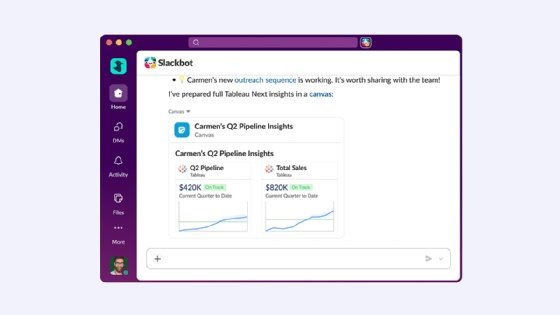
Slackbot, the “super agent”
For Salesforce users, it can be difficult at first to differentiate between what to deploy to Slackbot and what to deploy to Agentforce. This is because their functions seem to overlap.
Salesforce’s strategy is that users will want to use “super agents” like Slackbot to manage and route end-user requests to task-based agents. In theory, humans shouldn’t need to know which agent to reach to update a CRM or visualize sales trend data while speaking into a phone microphone. Instead, Slackbot will figure it out for you.
But what does this do to the old, familiar Salesforce interface that customers have relied on for decades? Gavin, co-founder of Salesforce and current Slack CTO Parker Harris. If Slack and its voice and other input channels become Salesforce’s home, and users never return, “that’s not a bad outcome,” he said.
“I think everyone agrees that this is a very powerful way of working and an upgrade from what we have today,” he said.
As organizations become familiar with the yin and yang of MCP and AI, it will become easier to find workflow use cases that actually drive efficiency. It becomes clearer which tools from different vendors work best.
The race is on. Salesforce, like all of its competitors, wants to rise to the top.
Currently, enterprise technology buyers and CIOs are very confused about when to use which AI tools, Wettemann said. They are exposed to competing product releases and announcements regarding bots and various platforms for deploying AI. For Salesforce users, there are multiple options within the platform to do the same with MCP and AI capabilities.
“Salesforce needs to be very prescriptive in telling customers, “Here’s what you need to do in Slackbot,” “Here’s what you need to do in Agentforce,” “Here’s what you need to build in Agentforce and then bring it to Slackbot,” Wettemann said.
Don Fluckinger is a seasoned B2B technology journalist with over 30 years of experience specializing in enterprise IT, digital experience, and content management. As a senior news writer for Informa TechTarget, I provide award-winning analysis that helps IT and business leaders leverage complex technology to improve customer and employee experiences. Any tips? send him an email.