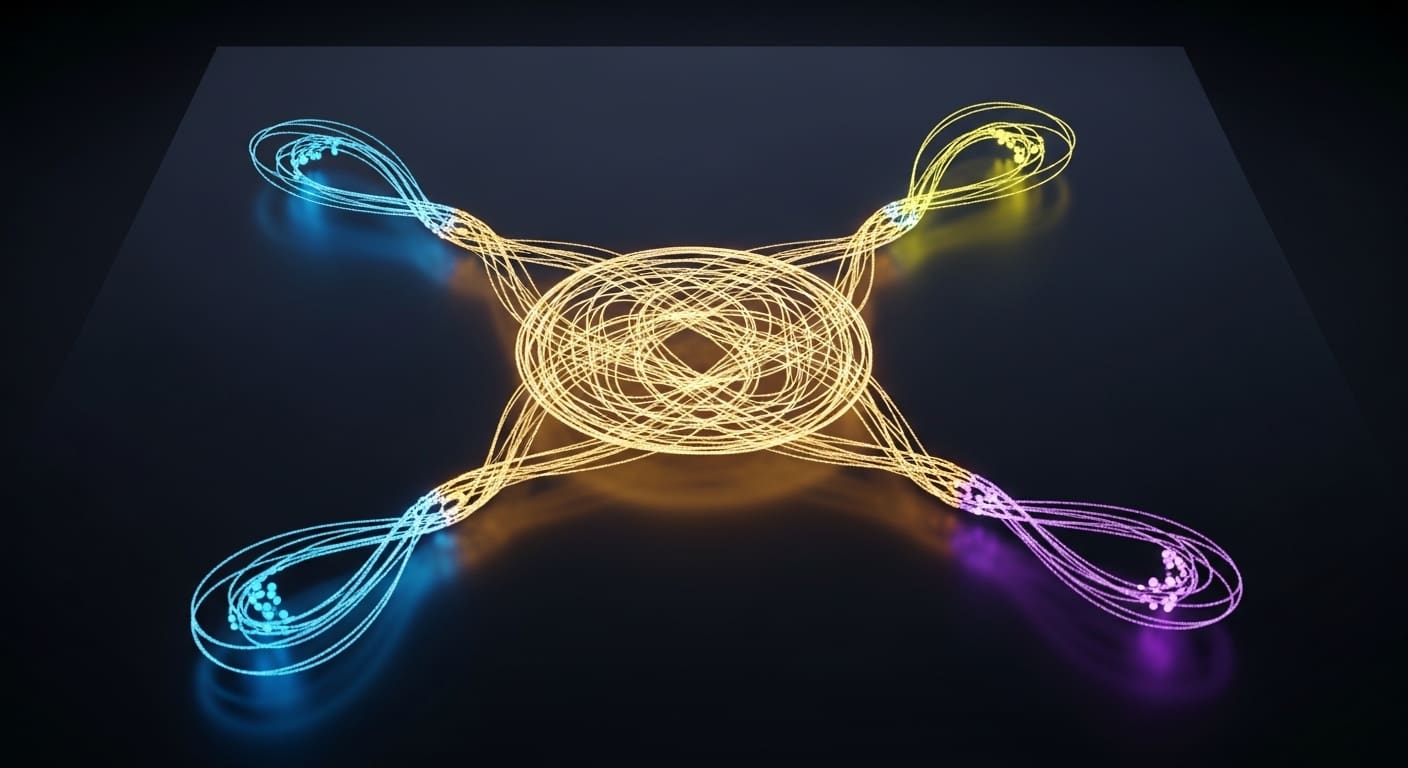
A novel machine learning framework is developed to detect complex energy braiding topologies within a dissipative atom simulator. Yang Yue and colleagues at the State Key Laboratory of Quantum Optical Technology and Devices at Shanxi University have developed a framework based on transformers. Their experimental demonstration exploits Bose-Einstein condensation to design a tunable dissipative two-level system, revealing how the braid of instantaneous energy exhibits different topological structures over time. The Transformer framework predicts topological invariants, identifies band crossings as the key geometric feature driving this behavior, and provides a new approach for exploring non-Hermitian topological topology in cold atoms and potentially other physical systems.
Simultaneous identification of topological classification and geometric origin in dissipative systems
By moving from indirect and complex methods to a single machine learning process, we observed a 10x improvement in simultaneously classifying topological invariants and identifying their geometric origins. Previously, determining both of these features in dissipative cold atomic systems required separate and laborious experiments, often requiring complex theoretical calculations and multiple measurement steps. The new Transformer-based framework achieves both simultaneously, greatly reducing the experimental and computational burden. The system accurately identified complex energy braids of braid order 0, 1, 2, and 3, representing structures ranging from topologically trivial simple unlinks to complex trefoil knots with nontrivial topologies. Understanding these topological invariants is of great importance as they determine the robustness of quantum states to perturbations, a key requirement for quantum technologies.
This advance relies on a “self-attention” mechanism that automatically highlights important band crossings where energy levels meet and can dramatically change the behavior of the system, as the geometric basis of the observed topology. The intersections of these bands represent degeneracy points in the energy spectrum and are fundamentally associated with the appearance of topological features. Utilizing the Bose-Einstein condensation of 87Rb atoms, the ability of the transformer to accurately classify complex energy braids of braid orders 0, 1, 2, and 3 was demonstrated, and a tunable dissipative two-level system was designed. Dissipation in this context refers to the loss of energy from the system and plays an important role in shaping the complex energy landscape. The machine learning framework not only predicted topological invariants but also autonomously identified band crossings as the key geometric feature driving the observed topology. Validation achieved by projecting attentional weights onto the test data reveals a clear focus on these critical energy points for each degree of braiding. The attention weight distribution was directly correlated with the theoretically calculated momentum spatial distribution. The system successfully generalized from simulation data to experimental measurements and demonstrated strong performance beyond initial training parameters, demonstrating its robustness and potential for broader applications. This generalization ability is essential for applying the framework to new and unexplored systems.
Transformer networks identify topological features of Bose-Einstein condensed energy bands
This research centers around Transformer networks, a machine learning architecture originally developed for natural language processing and repurposed here for the analysis of quantum data. Unlike traditional convolutional neural networks, which typically require predefined filters and manual feature extraction, they use a “self-attention” mechanism to automatically identify important relationships in the data. The network learns which parts of the complex energy band are most important for classification. This is similar to highlighting key points on a map to understand routes and identifying band intersections as the geometric origin of the observed topology. The complex energy band represents the allowable energy state of the system in the presence of dissipation, and its topology determines the behavior of the system.
This approach was chosen because traditional convolutional neural networks require manual feature engineering and lack direct geometric interpretation. A transformer network was utilized to analyze the complex energy bands created using the Bose-Einstein condensation of 87 Rb atoms and measure the eigenvalues for forming energy blades. Density-dependent dissipation resulted in braid evolution observed on short and long timescales, allowing observation of system behavior over time. 87Rb atoms are cooled to extremely low temperatures to form a Bose-Einstein condensate. A Bose-Einstein condensate is a state of matter in which the majority of Bose occupies the lowest quantum state, allowing precise control and manipulation of atomic systems. The dissipation was carefully controlled to design the desired complex energy band and observe the formation of energy blades. The observed timescale of braid evolution provides insight into the dynamics of non-Hermitian systems.
Machine learning deciphers quantum topology from limited geometric data
Indirect experimental measurements and complex theoretical modeling have long been relied upon to identify the precise geometric origins of topological properties in quantum systems. These methods often involve significant approximations and can be computationally expensive. Although this new machine learning framework provides a streamlined approach, current success is limited to distinguishing between four braid orders. Extending this to the much more complex knot structures found in real-world materials would require significantly larger datasets and more sophisticated network architectures, creating major hurdles. The complexity arises from the exponential increase in possible braid configurations as the degree of braiding increases.
Nevertheless, this initial success is an important step forward, demonstrating the potential of machine learning to decipher the complex relationships between geometry and topology in quantum systems, which previously relied on lengthy calculations. This is expected to accelerate materials discovery by efficiently identifying topological features important for advanced technologies, such as the development of more durable quantum computers and new electronic devices. Topological materials are predicted to have increased stability and robustness, making them ideal candidates for these applications. in [Institution Name]By applying Transformer networks, scientists can now determine the topological invariants of a system and pinpoint the band crossings that produce them. This automated process provides a more direct and efficient approach to characterizing the complex energy braids that form within cold atomic systems beyond previous indirect methods. It establishes a new way to link the topology of a quantum system with the geometric features that drive that topology. Future research will focus on extending this framework to higher braiding orders and exploring its applicability to other physical systems exhibiting non-Hermitian topology, which may include photonic crystals and metamaterials.
The researchers used a Transformer-based machine learning framework to successfully link the topology of a quantum system with its underlying geometry, and this was demonstrated using a Bose-Einstein condensate with tunable dissipation. This is important because it provides a faster and more direct way to identify important topological features within materials, potentially accelerating the discovery of robust materials for technologies such as quantum computing. Currently, the framework, which can distinguish between four braid orders, highlights band intersections as the dominant geometric feature. Future research will focus on extending this method to more complex structures and applying it to other non-Hermitian topological systems such as photonic crystals.
👉 More information
🗞 Detecting complex energy braid topologies in a dissipative atom simulator using transformer-based geometric tomography
🧠ArXiv: https://arxiv.org/abs/2603.25775