
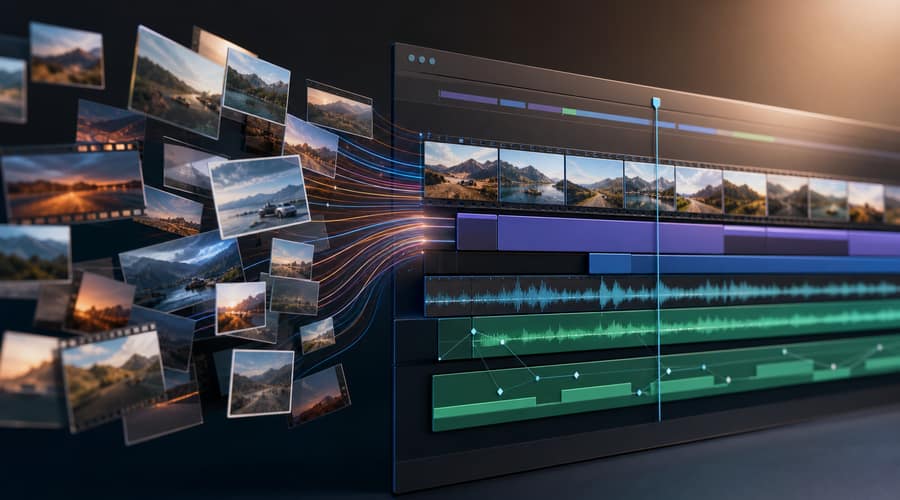
LTX Director is not a separate model launch. This shows that AI video is moving into a tool that creators can actually direct, modify, and build upon.
The latest signal in open source AI video didn’t come from a big product keynote. This is from a community developer who shipped the timeline editor in LTX 2.3 to the ComfyUI ecosystem and watched it migrate rapidly through the creator forums.
The LTX Director, shared on r/StableDiffusion and r/comfyui, is built within the free WhatDreamsCost-ComfyUI repository. The pitch is practical. It brings together image-to-video, text-to-video, first and last frame controls, intermediate frames, prompt relay, custom audio, resizing, and segment trimming in one working interface. This wasn’t just a sample video. This was a tool targeted at a very specific pain point.
This is important because AI video is caught between two worlds. On the one hand, there are powerful generative models that can generate impressive clips. The other is the hands-on work of creating scenes with timing, continuity, audio, and revision control. Most creators don’t just need a better prompt box. You need something similar to an editing environment.
According to the WhatDreamsCost GitHub repository and the developer’s Reddit post, LTX Director is the successor to the creator’s previous LTX Sequencer and Multi Image Loader nodes, and builds on Kijai’s Prompt Relay work and previous tools. That pedigree is important. This is how open source AI video is being developed. It is shown not as one complete, fully formed application, but as a chain of community modifications, experiments, and interfaces that gradually make their way into the production infrastructure.
Lightricks helped start this kind of work when we released LTX 2.3 in March with open weights, reference workflows, ComfyUI support, and LTX Desktop. The company described this release as a production-ready engine designed to be built on top of, and it appears the community took that literally. The LTX Director is one of the clearest examples of that layering around the model so far.
This change is often underestimated. Upgrading the model will improve the output. Workflow tools change who can reliably use the output. Once creators can place prompts on the timeline, trim segments, bring in audio, and combine reference frames without having to manually rebuild the node graph each time, the system starts to feel less like a lottery ticket and more like a crude but usable production tool.
This is exactly the center of the prompt relay. The Prompt Relay project by Gordon Chen, Ziqi Huang, and Ziwei Liu at Nanyang Technological University describes it as a training-free method for assigning prompts to specific time intervals in video generation. Simply put, different instructions can control different moments in a clip, reducing the problem of one idea percolating into another throughout the video.
For entrepreneurs looking at AI media, that’s the useful part. Better time control doesn’t just mean more beautiful demos. That means less waste. This means that filmmakers, advertising studios, social content teams, or individual creators can experiment with multi-beat shots without having to discard each generation, as the model ignores the sequence of events.
Indie tools fill the gap
LTX Director also shows why ComfyUI continues to be an important part of the AI creator economy. It’s not the most sophisticated environment for beginners, but it’s flexible enough for developers to quickly incorporate new features into their actual workflows. As such, it becomes a laboratory for the product layer, which often comes after the model layer.
The creator stated that this node was built for 6 days in a row with the help of Gemini. The details are small, but they capture something larger about software entrepreneurship at this time. A single builder can create a professional workflow tool in less than a week with AI coding assistance, an open-source model ecosystem, and ready-to-use community distribution channels. Engineering ability is no longer the only barrier. What matters is flair, speed, and whether the tools solve real problems for creators.
There are still limits. LTX Director is new software and the repository already lists hotfixes for interface issues and workflow fixes. Documentation is still arriving. Anyone expecting the stability of Adobe Premiere or DaVinci Resolve will be disappointed. But that’s still not the correct comparison. A better comparison is the nascent plugin ecosystem. There, a messy but useful tool reveals what the next mature product category will be.
Business opportunities lie in that gap. AI video models are becoming available, and the open source community is learning how to wrap them with controls that match their creative work. Some of these tools will remain as free community projects. Others will include hosted services, paid node packs, creator marketplaces, training products and vertical software for marketing teams, game studios, and short-form video producers.
The benefits are clear for Lighttrix as well. An open model becomes more valuable when independent developers build around it. Each workflow, node, and editor makes the underlying ecosystem harder to ignore. That’s how the infrastructure is deployed. It’s not only adopted through benchmarking, but also through everyday tools that people come back to because they save time.
The next stage of AI video cannot be won through prompts alone. Systems that people can control, modify, and ship will win. LTX Director is early, but it’s pointing in the right direction, away from isolated generations and toward an editable creative pipeline that indie builders can own.
Also read: TurboQuant gives AI startups a useful reminder about inference costs • InclusionAI brings trillion-parameter inference closer to startups • AI downsizing leaves founders with trade debt issues


