
UK deep tech startup Stanhope AI has secured €6.7 million ($8 million) in seed funding to power a new generation of AI designed for autonomous systems operating in the physical world.
The round was led by Frontline Ventures, with participation from Paladin Capital Group and Auxxo Female Catalyst Fund, with follow-on investments from UCL Technology Fund and MMC Ventures.
The startup is mentioned in a report from EU-Startups 2025 in which Berlin-based VC fund Auxxo is setting aside €26 million to invest exclusively in “teams with at least one female founder,” in which Stanhope.ai is mentioned as one of the portfolio companies enabled by Auxxo Female Catalyst Fund.
“We are moving from language-based AI to intelligence with the ability to act to understand the world – systems with fundamental agency.” Professor Rosalyn MoranCEO and co-founder of Stanhope AI. “Our approach goes beyond just processing words; it understands context, uncertainty, and physical reality.”
The broader European startup funding landscape has seen capital flowing into various AI and autonomy ventures since Stanhope AI’s €6.7 million seed round.
For example, Allonic (based in Budapest) closed a pre-seed round of €6 million in early 2026 to develop a robotic body manufacturing platform. In the broader AI sector, Mistral AI (Paris) secured a record Series C of €1.7 billion in 2025 to scale up foundational AI model development. Meanwhile, Nscale (London) raised €958 million for a full-stack AI cloud platform, and Hellsing (Berlin) raised €600 million to accelerate AI-powered defense software.
Taken together, these data points demonstrate the scope of funding in Europe’s deep tech and AI ecosystem, from early-stage robotics and physical AI hardware to large-scale infrastructure and software-centric AI rounds.
Against this backdrop, Stanhope AI’s seed funding reflects investors’ continued interest in startups building next-generation autonomy and real-world intelligent systems.
“This is very different from deep learning” added Professor Moran. “This is actually what we built [to be like] Memories in the human brain. You get all the great efficiency and logic, but you also get something basic: independence. it’s a real generative model”
Founded in 2023 as a spin-out from University College London and King’s College London, Stanhope AI is developing something called “.real world model” – is an adaptive intelligence framework that aims to overcome the limitations of large-scale language models when deployed in dynamic real-world environments.
Stanhope AI was co-founded by computational neuroscientist Professor Moran and theoretical neurobiologist Professor Karl Friston, based on research carried out at UCL’s Institute of Neurology. The company’s approach is rooted in the Free Energy Principle, a neuroscience framework that seeks to explain how intelligent systems minimize uncertainty through continuous awareness and action.
Building on this foundation, the team developed a brain-inspired paradigm known as “active inference.” This allows machines to learn and adapt in real-time, rather than relying solely on static, pre-trained datasets.
Unlike other AI systems that rely on large-scale cloud infrastructure, Stanhope AI’s models are designed to run directly on devices at the edge. The transition from cloud-based AI to on-device intelligence is becoming increasingly important as the industry seeks systems that are more efficient, resilient, and able to operate in communication-denied environments.
The company says its lean explainable model requires less data and energy and is suitable for deployment in autonomous systems, defense technology, industrial automation, and embedded devices.
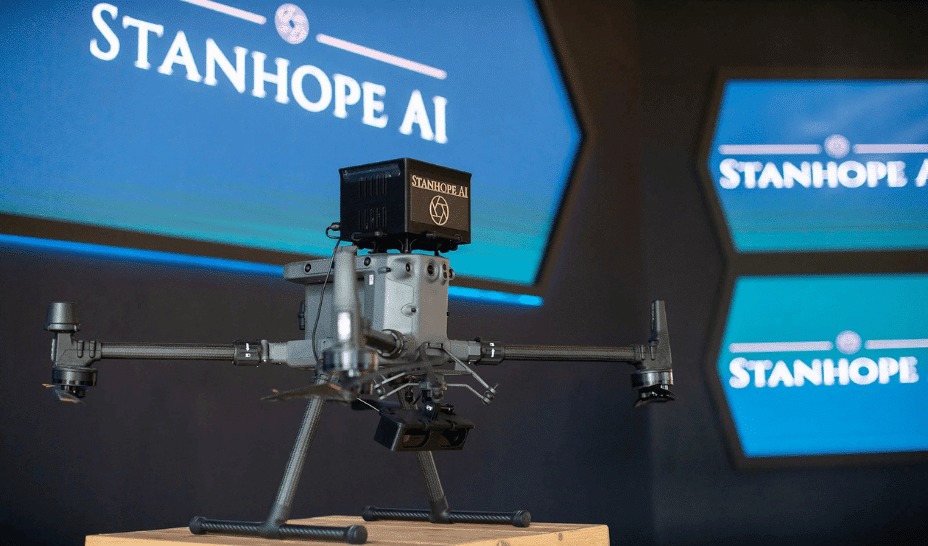
The company’s technology is already being trialled in autonomous drone and robotics applications with international partners, including defense-related use cases.
“The future of physical AI requires systems that can truly adapt in real time. The team at Stanhope AI has implemented a unique scientific approach to do just that, and it’s already proven itself in high-stakes real-world applications.” Zoe ChambersPartner at Frontline Ventures. “From academic research papers to systems running securely at the edge, the pace at which they execute is rare and critical.”
The funding follows the company’s €2.6m (£2.3m) raise in March 2024 in a round led by UCL Technology Fund, with participation from Creator Fund and MMC Ventures. Since then, Stanhope AI says it has progressed from basic research and prototypes to production-grade systems running in customer environments.
In contrast to traditional deep learning approaches that rely on extensive retraining cycles, Stanhope AI claims that its active inference-based systems can adapt during deployment. This capability is especially important in high-stakes environments such as defense and industrial robotics, where conditions can change rapidly and unpredictably.
The technology is currently being tested on autonomous drone and robotic platforms, where machines are introduced into new environments and tasked with avoiding obstacles in real time.
“We are excited to support Stanhope AI as it redefines the boundaries of machine intelligence.” added Christopher SteedChief Investment Officer and Managing Director of Paladin Capital Group. “Their technology represents the next evolution in AI: intelligent systems that can operate with autonomy, efficiency, and resilience across real-world domains. This strongly aligns with our mission to support innovations that strengthen and secure critical technologies around the world.”


