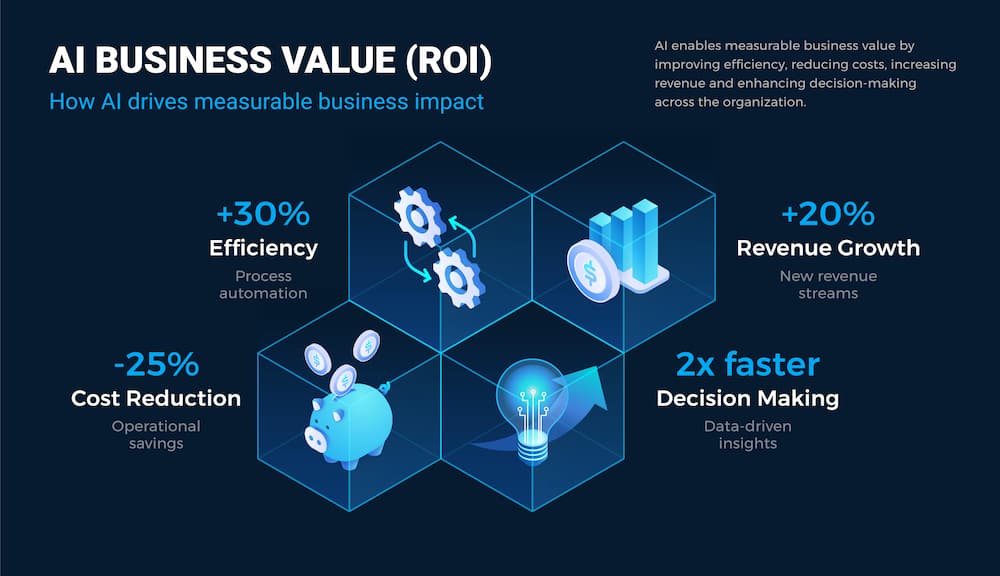
Organizations expect a quick return on their AI investments, but many initiatives fail to make it past the proof-of-concept (PoC) stage. This tension highlights a key challenge for HR leaders and professionals: preparing the workforce to fully realize the transformative potential of AI.
According to one of Avanade’s studies, 57% of U.S. business and government leaders expect up to a 4x return on investment (ROI) from AI co-pilots and agents, with most expecting revenue within 12 months. However, more than half of respondents are still developing their AI business case, and 41% are still stuck in PoC. Rushing for ROI without a clear strategic direction highlights a critical gap. Only 30% of organizations are developing a forward-thinking AI strategy.
See also: Most organizations remain in ‘firefighting mode’: KPMG
Why a visionary AI strategy matters
A visionary AI strategy acts as a north star, ensuring efforts are aligned with long-term organizational goals. Without this, AI deployments risk becoming fragmented. This concern is highlighted by 75% of organizations deploying AI in isolated functions rather than as part of an integrated framework. For HR leaders, this disjointed approach can lead to uneven workforce readiness, skills gaps, and missed opportunities for transformation.
A coherent strategy starts with understanding your organization’s “why.” This clarity guides innovation, integrates AI into business processes, and maximizes the value of existing investments in cloud, data, and security. HR professionals play a critical role in this effort by facilitating organizational alignment and preparing employees for AI-driven change.
Important questions for HR leaders
Here are some important questions for HR professionals to consider to help guide their organizations.
- Is there a clear understanding within your organization that human-centric processes and roles will be impacted by generative AI?
- How much support do I need to onboard and train employees to leverage generative AI tools like Microsoft 365 Copilot?
- What strategies are in place to address the potential disconnect between AI-enabled and non-AI-enabled employees?
Build readiness to realize long-term AI value
Research has revealed encouraging signs of progress. U.S. organizations are taking fundamental steps to prepare for the integration of AI.
- 98% are accelerating their traditional modernization plans.
- 97% are accelerating cloud adoption.
- 96% recognize that protecting sensitive data is critical to improving their organization’s reputation.
These efforts are essential to achieving many organizations’ primary objectives: integrating AI into processes and creating new revenue streams. For HR leaders, these efforts demonstrate the need to ensure that employees are prepared as technology advances.
Workforce preparation: Prioritizing people over technology
Successful AI implementation depends on prioritizing people. To address the socio-emotional aspects of technology adoption, AI fluency must be incorporated into an organization’s strategy. Encouragingly, U.S. organizations are stepping up efforts to:
- 98% are prioritizing upskilling their employees and creating new roles to offset potential AI-related turnover.
- 84% focus on change management to support evolving workflows.
- 81% are increasing their investment in training and fluency in emerging technology tools.
For HR professionals, a focus on upskilling and change management is an opportunity to drive meaningful cultural change, ensuring employees are not only equipped but empowered to thrive in an AI-enhanced environment.
Breaking the deadlock: From PoC to ROI
Organizations stuck at the PoC stage can benefit from starting small and experimenting with pilots to assess impact and build a business case for expansion. An experienced partner can support your workforce readiness efforts while providing critical guidance on selecting and implementing the right tools. For HR leaders, this means working with partners who can help bridge the gap between technical capabilities and employee capabilities.
risk of delay
Despite these efforts, 81% of survey respondents are concerned about losing competitiveness by not implementing AI quickly enough. This urgency underscores the importance of a balanced approach: bold action tempered by thoughtful strategy. HR leaders are uniquely positioned to drive this balance, enabling organizations to not only embrace AI, but also to harness its full potential to drive sustainable growth.
conclusion
In today’s rapidly evolving AI landscape, the difference between success and stagnation lies in an organization’s ability to move beyond proof of concept toward tangible value. As pressure increases to quickly realize AI-powered ROI, a clearly defined strategy rooted in workforce responsiveness, upskilling, and organizational alignment can help businesses effectively navigate this transformation. HR leaders play a critical role in bridging the gap between AI’s technical potential and real-world impact by empowering, preparing, and engaging employees. By taking a forward-thinking approach, organizations can turn their AI aspirations into a lasting competitive advantage and drive innovation that benefits business and employees alike.