
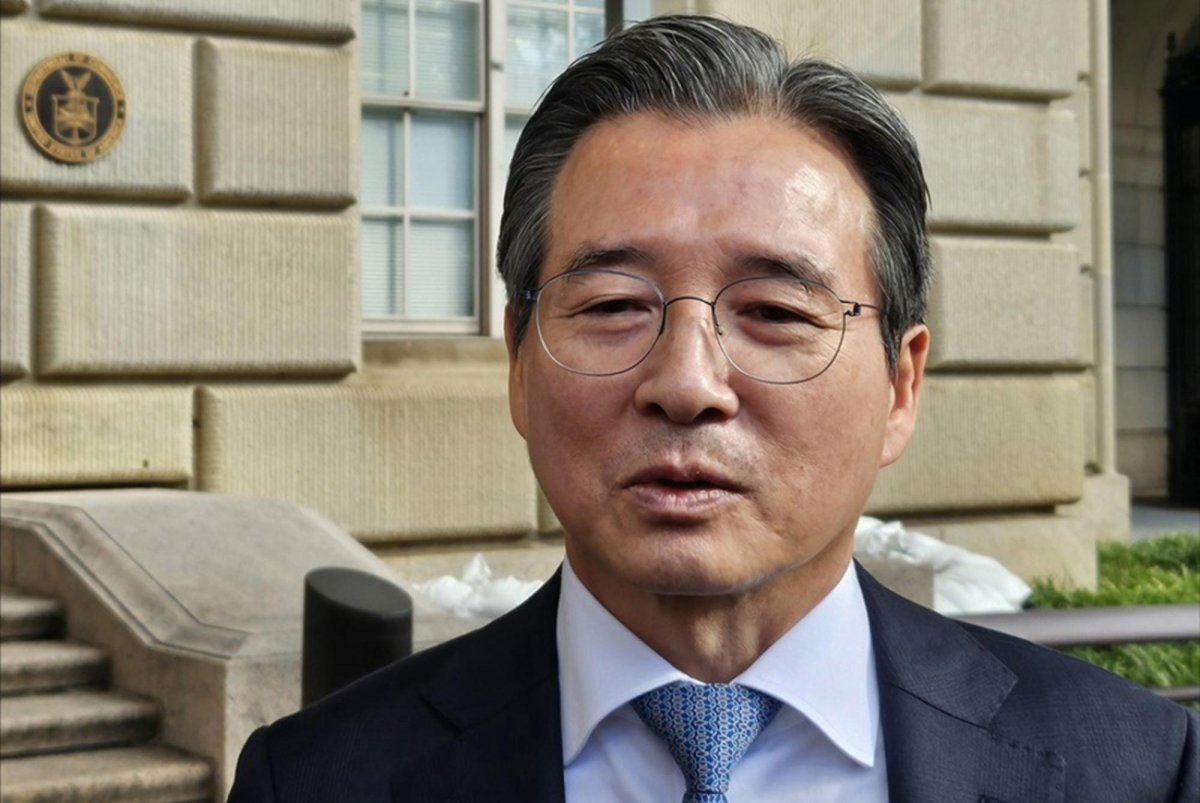
South Korean Presidential Chief of Staff Kim Yong-beom spoke to reporters after negotiating additional tariffs with US Secretary of Commerce Howard Lutnick. file. Photo provided by Yong Hap/EPA
July 6th (Asia Today) — South Korea’s presidential policy chief said Monday that the government’s three mega-projects in semiconductors, artificial intelligence data centers and physical AI should be treated as a 10-year national strategy that will continue regardless of a change of government.
Kim Yong-beom, President Lee Jae-myung’s chief of staff for policy, said these projects are not limited to the remaining four years of the Lee administration, but should also be promoted by future governments.
Kim made the remarks in response to concerns in some political circles that the project could favor certain regions or be scaled back after a change of government.
Kim said, “This is not a project that will be completed in the remaining four years of the Lee Jae-myung administration.” “This is a project that must be continued by the next administration.”
Kim said the strategy is tied to long-term investment plans by South Korea’s two largest semiconductor companies, Samsung Electronics and SK Hynix. He said the government’s role is to support infrastructure such as electricity, water and land to maintain a stable supply of memory chips in the age of AI.
Kim said, “That is the responsibility of Samsung Electronics and SK Hynix, and it is also the responsibility of our country’s top two companies.” “The AI revolution cannot accelerate unless memory is delivered on time.”
Kim said if supplies are delayed, prices will rise and only those who can afford the expensive chips will benefit.
“I think it is South Korea’s responsibility to provide electricity and water support so that memory can be supplied in large quantities without delay,” Kim said.
Kim said the investment is based on the company’s actual demand forecast.
“The two semiconductor companies announced their plans based on demand forecasts for the next three, five, and 10 years,” Kim said. “They also have construction plans in Yongin and the Seoul metropolitan area, and have long-term demand forecasts, so the announcement was based on actual demand.”
Kim said companies are pushing up completion schedules by eight to 12 years because of strong demand.
“This is a demand-based plan, so it is a project that must be carried out regardless of the government,” Kim said.
Kim also raised the need to build semiconductor manufacturing plants outside the Seoul metropolitan area.
He said the manufacturing plant would require 1.5 million tsubo, or about 5.3 million square feet, of land, and including suppliers, could require up to 2 million tsubo, or about 71.2 million square feet. He said such locations are difficult to secure.
“It may seem strange to see a system concentrated in the metropolitan area, but in other countries, industrial bases are spread out across the country,” Kim said. “It’s the same with Japan and Taiwan. We are the only ones concentrated in a small metropolitan area.”
Kim said that widespread regional investment is not only a matter of balanced development, but also a macroeconomic strategy.
He said social consensus was important because it could widen the gap between areas that benefit from large-scale projects and those that don’t.
“The whole country needs to be integrated,” Kim said. “Instead of moving to one extreme or the other, we need to present policies from the middle and try to reach agreement.”
Kim also warned against too much liquidity flowing into real estate as the semiconductor boom and stock market rally increase investor interest.
“The worst outcome is that liquidity flows into real estate,” Kim said. “An influx into assets in certain parts of the metropolitan area could have very serious side effects.”
Kim said that while it may be acceptable for funds to flow into stocks, real estate speculation could increase both jeonse deposits and monthly rents.
“For some people, housing is an investment, but for most people, housing is a basic right,” Kim said.
— Asia Today reported. Translation by UPI
© Asia Today. Unauthorized reproduction and redistribution is prohibited.
Korea original report: https://www.asiatoday.co.kr/kn/view.php?key=20260706010002184


