

Key Insights
- The significant ownership of retail investors in C3.ai means that they collectively have a greater say in management and business strategy.
- A total of 25 investors hold 43% of the company's shares.
- Insiders own 11% of C3.ai
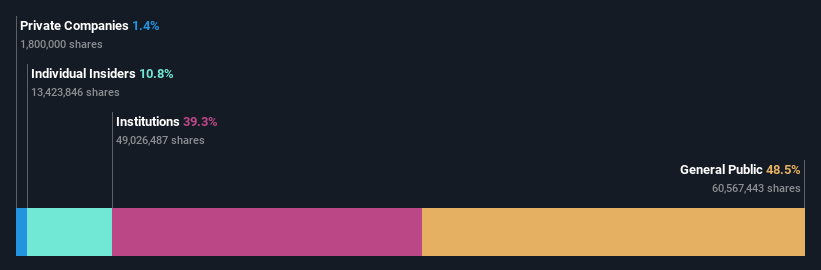
To understand who really controls C3.ai, Inc. (NYSE:AI), it's important to understand the company's ownership structure. And the largest share belongs to retail investors, with 49% ownership. In other words, this group stands to gain the most (or lose the most) from their investment in the company.
Retail investors suffered the biggest losses after the stock price fell 8.3% last week, but institutional investors, who hold 39% of the stock, were also hit.
Let's start with the table below to take a closer look at each type of owner at C3.ai.
Check out our latest analysis for C3.ai
What does institutional ownership tell us about C3.ai?
Many institutions measure their performance against an index that approximates the local market, so they usually pay particular attention to companies that are included in major indexes.
We can see that C3.ai has institutional investors, who own a significant portion of the company's shares. This means that the analysts working for these institutions have looked at the stock and like it. However, just like everyone else, the analysts could be wrong. When multiple institutions own a stock, there's always a risk that you may end up in a 'crowded trade'. If such a trade goes wrong, multiple parties could compete to sell shares fast. This risk is higher in companies without a history of growth. You can see C3.ai's historic earnings and revenue below, but keep in mind that there's always more to the story.

Hedge funds don't hold much stock in C3.ai. The company's largest shareholder is the Vanguard Group, with 8.5%, while the second and third largest shareholders hold 7.7% and 5.3% of the shares outstanding, respectively. The second largest shareholder, Thomas Siebel, also happens to hold the title of CEO.
A closer look at our ownership data shows that the top 25 shareholders collectively hold less than half of the registered shares, suggesting there is a large group of smaller shareholders where no single shareholder holds the majority.
While it makes sense to study institutional ownership data for a company, it also makes sense to study analyst sentiment to know which way the wind is blowing. There are a fair number of analysts covering the stock, so it might be useful to find out their aggregate view on the future.
C3.ai Insider Ownership
The definition of an insider varies slightly from country to country, but members of the board of directors always qualify. Company management should report to the board and the board should represent the interests of shareholders. Notably, top-level managers may themselves be board members.
Insider ownership can be a positive if it signals management are thinking like the true owners of the company. However, high insider ownership can also give immense power to a small group within the company, which can be a negative in some circumstances.
Based on our information, it appears that insiders hold a significant amount of shares in C3.ai, Inc. It's quite interesting to see that insiders own US$374m worth of shares in this US$3.5b business. Many will be pleased to see that the board is investing right along with them. You can also access this free chart showing recent transactions by insiders.
General public property
The general public (including retail investors) own 49% of the company's shares, so it can't be easily ignored, and while this group doesn't necessarily have the decision-making power, it certainly has a real influence on how the company is run.
Next steps:
Finding out who owns a company is very interesting. But to gain real insight, other information needs to be considered. C3.ai: Two Warning Signs in Investment Analysis things you should know…
If you're like me, you might want to think about whether the company is likely to grow or shrink, and luckily you can check this free report showing analyst forecasts for the company in the future.
Note: The figures in this article are calculated using data from the last 12 months, which refers to the 12-month period ending on the last day of the month in which the financial statements are dated, which may not match the figures in the annual report.
Valuation is complicated, but we can help make it simple.
investigate C3.ai By checking our comprehensive analysis, you can see whether it may be overvalued or undervalued. Fair value estimates, risks and warnings, dividends, insider trading, financial strength.
View free analysis
Have feedback about this article? Concerns about the content? contact Please contact us directly. Or email editorial-team (at) simplywallst.com.
This article by Simply Wall St is general in nature. We use only unbiased methodologies to provide commentary based on historical data and analyst forecasts, and our articles are not intended as financial advice. It is not a recommendation to buy or sell stocks, and does not take into account your objectives, or your financial situation. We seek to provide long-term focused analysis driven by fundamental data. Note that our analysis may not take into account the latest price sensitive company announcements or qualitative material. Simply Wall St has no position in any of the stocks mentioned.
Valuation is complicated, but we can help make it simple.
investigate C3.ai By checking our comprehensive analysis, you can see whether it may be overvalued or undervalued. Fair value estimates, risks and warnings, dividends, insider trading, financial strength.
View free analysis
Have feedback about this article? Concerns about the content? Contact us directly. Or email us at editorial-team@simplywallst.com


