
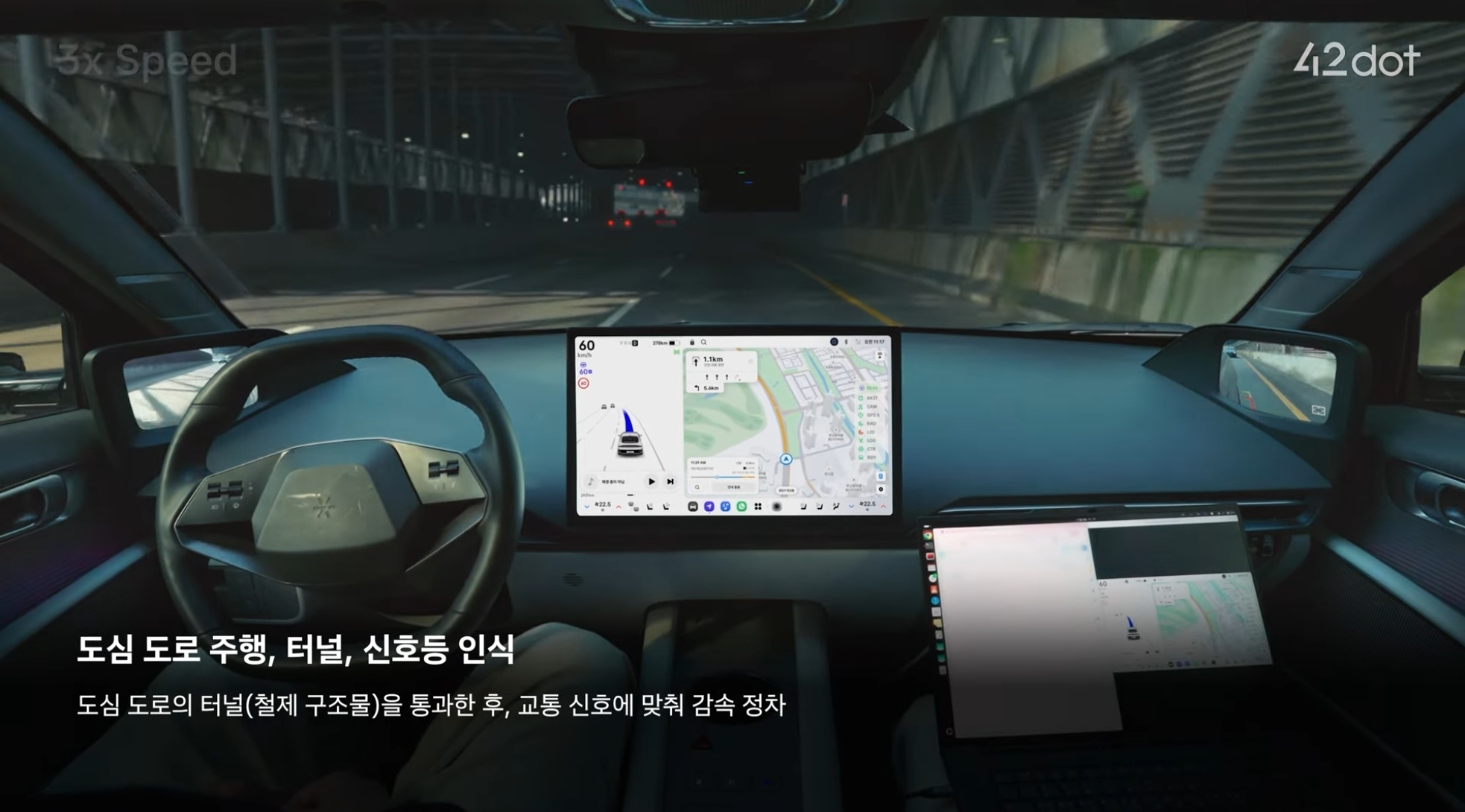
Hyundai Motor Group's mobility startup 42 dots has unveiled a rare and highly anticipated showcase of end-to-end (E2E) autonomous driving technology. The company has released new footage of its Atria AI test vehicle demonstrating autonomous driving and parking in real life. This is the first public technology update in over two years. The timing of this announcement is attracting a lot of attention, as it came just after the resignation of Song Chang-hyun, head of Hyundai Motor Group's AVP division and former CEO of 42dot.
Surprising revelation after many years of secrets
42dot has posted two new videos on its official website and YouTube channel that capture self-driving and self-parking scenarios in real-world traffic environments. The disclosure surprised many in the industry, as 42dot has maintained an unusually strict policy of keeping its self-driving research confidential.
This is the first content update since August 2023, ending a long period of silence that left many observers speculating about the status of the project.
Strong market reaction and growing curiosity
The response to the new Atria AI demonstration was swift and enthusiastic. By the morning of the 8th, the main self-driving video had been viewed more than 58,000 times and received more than 860 comments. The sudden surge in attention highlights the market's curiosity about Hyundai Motor Group's progress in the competitive self-driving environment.
Atria AI performs real-world autonomous operations
The footage released features an Atria AI test vehicle navigating a complex urban situation. The main features shown in the video are:
- City driving with complete hands-off operation
- Recognize tunnels, traffic lights, and surrounding conditions using only the camera.
- Smooth left turns and lane changes at intersections
- Perform automatic parking based on past visit history
This practical demonstration focuses on the practicality and maturity of the technology rather than controlled laboratory conditions.
End-to-end autonomous driving without HD maps
In the video description, 42dot explains that Atria AI is built around a complete end-to-end self-driving model. Unlike approaches that rely heavily on high-resolution maps, Atria AI relies solely on eight onboard cameras to perceive the environment and make driving decisions.
The company highlights several core technologies driving the demo.
- Camera-optimized recognition system
- End-to-end autonomous driving model (E2E Driving)
- High performance AI computing with 400 TOPS class NPUs
- Equipped with NOA (Navigation on Autopilot) functionality for both highways and city roads
42dot positions Atria AI as a leading example of the future direction of software-defined autonomous driving systems.
42dot says it has nothing to do with changes in leadership within the company.
There was speculation in the industry that the timing of the video release was related to Song Chang Hyun's recent departure from the company. However, early evaluations indicate that this update is likely part of 42dot's long-term communications roadmap, rather than a reactionary move.
Comparing Atria AI to Tesla and GM Technologies
Although Hyundai Motor Group's self-driving technology has evolved significantly, there is still intense comparison in the market. Tesla's FSD (Full Self-Driving) and General Motors' Super Cruise are still classified as Level 2 partially automated systems, meaning the driver remains responsible for any accidents. However, many consumers and analysts claim that the actual performance of these systems is still market leading.
The announcement of Atria AI signals Hyundai Motor Group's intention to close that gap by demonstrating stronger map-independent, camera-based autonomy.


