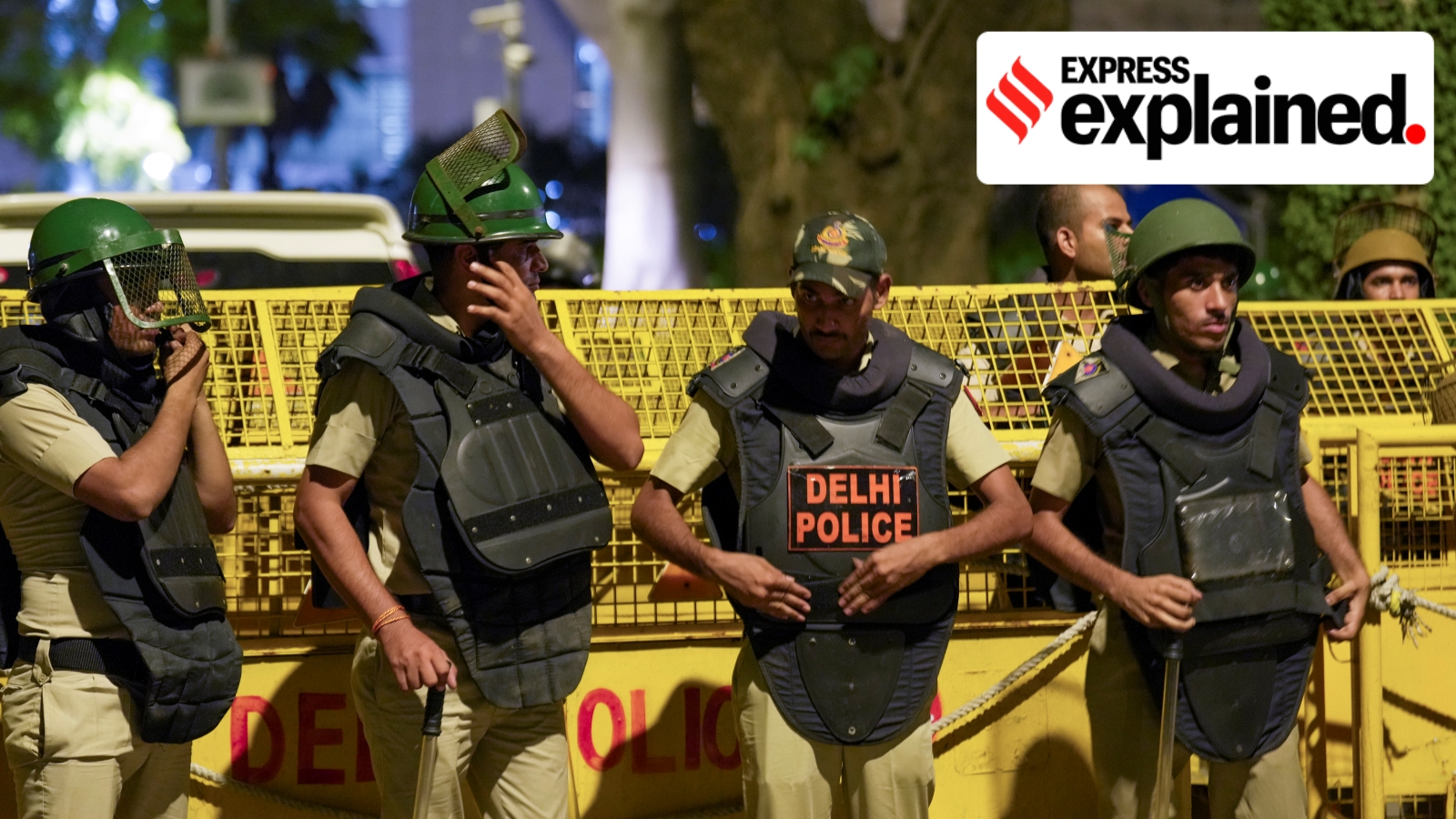
The deployment of surveillance vehicles near the student protests at Jantar Mantar has focused on expanded police operations, using live video feeds and facial recognition powered by artificial intelligence (AI) to scan people gathered at public demonstrations.
of delhi police It said the system is used to maintain law and order and identify known criminals. But protesters say the 24-hour recording creates an intimidating atmosphere, with some students covering their faces for fear of being profiled. The dispute has reached the Delhi High Court, raising questions about how facial recognition works and what safeguards govern its use.

Across India, digital surveillance systems are becoming an important part of modern policing, with law enforcement agencies deploying networks of CCTV cameras, facial recognition technology, drone-based surveillance, automatic number plate recognition systems, and AI-powered video analytics.
Although authorities claim such tools improve public safety and police efficiency, their increased use has also raised concerns among civil rights groups about privacy, proportionality, transparency, and the lack of a comprehensive legal framework governing state-sponsored surveillance.
What surveillance technology does Delhi Police have in place?
One vehicle at the scene is a mobile command and control vehicle, with police personnel examining the live CCTV feed. The second vehicle, called Ikshana, is a mobile surveillance van deployed ahead of the G20 summit to be held in Delhi in 2023.
Ikshana has eight fixed cameras that provide a 360-degree view. According to the company’s technology partner CP Plus, the vehicle supports facial detection and recognition, license plate recognition, traffic management, crowd monitoring, and on-site video analysis. At Jantar Mantar, footage from cameras in the area is run through facial recognition software, which places boxes around detected faces and compares them with images in the police database.
one senior executive said indian express The purpose was to check whether the system would flag people who matched the police’s criminal database. Delhi Police has not disclosed the size or composition of its database, the accuracy of the software at the protest site, or the steps taken after a match may have taken place.
Story continues below this ad
Some reports on social media have also suggested that police are wearing AI-powered smart glasses to monitor protesters. During Republic Day celebrations earlier this year, the Delhi Police used AI-enabled smart glasses equipped with an integrated facial recognition system and thermal imaging technology. This product was developed by an Indian company called AjnaLens.
Delhi Police did not respond to queries on the issue.
How does facial recognition work?
Facial recognition systems analyze a person’s facial features from an image or video, convert them into a unique digital template, and compare that template with images stored in a database. If the similarity score exceeds a predefined threshold, the system flags the potential match for further validation. In response to a Right to Information (RTI) request in 2022, Delhi Police clarified that a match will be considered ‘positive’ if the system shows 80% accuracy.
The results themselves do not prove your identity. Performance varies depending on the algorithm, camera angle, lighting, image quality, mask, and database being searched. Testing by the National Institute of Standards and Technology found that many algorithms showed differences in error rates across demographic groups. Therefore, human verification, audit trails, and clearly defined thresholds are important in policing.
Why are the protesters concerned?
Story continues below this ad
Students at Jantar Mantar said the cameras are changing the way they participate in protests. Some covered their faces despite wanting to put up posters, while others feared the footage would reach their families, educational institutions and potential employers. This is often described as an atrophic effect. Although people formally maintain the freedom to protest, surveillance can prevent them from exercising that right.
Former JNU Students’ Union president Aishe Ghosh has challenged the surveillance in the Delhi High Court, alleging “continuous, indiscriminate and intrusive surveillance” including videotaping and watchtowers. Her petition alleges violations of her rights to privacy, dignity, free speech, and peaceful assembly.
At a hearing on the matter on Monday (July 20), Solicitor General Tushar Mehta, on behalf of the Delhi Police, said the video recording was only for maintaining law and order and public safety and was not voyeuristic. The court asked whether the Delhi Police had standard operating procedures or standing orders to deal with protests in line with earlier Supreme Court directions.
What does Indian law say?
Facial images and digital templates associated with an identifiable individual fall within the broad definition of personal data under the Digital Personal Data Protection Act 2023. However, Article 17 of the Act exempts some obligations where data is processed for the prevention, detection, investigation or prosecution of crime. The Center can also exempt the activities of notified state agencies, including security forces such as the Delhi Police, on grounds such as national security and public order.
Story continues below this ad
The law does not set out a dedicated framework for police facial recognition, including rules for watch lists, matching thresholds, independent audits, or specific retention periods. One police officer said there are no clear guidelines for preserving protest footage as it may be needed in future investigations.
Constitutional issues are broader than data protection. In a landmark 2017 judgment, the Supreme Court recognized privacy as a fundamental right and held that restrictions must meet legality, necessity and proportionality. A key question is whether the continued identification of people at peaceful protests is a narrowly tailored public safety measure or an unwarranted intrusion that treats all participants as potential suspects.