“You need a trendy catchphrase to get people’s attention.”

In late October, a video titled “Cooking an Ancient Mosasaurus into 6 Dishes (Part 1)” went viral on Bilibili. It achieved 7 million views in just 3 days after its release. Importantly, this is a 6-minute, 23-second video that is completely AI-generated. Based on past patterns, it’s very rare for a video with these two elements to get this much traffic.
After all, many people are “disgusted” by AI-generated content. But most of the nearly 5,000 comments below this video are expressions of shock at both the rapid improvement in AI’s image quality and the control it has over its creators.
This video is certainly different from most previous AI videos. It’s not about cutting stones or cooking for cats. Instead, chefs from several countries will compete in a cooking contest using mosasaurs as ingredients. Well, have you ever seen the Mosasaurus, an ancient creature that went extinct 65 million years ago, cooking with it?
The video begins with a spectacular scene of a foreigner sawing meat and cutting into ribs that are taller than a man. The camera zooms in, rotates, and switches quickly. When the characters appear, a fight breaks out. The story is compact and full of tension, which immediately captures the audience’s attention.

● Start of the video “Cooking an Ancient Mosasaurus into 6 Dishes (Part 1)”
The most difficult and important thing is to keep the audience captivated for the entire 6 minutes and 23 seconds. To that end, Bilibili UP master “Huangpujiang Salmon” (hereinafter referred to as “Salmon”) made full use of a number of “tactics”.
For example, there are various trending catchphrases throughout the video. The first person on the scene was an Indian chef who made “nine-rotating intestines.” The Chinese chef is “Cynthia” from Shanghai. When she appears, background music and narration are played. There’s a famous line that goes, “The most expensive ingredients often require the simplest preparation.” That’s because “Salmon” strongly believes in it. “You need a trendy catchphrase to get people’s attention.”
Beyond that, the most basic one is an almost realistic image generated by AI. “We can’t make them exactly the same, but we strive for 90% authenticity.” Some netizens once claimed that “they were obviously taking real photos, but they claim they were generated by AI.” “Salmon” didn’t argue, just said, “A few days ago, I caught a dragon in the South China Sea.”
Displaying such high-quality images and maintaining consistency across multiple characters is not easy. When producing one of the special effects scenes, “Salmon” is said to have filled entire pages of the document with prompts. Additionally, feeding prompts to large models typically requires multiple attempts to produce a perfect, usable video clip. This is like opening a blind box, also known as “card drawing” in the field of AI generation.
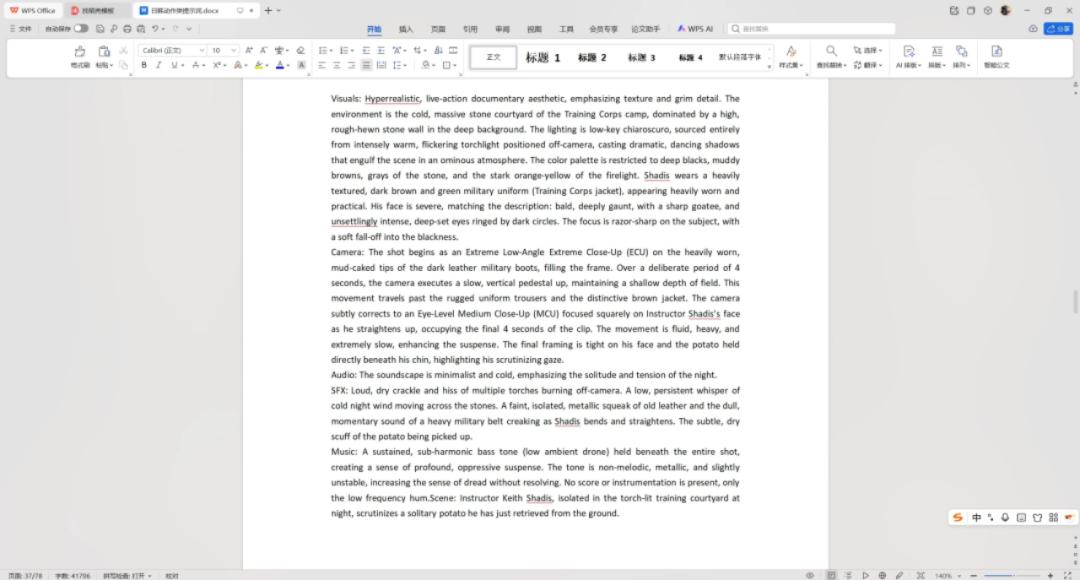
●Prompt written by “Huangpu River Salmon”
Currently, most video models can only produce clips of 5 seconds or at most 10 seconds. In theory, this 6 minute 23 second video would require stitching together at least 75 5 second shots. But in reality, “Salmon” produced more than 1,000 pieces of material for this video, and in some shots the process of drawing the cards was repeated more than 100 times.
The video, which has already been viewed 7.4 million times, had one person commenting, “This is the most amazing AI video I’ve seen since AI was born.”
Actually, 28-year-old “Salmon” works as an accountant by profession. Three years ago, when AI first appeared in public applications, he immediately followed the trend and started learning. From image generation to 3D modeling to animation, it sometimes took a month to create a short clip. Now, he can “make several short clips a day.”
Especially after this year’s Chinese New Year, he realized that a small advertising video could be completed completely with AI. Although it was a little rough, we were able to deliver it safely. After witnessing the rapid advancement of large models, “I decided I wanted to get closer to the industry.” After all, his childhood dream was to become a director.
So the success of Cooking an Ancient Mosasaurus into 6 Dishes (Part 1) was no accident. Apart from the amazing advances in large models in a short period of time, it was also a well-planned hunt for traffic by “salmon”.
A month before this video, he uploaded three dinosaur-cooking-themed videos once a week, like a prelude to A/B testing.
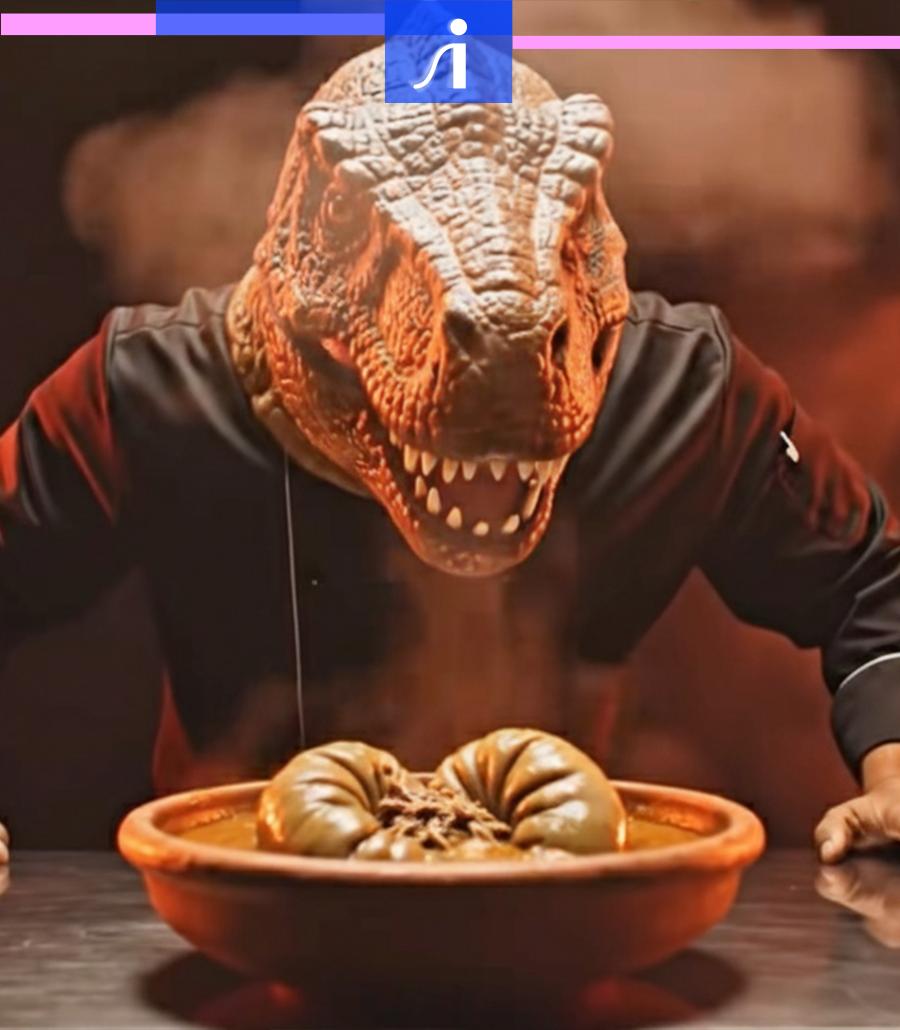
In the first episode, “Cooking a Tyrannosaurus Rex into 3 Dishes,” the main characters were not featured, just cooking and putting their ideas into practice.
In the second episode, “Shanghai Chef Cooks Pterosaurs into 3-in-1 Soup,” the main character, Shanghai Chef Cynthia, appears, and a popular catchphrase also appears. The audience reaction was strong.
In the third episode, “A Cantonese man who makes a triceratops with three meals a day”, elements of “Chibi Maruko-chan” were added instead of the main character, and the effect was weakened.
After these three episodes, “Salmon” basically understood the logic of creating viral AI videos. He had intentionally left some continuity errors in the video. For example, Cynthia often places her hand over a boiling pot to invite people to talk. And a lively discussion will push the video into a wider traffic pool.
Of course, there are also changes in the external environment that cannot be ignored, such as the significant increase in acceptance of AI-generated content by major content platforms and audiences. Most of Bilibili’s popular videos include AI elements, and there was even a singing contest with AI-generated NPCs. Kuaishou also claims, “We want to bring AI to more creators on our platform and look forward to seeing more high-quality long-form AI content produced on our platform.”
A month ago, AI video generation models Sora2 and Veo3.1 started a fierce competition and their capabilities skyrocketed. Sensitive “Salmon” clearly made a decision – the time was ripe.
November 9th: Updated “Cooking the Ancient Mosasaurus into 6 Dishes (Part 2)” in “Salmon”. By noon on the 13th, the number of views had already reached nearly 2.34 million, and Bilibili’s followers had increased to 71,000. Invitations for cooperation are pouring in from behind the scenes. I’m currently well on my way to becoming a full-time AI designer.
In early November, the Future Human Research Institute spoke with Huangpu River Salmon to discuss the ingenuity, production, and future plans behind this viral video. Below is an organized summary of the conversation.

“I thought it would be good, but I didn’t expect it to be this good.”
Future Human Research Institute: The first three videos were basically uploaded once a week. There was a gap of 16 days between Cooking an Ancient Mosasaurus into 6 Dishes (Part 1). Where did you spend most of your time?
Huangpu River Salmon: It didn’t take long to create. Most of the time was spent organizing scripts and prompts in the early stages. I thought about this script quietly in my mind for about a week. Who will win, who will lose, what their personalities will be like, what kind of food they will cook, and what will happen in the finals… After thinking about the overall outline of the story, I started drawing the two characters in the first episode (Indian chef and Cynthia). Once I started writing it, I managed to finish it in a little over a week, of course staying up late every day.
Future Human Research Institute: Did you expect this video to become so popular?
Huangpu River Salmon: I knew it was delicious, but I didn’t expect it to be this delicious. We expected it to reach a maximum of 1 million views. I posted it at 10:30pm, but I didn’t pay attention to it and went to sleep. The next day, it had been viewed more than 1 million times. My private messages flooded in. I had a few offers to help, but more people asked me how I made it and wanted me to share it. I was told that the AI I was using seemed to be a different product than theirs.
Future Human Research Institute: I once spoke to a blogger who specializes in AI product reviews. The reason this video went viral can be attributed to the overall placement of the story, the density of trending catchphrases, and the rapid switching of images. I noticed that I was switching shots almost every 1-2 seconds. The presentation of the AI is really secondary.
Huangpu River Salmon: yes. My understanding is that the videos people are willing to watch are abstract and interesting, for entertainment purposes. The other type is commonly produced. Although the image was created by AI, I don’t think there are many mistakes. We strive to make AI-generated images more realistic. It won’t be exactly the same, but we aim to be 90% authentic. The third thing to do is to incorporate catchphrases that are popular on the internet and ride the wave of buzz. I think the combination of these three elements is what made this video so successful.
You need a trendy tagline to grab people’s attention. If it’s just cooking, I think it will get a few hundred thousand views at most.
Future Human Research Institute: We understand how to attract traffic. Do you have other designs to drive traffic within your videos?
Huangpu River Salmon: Deliberately adding what appear to be defects to a realistic-looking AI-generated image. For example, Cynthia likes to put her hand over a boiling pot. In that case people will say there is a continuity error. Because if this part has a lot of comments, it can push you to the next traffic level. Therefore, I will purposely add things that may spark comments and discussion.
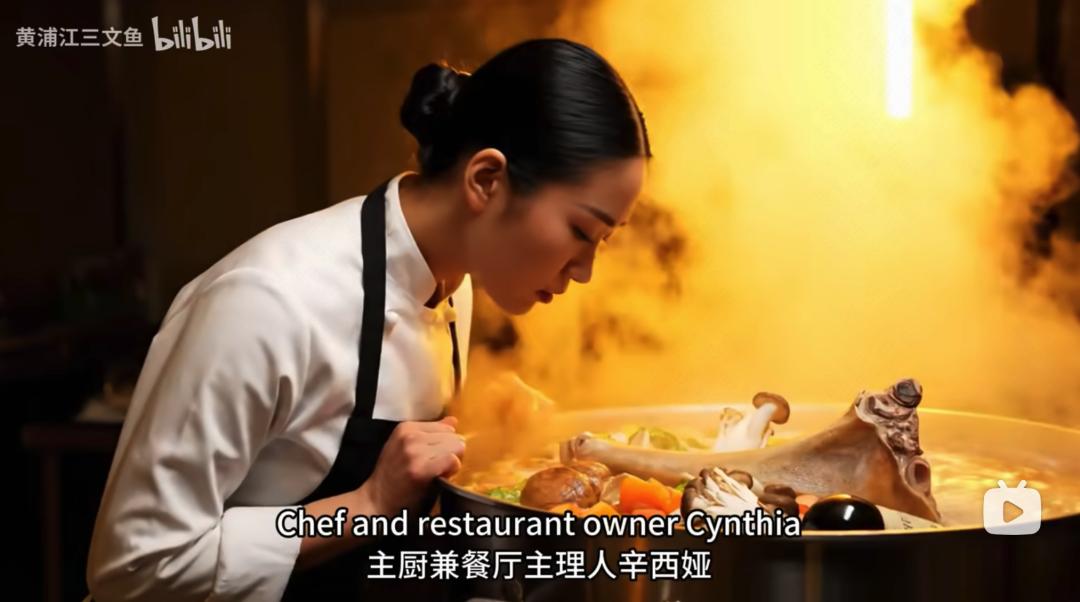
● Cynthia puts her hand on the pot.
Future Human Research Institute: You are very cunning.
Huangpu River Salmon: This scene is actually quite interesting. People think it’s an “iron sand palm” or something like that. In fact, there is a well-made video of her not touching the pot. However, after some thought, I decided to leave this flawed shot alone.
Future Human Research Institute: So you intentionally left room for people to debate.
Huangpu River Salmon: yes. Many people debated this part, including the scene where the black truffles are fried. Some people said that the flavor of black truffles decreases when fried, while others said that it is okay to fry them. Some people questioned the combination of chanterelles and black truffles. Many professional chefs said, “Yes, you can do it this way,” and some said, “I would like to recreate it.” Actually, I thought it would be delicious if I fried black truffles, so I added a few mushrooms that are characteristic of Yunnan. I threw in these absurd things for netizens to discuss.
Future Human Research Institute: How did you discover these patterns?
Huangpu River Salmon: This is also based on my past work. When the chefs were cooking, I sometimes didn’t notice their hands passing through the open flame. But at the time, I noticed that as soon as a scene like that appeared, people would start posting bullet point comments saying there were continuity errors or making jokes about Iron Chef. So we thought that by adding a proper AI-related continuity error later on, we could let people know that the video wasn’t actually shot.
I’ve had people send me private messages saying things like, “You clearly filmed real footage, but you’re claiming it was AI-generated,” or “You’re clearly mixing real footage with a small amount of AI-generated content and claiming it’s all AI-generated to fool people.” My purpose is twofold. One is to make people laugh, and the other is to prove that everything is generated by AI.
Future Human Research Institute: Would you be happy if someone told you that your video is real, meaning it was filmed?
Huangpu River Salmon: I’m a little happy because it means that my ability has been recognized. I also told them, “Yes, I really did shoot one. I caught a dragon in the South China Sea a few days ago, or I just caught one in Guangzhou.”

path to authenticity
Future Human Research Institute: How did you come up with the idea to cook dinosaurs?
Huangpu River Salmon: At that time, I saw some domestically produced AI works. Everyone was doing the same thing: cutting stones with knives, cats cooking, creating ASMR-like effects. After one became popular, others started copying it.