

Artificial Intelligence (AI) may seem like it became a media buzzword overnight, but this disruptive technology has been at the forefront at Digital Realty for years. We've seen the advent of cloud technology profoundly change the face of digital business, and now AI is poised to disrupt industries in ways we're only beginning to understand. The key, as always, is to embrace change and use it to your advantage to be on the right side of disruption.
Getting AI right is a race, and companies are feeling the pressure to use AI to build unique value ahead of competitors.
Digital Realty predicted how AI would disrupt IT infrastructure and began planning a roadmap to support our customers more than six years ago, and we've continued to learn as we work with groundbreaking early adopters to learn what it takes to successfully navigate the inevitable disruption and harness the potential of AI to your advantage.
The Evolution of AI: Machine Learning, Deep Learning, GenAI
AI encompasses a rapidly evolving set of technologies that really took off in the early 2000s with machine learning (ML), which processes vast amounts of data and “learns” from the results, discovering patterns, making predictions, and automating some tasks.
Then, in the 2010s, deep learning emerged, further enhancing computer vision's perception capabilities, enabling object classification and detection, speech recognition, and even partially autonomous cars.
We are currently witnessing the rise of generative AI in the 2020s with its emphasis on language mastery. The implications are profound, given that language permeates every aspect of organizational activity: organizational knowledge, communication, and process.
The potential benefits are enormous: Accenture estimates that large-scale language models like GPT-4 could augment 40% of all workdays, and that 65% of language tasks could be transformed into more productive activities through augmentation and automation.
Importantly, all these AI technologies rely on data, which is why Digital Realty has always focused on managing the challenges of data and data gravity, providing the meeting place where companies, technology and data come together to help customers efficiently store, analyze and derive value from their data.
Cloud case studies: lessons learned
The journey of the cloud is a good case study for thinking about disruptive change. While I remember the birth of the cloud and the early debates about whether it was friend or foe, many businesses are still navigating the cloud's profound impact on their digital transformation.
As oceans of data feed cloud workloads and applications, generating even more data, the big question becomes: how do we optimize this relationship to create the most value?
Initially, the cloud was accessed over the public internet with little consideration given to proximity and security. Many companies now understand that proximity and security are in fact very important and not optimizing each can make a company lose its competitive edge. In fact, I have built my career on leading the way in private cloud consumption and helping companies optimize their digital transformation.
Digital Realty is committed to transforming the cloud into a secure, efficient environment where businesses can create their own value. Today, we manage over 2.4 GW of power, connecting campuses around the world.¹ We are committed to lowering the barriers to optimizing hybrid multicloud with ServiceFabric™ Connect, our private, software-defined interconnection solution.
We've helped 5,000 customers get started in the cloud, and we're ready to do the same with your AI journey.
Unlocking the value of data with AI
Falling behind in AI could lead to disruption: a rush to grab land to build unique value over competitors and fend off new entrants, such as digital disruptors, that aren't competing with traditional infrastructure.
Digital Realty has been tracking the evolution of AI since before our 2017 investor day, where we identified AI as a key driver of next-generation data center requirements. Digital Realty has been adapting its offerings to meet these new demands. We knew our customers needed an AI-enabled global data center platform purpose-built to deploy and scale their innovation and drive business value.
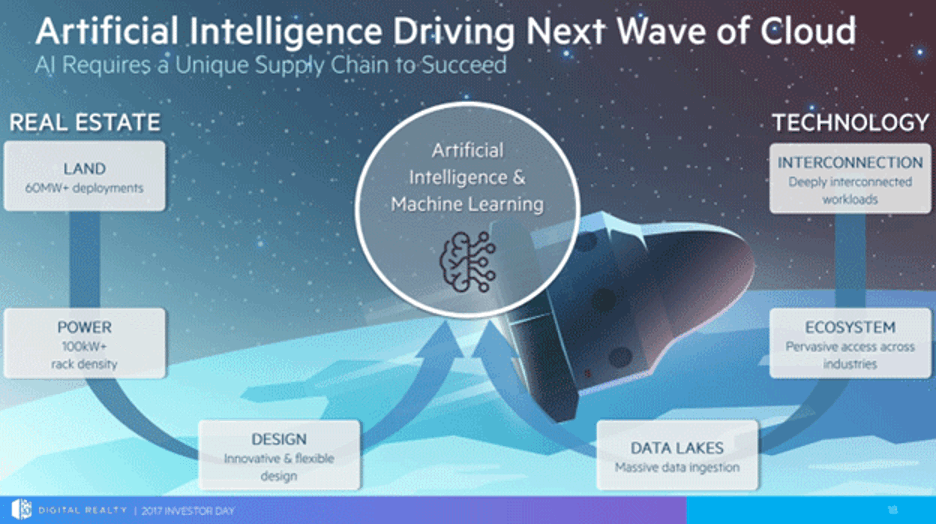
Digital Realty
Source: Digital Realty Investor Day Presentation, Slide 18, 2017
Why does AI need an AI-enabled data center platform?
AI, and especially analytics, has specific hardware and data processing requirements and therefore requires specialized environments. AI power density requirements can be 5-10 times greater than traditional data center capabilities, rapidly increasing the need for liquid cooling.
Digital Realty's solutions provide cutting-edge tools for building optimized AI architectures and the ability to digitally engineer deployments in virtual environments. Our data centre designs include modularity and high-capacity blocks to support legacy and high-density AI deployments, all interconnected with ServiceFabric™, a global, purpose-built network fabric.
We're also focused on sustainable growth: with 400MW of space due to come online over the next 18 months, 1GW of contracted renewable energy, and our entire European portfolio and US colocation portfolio running on 100% renewable energy, we're well positioned to meet your sustainable data needs now and in the future.
Digital Realty has been supporting cloud providers around the world for many years, and along the way, we have developed core competencies that enable us to similarly support customers who need an AI home base.
Stay innovative, contact us and let’s adopt AI in a way that will transform your organization.
¹As of March 31, 2023. Represents the sum of the consolidated portfolio and the managed portfolio of unconsolidated joint ventures based on the Company's ownership percentage.


