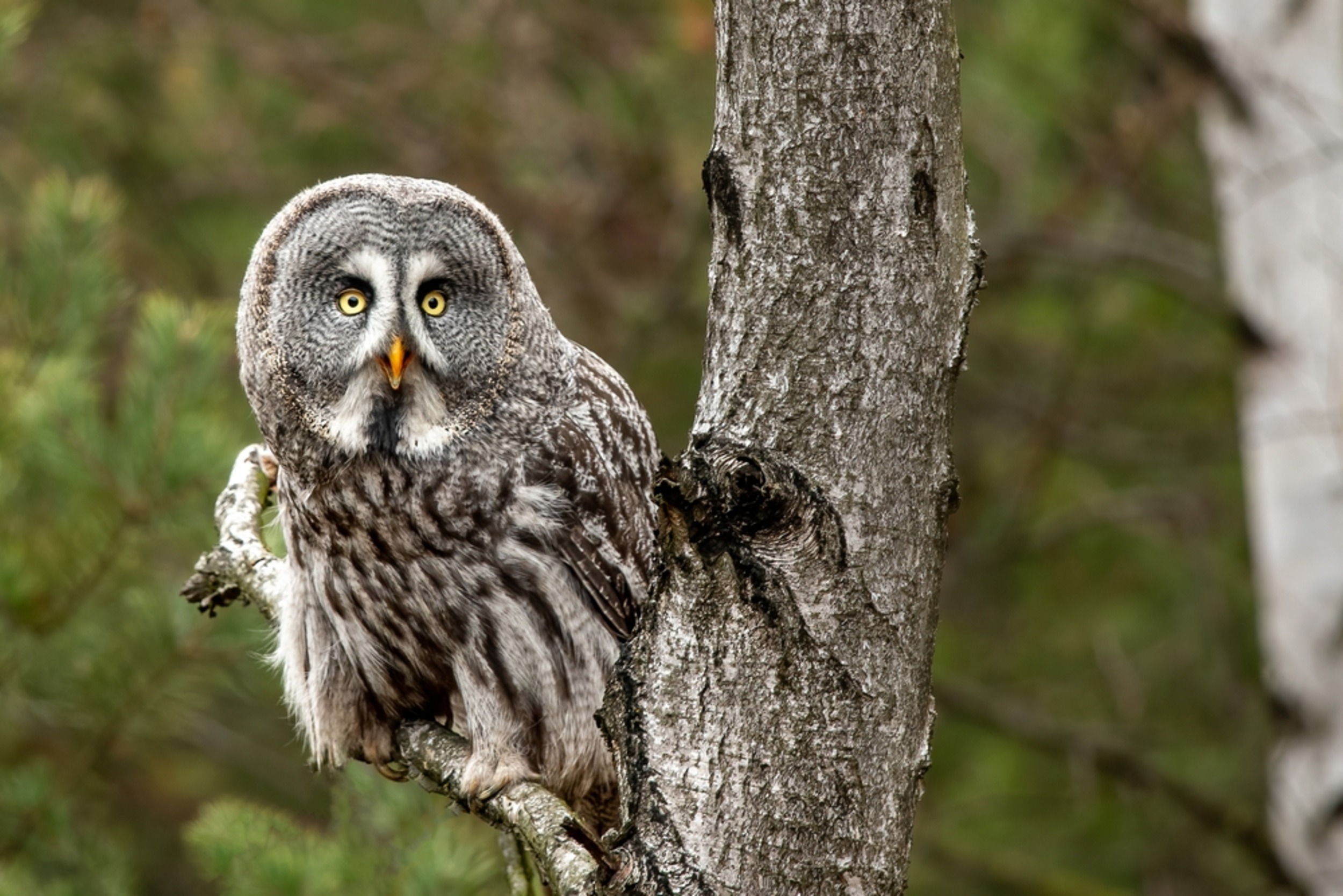
The discovery that great gray owls thrive near human areas casts fundamental doubt on the myth of Alaska’s wilderness. With their distinctive facial discs and piercing yellow eyes, these magnificent birds have long symbolized the pristine Arctic wilderness. But researchers at the University of Alaska Fairbanks have found that they live along roads, near small towns, and even along the TransAlaska Pipeline.
This revelation comes from advanced computer modeling that analyzes temperature data from platforms like eBird, infrastructure maps, and thousands of citizen science observations. The results overturn conventional wisdom about these elusive predators.
Understanding urban adaptation
Great gray owls exhibit remarkable adaptability, a pattern comparable to that seen in other urban birds. Human-modified landscapes unintentionally create ideal hunting conditions through cleared spaces, edge habitats, and abundant rodent populations that are attracted to human settlements.
Unlike barred owls that expand into new territories, great gray owls are actually adapting rather than invading. Forest edges near developments provide important perching areas for their distinctive hunting style, in which they listen for rodents beneath the snow and dive feet first to capture their prey.
AI revolutionizes wildlife research
The Alaska study exemplifies how artificial intelligence can transform conservation efforts. Machine learning algorithms processed vast datasets that would have taken decades to manually analyze by human researchers. This technique identified subtle patterns in owl distribution that could be missed by traditional field surveys.
Similar AI applications monitor biodiversity through audio, track the movements of endangered species, and predict wildlife behavior. In Alaska’s difficult terrain and vast distances, these tools can prove invaluable in understanding species distributions without disturbing sensitive habitat.
The changing landscape of Alaska
The discovery comes as Alaska’s ecosystem is undergoing dramatic changes. Climate change affects everything from permafrost stability to prey abundance. As traditional habitats change, great gray owls’ flexibility near human infrastructure may prove critical to their survival.
Professor Falk-Huettman’s observation that these owls contradict “traditional stories and myths that persist about wildlife” resonates beyond ornithology. This study suggests reevaluating assumptions about how wildlife responds to development in Alaska’s rapidly changing environment.
Conservation impact
This research will transform conservation planning. Rather than focusing solely on preserving pristine nature, strategies must take into account the wildlife that thrives in human-altered landscapes. Urban spaces that support bird diversity demonstrate that thoughtful development can coexist with wildlife.
Understanding why certain species succeed near human activities can help design wildlife corridors, manage development impacts, and predict how animals will respond to future changes. Although the Trans-Alaska Pipeline corridor was initially viewed as habitat fragmentation, it may actually provide hunting opportunities and migration corridors for adaptive predators.
Future research directions
The success of AI-powered wildlife monitoring in Alaska has opened the door to research on other elusive boreal species. Researchers could apply similar methodologies to understand the distribution of lynx, wolverine, or caribou relative to human infrastructure.
As drones and AI revolutionize animal counting, combining these technologies with citizen science platforms creates an unprecedented opportunity for comprehensive wildlife monitoring across Alaska’s 663,300 square miles.
The Gray Owl is a reminder that nature’s resilience is often amazing. Their ability to exploit human-altered environments challenges simplistic conservation narratives. The great gray owl also highlights the complex relationship between development and biodiversity in a rapidly changing world.
—–
Like what you read? Subscribe to our newsletter for fascinating articles, exclusive content and the latest updates.
Check us out on EarthSnap, the free app from Eric Ralls and Earth.com.
—–