

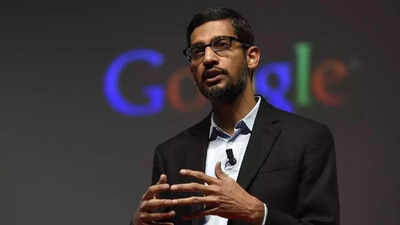
In an interview with BBCGoogle CEO Sundar Pichai has envisioned a future where artificial intelligence is not just an industry tool, but a presence in the workplace that can take over “complex” tasks for users. According to him, that acceleration will become visible within the next 12 months.“That’s where it gets really interesting,” he said. BBCdescribes the transition from AI as an assistant to AI as an agent. And he went further. Artificial intelligence could do his job, he suggested.
“I think what CEOs are doing may be one of the easiest things for AI to do someday,” he said. Pichai did not say which chief executive functions might be automated first, but he described the upcoming transition as one where some jobs will disappear, others will “evolve and migrate” and people will “need to adapt.”
A growing chorus: Other CEOs say the same thing
Pichai’s comments place him squarely in a growing group of technology leaders who have publicly acknowledged that their roles may be taken over by algorithms.OpenAI CEO Sam Altman has previously said that AI will one day do a better job than he does, adding, “I’m just going to be excited when that happens.” Klarna CEO Sebastian Siemiatkowski wrote in X earlier this year that the technology “can do all of our jobs, including my own.”Their comments echo sentiments found in an edX survey of 500 CEOs, with 49% saying “most” or “all” of their jobs should be automated with artificial intelligence.Not everyone agrees. Asked if artificial intelligence could replace him, Nvidia CEO Jensen Huang said, “Absolutely not.” He added that while the technology can outperform humans by “1,000 times” on certain tasks, it is still far from fully replicating human work. “As we speak, there is no chance that AI will do what we are doing,” he said.
What parts of a CEO’s job can be automated?
The conversation is now focused on practical questions. Which elements of leadership are amenable to automation? The answer lies in the parts of the role that rely heavily on structured data, repeatable logic, and quantifiable results. Areas where machines already exceed human speed and scale.
- Daily decision flow and predictions: AI can handle repetitive, data-driven tasks such as financial modeling, risk scoring, and predictive analytics. Executives are already using machine learning to predict market trends, predict demand, and optimize resource allocation in real-time.
- Data-rich decision cycle: CEOs regularly review financial statements, forecasts, and internal reports before making day-to-day decisions. These cycles rely on structured information. Structured information is something that algorithms can process faster and with fewer errors. AI systems can already analyze revenue trends, assess supply chain risks, and generate scenario outputs in minutes, automating the analytical portion of a CEO’s daily decision-making flow.
- Strategic modeling and scenario testing: When a CEO evaluates a change in go-to-market strategy or pricing, much of the work involves predicting outcomes, testing hypotheses, and comparing alternatives. These tasks rely on simulation rather than human instinct. This aspect of the job is becoming increasingly algorithmic, as modern models can run thousands of strategic scenarios at once.
- Operational monitoring and anomaly detection: CEOs use dashboards to track performance, identify deviations, and decide when to intervene. Because this monitoring is primarily pattern recognition, such as monitoring metrics, identifying anomalies, and flagging risks, automated systems can replicate the monitoring layer of business controls with continuous and real-time accuracy.
What parts of a CEO’s job can’t be automated?
Limitations emerge when leadership moves from calculation to moments that require judgment, trust, and moral clarity. These are the areas where the CEO role becomes fundamentally human, and where automation will naturally plateau.
- Judgment in ambiguous situations: CEOs don’t just read the numbers; they read the context: political pressures, cultural signals, regulatory changes, and influences that go beyond a spreadsheet. Such situations require judgment based on lived experience. AI struggles because it cannot weigh competing values, navigate incomplete information, or understand consequences beyond data patterns.
- Earn trust and lead people: CEO authority comes from credibility. This includes persuading employees during a crisis, convincing a board of directors during a dispute, and calming investors after a setback. These are relational tasks rooted in emotion, reputation, and presence. AI systems cannot replicate trust-building, cannot take responsibility, nor can they be held accountable when decisions go wrong.
- Ethical reasoning and moral risk-taking: Top leadership often involves deciding not just what is efficient, but what should be done. Layoffs, safety compromises, privacy trade-offs – these require moral judgments that go beyond optimization. Algorithms cannot make value-based calls or bear the ethical weight of real-world consequences.
So is it really possible for systems to reproduce these properties? Only the future will tell.
What this suggests about the future of leadership
Taken together, Pichai’s comments reveal how CEOs have come to think about their own relevance. For decades, the automation debate has revolved around factory floors and back-end operations. Now they have risen to the top of the organizational chart. When leaders of multi-trillion dollar companies start describing their roles as “easier to do” for AI, the center of gravity shifts.The question is not whether automation can provide leadership, but what leadership will look like when AI becomes a reliable candidate for the job. If CEOs see their roles as something they can delegate to algorithms, the definitions of strategic oversight, accountability, and judgment will be quietly rewritten.Mr. Pichai’s comments, coming from the head of one of the world’s most influential technology companies, indicate that this rewriting has already begun.


