
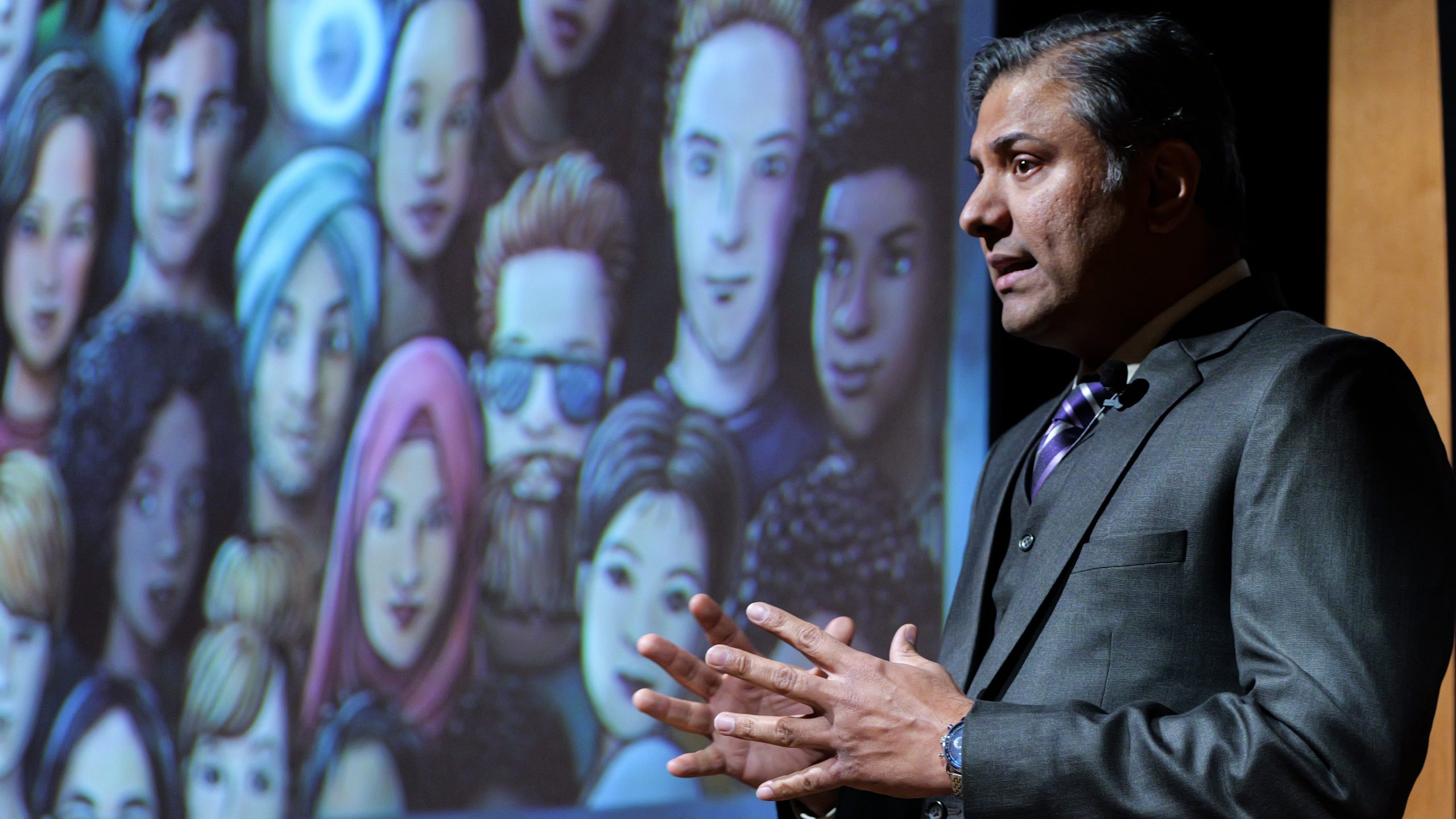
This is something Ali has never seen before in American journalism, but AI anchors have been used for years across Asia and the Middle East, including in his native Pakistan, and are rapidly improving in their ability to mimic human conversational behavior.
“What’s really unknown, especially in the US, is how audiences will react to these changes and whether they will embrace AI news presenters,” he said. “It’s one thing when it comes to movies and comics, but it’s another thing when it comes to the nightly news.”
Even those who have been following the rise of AI journalists and anchors may not be aware that broadcasters are requiring anchors to sign contracts that give their companies the rights to their faces, to build digital versions that are available day and night, to require no holidays, health insurance or sick leave, and to not require long commutes.
You can probably guess what the future holds, but Ali said AI will create new kinds of jobs in journalism without replacing editorial judgment or human curiosity. For example, broadcasters in Pakistan have begun employing “prompt managers” that use AI to create and improve the content read by digital anchors.
“Technology companies are having a much greater impact on news than we expected.”
Muhammad Ali, Journalism
Even if job losses are minimal, there are many ethical considerations for a move like this, and given the speed at which AI is being deployed in news and other fields, research like Ali’s is important for us to slow down and ask the right questions about how this technology could change our relationship with news.
“Who will take responsibility if something goes wrong?” he said. “Organizations are asking journalists to show a face, but that face is not accompanied by his integrity, his objectivity, his convictions. There is a real possibility that it could be exploited.”
In fact, he has already found examples of this, including authoritarian regimes and terrorist groups that are leveraging AI anchors to spread misinformation and propaganda in ways that appear convincing.
problem of perspective
Ali’s adviser, Patrick Ferrucci, said the study was important because there was little scholarship on the subject in Western Europe and the United States, where press freedom has historically helped journalists oppose this type of innovation. And his background, in addition to growing up in a region where AI anchors are more common, brings years of leadership and industry experience in public relations, making his perspective particularly valuable, both in the classroom and as a researcher.
“Journalism here has historically fought new technologies long after they lost the battle,” said Ferrucci, professor and dean of the School of Journalism. “We can definitely see AI anchors coming into journalism because there are economics in news.
“But I look at some of the things that AI can do and think, ‘That would have been useful when I was a journalist,'” he added. “Understanding how to use these technologies without making yourself irrelevant is something we talk about with our students, and Ali’s research is very important, especially since this topic is not well studied outside of Asia.”
The interdisciplinary nature of CMDI education—where students are encouraged to explore the intersections of different industries and schools of thought to better discover innovation—helped Ali bring a technology-oriented perspective to the craft and business of journalism.
“Technology companies’ influence on news is far greater than we ever expected, and it means we have to answer to new kinds of bias and hallucinations in unchecked data,” he said. “And as we’ve heard in other industries, editorial decisions are also being influenced by these technologies.”
He has already begun to make a name for himself in academia, winning the Best Student Paper Award at the Journalism and Mass Communication Education Association Conference and the Kappa Tau Alpha Award for Outstanding Student Paper.
Motivated by his father’s memory, Ali is dedicated to using his Ph.D., which he plans to complete in May, to teach future generations of students to take advantage of these technologies and become smart news consumers who recognize the intrusion of AI into the nightly news.
Especially since, as he discovered, younger viewers are more receptive to headlines coming from machines.
“Younger generations want to experience new things and see new things, and they’re used to using technology and social media to do that,” he says. “These AI videos are generating views on social media and making money on social media, and enterprise managers will be paying close attention to that.”
Joe Arney covers university research and general news.


