
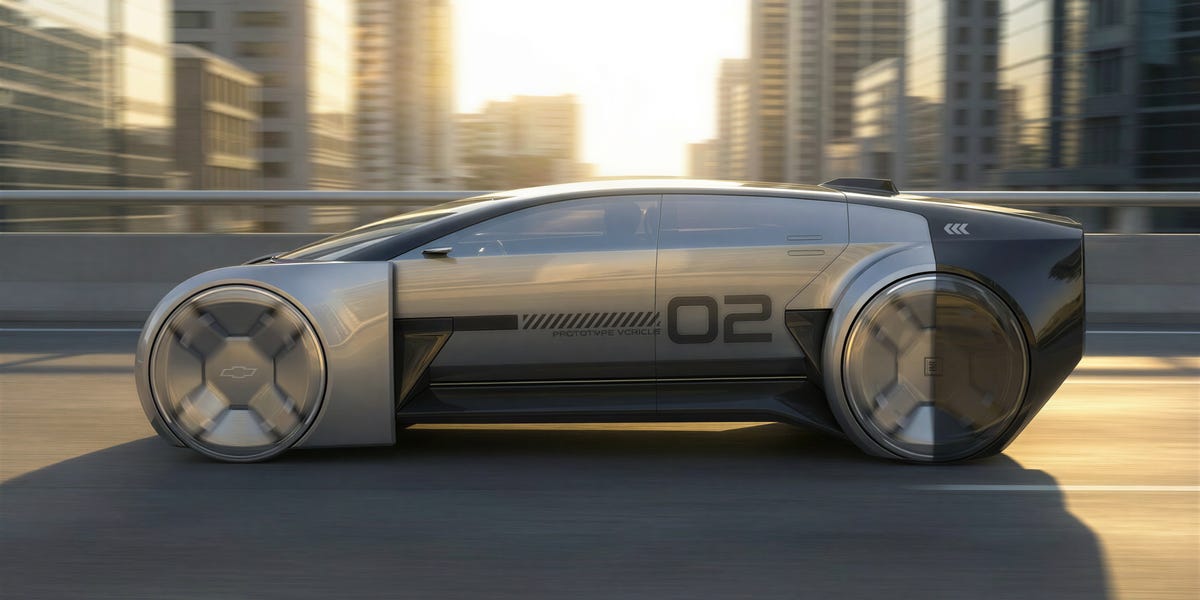
General Motors is bringing artificial intelligence to a part of the car business that has traditionally been deeply human: design.
Automakers have long focused their AI efforts on manufacturing efficiency, product reliability, and supply chain analytics. Now, GM says its generative AI tools are embedded throughout the creative process.
The system can transform early hand-drawn sketches into concept videos, suggest design changes, and even perform early-stage aerodynamic testing. As a result, executives say the design schedule has been significantly shortened.
This is becoming increasingly important in an industry where it typically takes five to seven years to develop a new car. It also faces significant headwinds, including supply chain shortages, tariffs on emerging Chinese EV rivals and shifting federal policy incentives.
And GM says it’s putting designers in the driver’s seat even as it unveils AI tools with immediate impact.
“Human creativity determines the vision,” General Motors creative designer Dan Shapiro told Business Insider. “AI allows us to see that sooner.”
From sketch to simulation in minutes
GM took a sketch of the Chevrolet P2 concept car (gray on the left) and fed it into the AI. A video has been generated (clip on the right). general motors
The first steps in car design at GM still begin with a human and a sketchpad. AI will help realize that vision faster, GM says.
Through a partnership with AI startup Discom, GM has developed software that takes hand-drawn sketches from multiple angles and builds a complete 360-degree model of the car.
This tool can generate multiple visual variations, simulate camera movement, and create short animations showing vehicles in motion.
This greatly accelerates the design process.
“Traditionally, creating high-quality animation from design sketches has taken multiple teams and months of work,” Shapiro said. “Now we can do all of this within a day.”
Manage air flow – and the car gets a new one?
Chevrolet said its new AI system can predict the car’s aerodynamics. general motors
GM is also applying AI to aerodynamic testing, one of the most time-consuming parts of vehicle development.
Engineers typically use computational fluid dynamics simulations to model the airflow around a vehicle. These tests are accurate but time-consuming, often requiring weeks of iteration between design and engineering teams.
GM announced that it has developed a “virtual wind tunnel” that uses AI to estimate air resistance in near real time.
“Previously, this design and engineering iteration took about two weeks to complete,” said Rene Strauss, director of virtual integration engineering at GM. “What we’re looking at now is instant. An aerodynamicist and a creative designer can sit in front of the same screen and change things live.”
For example, GM said it can digitally adjust the windshield angle and generate updated drag estimates in just over a minute.
Strauss said the technology is also impacting components inside the car. In one case, a machine learning optimization tool suggested a new structural reinforcement design to reduce cabin vibration.
“It really looked like a hip bone,” she said. “It was really interesting because the human body optimizes itself over time, and it was really cool to see that happen in the car.”
He added that GM’s use of additive manufacturing allows it to quickly manufacture and test such designs.
AI as a collaborator, not a decision maker
Chevrolet says AI will not replace human creativity. This alone will speed up product development. general motors
Despite the expanding role of AI, GM is positioning the technology as a tool rather than a replacement for designers.
“It’s really about having a holistic, integrated, AI-enabled workflow from start to finish,” said Brian Stiles, GM’s global director of design innovation and technology operations. “What we found is that the biggest benefit is reducing handoffs between steps.”
GM designers say AI is helping them move ideas from concept to production faster.
The company has set internal goals to shorten development schedules, but executives declined to provide details.
Still, they say the risks, if not existential, are clear.
“We have been very focused on how we can most effectively ride the upcoming wave of AI,” Stiles says. “That wave is coming so quickly that unless we have a common philosophy and strategy on how to leverage AI, we will be left behind by it. Either way, it’s coming.”


