Kawasaki City, Japan, May 25, 2026 – (JCN Newswire) – Fujitsu Limited today announced the development of self-evolving multi-AI agent technology.[1] This enables multiple AI agents to perform tasks as a team and continuously and securely learn from daily execution results, human feedback, policy revisions, and specification changes.
In business operations, legal revisions, system changes, specification updates, changes to workplace rules, etc. occur continuously. In businesses that handle large volumes of documents and design specifications, decisions such as which information to refer to, which decision criteria to prioritize, and how to confirm the scope of impact when responding to business needs have traditionally relied on the experience and tacit knowledge of seasoned experts. In addition, the system required continuous adjustment by experts in response to changes in prompts, search methods, evaluation criteria, and operational rules.
While conventional AI agents demonstrate high processing ability in response to instructions given to them, it has been difficult to independently analyze the reason for failure and safely incorporate it into subsequent operations. As a result, experts needed to continually adjust prompts, search methods, evaluation criteria, and operational rules to adapt AI agents to modern business environments.
To address this challenge, Fujitsu has developed technology that allows AI agents to safely learn by autonomously validating their own operational experience.
This technology is a multi-AI agent technology that adapts to changes in the business environment and continuously and safely evolves by incorporating business execution results, human feedback, system revisions, and specification changes. Its most important feature is that the AI agent identifies the reasons for success and failure during task execution, extracts actionable knowledge and operational insights, and does not simply save the generated improvement suggestions. This will enable AI agents to take over tasks such as rapid adjustments and updating evaluation criteria, which were previously carried out by experts. Furthermore, by introducing AI into the customer’s environment, we will continuously adapt to the individual rules and judgment criteria that arise during business operations, creating a business foundation that evolves with people and the environment.
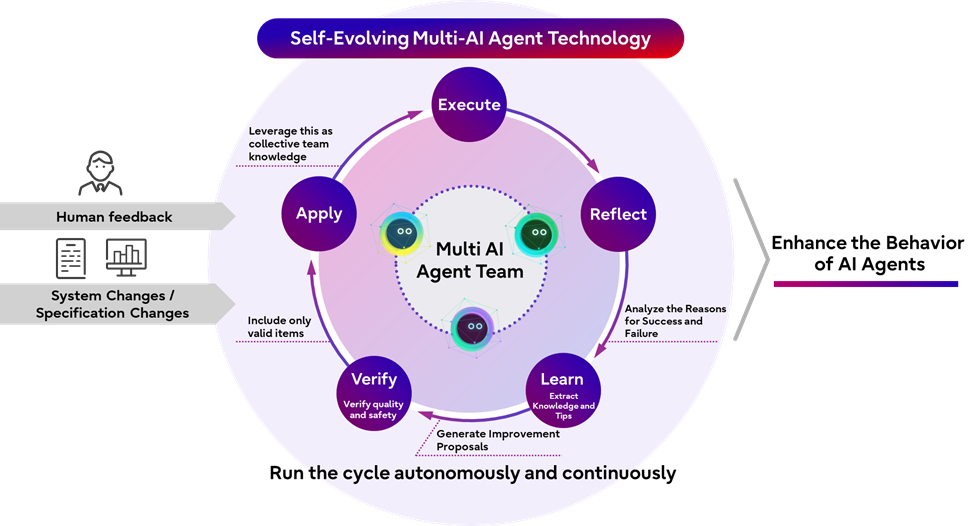
Figure 1: Technology overview
Fujitsu applied the newly developed technology to the following two areas and evaluated its accuracy.
1. Automatic enhancement and continuous evolution of business-specific LLMs
This technology can be applied throughout the process of building a business-specific LLM. Multi-AI agents will autonomously perform and optimize a series of tasks that were previously performed by experts, such as data selection, adjustment of learning conditions, evaluation, and improvement. Each AI agent generates improvement proposals based on business execution results and evaluation results, and continuously improves model performance by verifying and reflecting only effective proposals. This will significantly reduce the work that was previously performed by experts, and create a system in which AI can continue to evolve autonomously in the course of work.
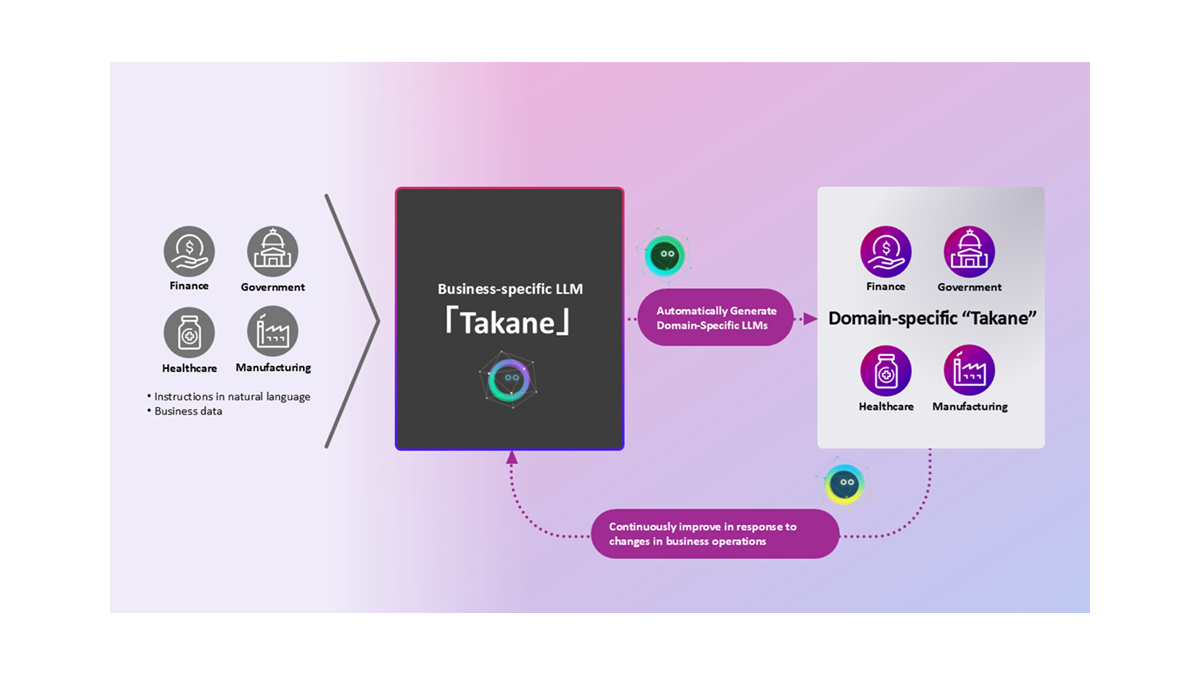
Figure 2: Automated enhancement and continuous improvement of business-specific LLMs with self-evolving multi-AI agent technology
Fujitsu has automatically enhanced Takane for multiple areas such as manufacturing, medical care, finance, and government, and has continuously improved it through operation. Continuous improvements were implemented through operational use, resulting in a significant improvement in average accuracy of 28 points compared to pre-specialization performance. For example, in the medical field, by applying this technology, it becomes possible to structurally extract information appropriate to the business from unstructured data such as medical records and test results, such as extracting diagnosis names, stages of progression, treatment policies, etc. in a consistent format. This not only improves response accuracy, but also demonstrates that multi-AI agents can automate the process of building and improving business-specific LLMs, which previously required design and adjustment based on expert knowledge, and enable continuous optimization throughout operation. This makes it possible for companies to quickly build AI tailored to their operations and continuously improve it as their operations change, without relying heavily on AI experts.

Figure 3: Benchmark evaluation results before and after domain-specific optimization.
Furthermore, under the OneFujitsu concept,[2]Fujitsu is promoting the global standardization of internal IT, data, and business processes. By applying this technology and a multi-AI agent platform equipped with “Takane” globally, Fujitsu will achieve autonomous business execution and accelerate management speed, accelerating the transition to data and AI-driven management.
2. Application to design specification search in large-scale business systems
This technology was applied to document searches using an AI agent for design specifications for Fujitsu’s electronic medical record system for Chuo University Hospital and business solutions for local governments. Traditionally, determining the scope of software changes due to legal or policy changes has required skilled experts with deep knowledge of regulations, business processes, and system architecture. This technology allows AI agents to learn from past search results, failures, and human fixes. As a result, search scope expansion and document extraction strategies are autonomously improved. This reduces the effort required to design and improve search logic and improves accuracy. This shows that the AI agent did not simply repeat the search, but also learned and applied the search methods of seasoned experts, such as checking related documents during the job, and not excluding documents that at first glance seem unrelated if they belong to the same business domain. Going forward, Fujitsu will apply these insights and technologies to its AI-driven software development platform to further enhance and streamline the overall design and development process.
Future plans
Fujitsu plans to integrate this technology into its own AI platform and provide it as a core technology that supports the in-house development and autonomous operation of business-specific AI. Furthermore, Fujitsu will promote the application of the Fujitsu Kozuchi AI Platform as one of its advanced AI technologies to a wide range of areas that require specialized knowledge and continuous improvement.
Furthermore, by combining the knowledge gained through joint research with Carnegie Mellon University’s Associate Professor Graham Neubig and Assistant Professor Tim Dettmers with the generative AI reconstruction technology developed by Fujitsu, we will proceed with the development of technology that allows self-evolving multi-AI agent systems to operate with less memory and power. This aims to enable the use of AI teams that continue to learn from operations, not only in cloud environments, but also in highly confidential on-premises and edge environments. Fujitsu aims to realize sovereign AI that continuously learns not only in the cloud but also on-premises and edge environments. Furthermore, by enabling AI to learn in real time from on-site mistakes, human instructions, changes in the environment, etc., and safely utilizing it for subsequent work, we will evolve AI into an intelligent platform that grows with the on-site. This will solve social issues such as the lack of specialized human resources, responding to regulatory changes, passing on tribal knowledge, and increasing the sophistication of on-site operations, creating a future where humans and AI learn from each other and evolve the entire industry.
[1] Self-evolving multi-AI agent technology:
A technology in which multiple AI agents share and execute tasks, and continuously and safely improve subsequent actions based on the results, human feedback, and environmental changes such as policy revisions and specification changes.
[2] OneFujitsu’s initiatives:
An initiative to define a common global standard process (golden standard) across Fujitsu and integrate and optimize operations across organizations and countries.
Fujitsu’s efforts towards Sustainable Development Goals (SDGs)
The Sustainable Development Goals (SDGs), adopted by the United Nations in 2015, represent a set of common goals to be achieved around the world by 2030.
Fujitsu is committed to contributing to the vision of a better future through the SDGs, with the purpose of “building trust in society and making the world more sustainable through innovation.”
About Fujitsu
Fujitsu’s purpose is to build trust in society and make the world more sustainable through innovation. As the digital transformation partner of choice for customers around the world, our 100,000 employees work to solve some of the biggest challenges facing humanity. Our wide range of services and solutions leverage five key technologies: AI, computing, networking, data and security, and converging technologies, which come together to enable sustainability transformation. Fujitsu Limited (TSE:6702) reported consolidated sales of 3.5 trillion yen (US$23 billion) for the year ending March 31, 2026, and remains Japan’s top digital services company by market share. For more information, please visit global.Fujitsu.
press contact
Fujitsu Limited
Public Relations/Investor/Analyst Public Relations Department
inquiry
Topic: Press Release Overview
Source: Fujitsu Limited
Sector: Enterprise IT
https://www.acnnewswire.com
From Asian Corporate News Network
Copyright © 2026 ACN Newswire. Unauthorized reproduction is prohibited. A division of Asia Corporate News Network.