Further leaps in video quality cannot be achieved through compression alone. This is made possible by AI that enhances what viewers see after the video is decoded. Nokia’s public neural network post-filtering (NNPF) software release provides a hands-on demonstration of how AI-based post-filtering can deliver a better, more efficient, and scalable streaming experience.
Most people don’t even think about codecs, metadata, or AI inference libraries. More simply, they notice whether the videos they watch look clear, natural, and immersive. When fine textures disappear, gradients become disjointed, and details in dark scenes are lost, the user experience becomes unconvincing. NNPF helps close that gap by applying AI at the end of the video pipeline to improve the images viewers see while working with the standards-based innovations the industry relies on.
This release builds on previous work on neural network post-filtering within the broader VVC and VSEI standards ecosystem. Simply put, NNPF uses AI after decoding the video to restore detail, sharpen textures, and improve perceived quality without increasing bitrate. For streaming platforms and device manufacturers, this means a more efficient path to improving image quality. For viewers, that means videos that look richer and more realistic on the devices they’re already using.
Why this release matters now
Timing is important. VVC is emerging as the foundation for next-generation video services, delivering high quality at low bitrates across broadcast and streaming use cases. At the same time, consumer devices, from laptops and phones to televisions and set-top devices, are leveraging dedicated AI acceleration. Our public NNPF software release sits at that intersection. On the one hand, more efficient codecs, and on the other hand, running practical AI on everyday hardware.
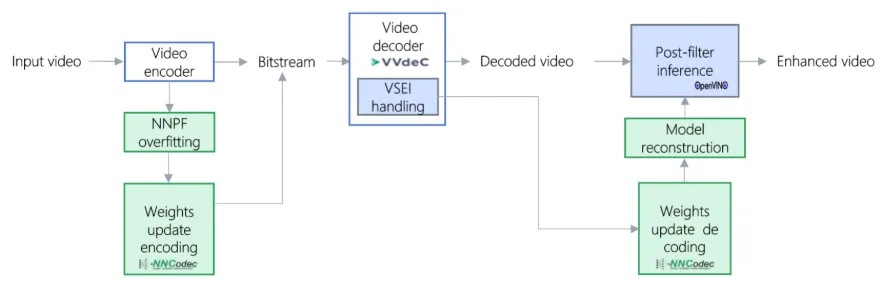
So a release is more than just dropping code. This is a concrete demonstration of how standards, software, and hardware can work together to advance progress. The software described here combines a VVC decoder path with support for NNPF SEI messages, neural network weight processing, and real-time inference via OpenVINO. In other words, it shows how AI-enhanced video can be delivered in a standards-compliant and interoperable manner, rather than as a private, one-off demo.
Figure 1. VVC bitstream to extended picture. Nokia’s public NNPF software release demonstrates a practical, standards-compliant workflow for AI-enhanced video that combines VVC decoding, synchronized metadata, and neural network inference into one interoperable toolchain.
Why is NNPF important to consumers?
The benefits for viewers are clear. Better compression and better post-processing result in clearer, more immersive video even when bandwidth is limited. Fine textures hold better. The edges look more natural. Skies, shadows, and subtle gradients retain more details that are often lost during delivery. Additionally, because NNPF works after decoding, these benefits can be achieved without redesigning the entire distribution chain.
That’s important whether you’re watching premium drama on the big screen, watching sports on your laptop, or watching short-form videos on your phone. It also matters where the network is constrained. Streaming becomes more resilient, more efficient, and more comprehensive when the same bitrate can provide a better visual experience. As highlighted in previous NNPF work, AI can help restore removed compression and enable richer colors, smoother gradients, and sharper textures in consumer devices already on the market.
With weight updates sent
random access (first 64 photos)
Via VTM CfE anchor decoded without NNPF
Y PSNR
UPSNR
VPSNR
VMAF
SRH (first 64 photos)
-2.93%
-29.70%
-32.44%
-5.15%
SRH1-Dax takeoff
-5.27%
-64.30%
-76.88%
-10.75%
SRH2-Driving POV4
-2.06%
-21.40%
-24.35%
-2.90%
SRH3-Seeking
-1.99%
-18.28%
-11.03%
-1.83%
SRH4-Umbrella
-2.42%
-14.82%
-17.49%
-5.14%
Figure 2. Improved video quality without increasing bitrate. Sample results from Nokia’s NNPF workflow show measurable quality improvements and demonstrate how AI-based post-filtering can improve perceived video quality without increasing delivery bitrate.
What NNPF means for the video industry
For the media and entertainment ecosystem, the implications are broader. Public software lowers the barrier to experimentation. Researchers, developers, encoder vendors, and platform teams can now consider specific implementation paths for AI-based post-filtering using VVC. The NNPF software is available under a BSD 3-clause clear license that supports evaluation and experimentation, but use of the underlying Nokia patented inventions remains subject to Nokia’s applicable licensing programs. This release demonstrates the practical benefits of AI-based post-filtering and helps set a clearer path for future adoption. This accelerates learning, interoperability testing, and production. Equally important, it helps move the conversation from what AI-enhanced video can do to what it can actually already do.
This is especially important for broadcasters and streamers looking for new ways to stand out. The Media Coding Industry Forum (MCIF) highlighted how VVC is supporting next-generation services in broadcast and streaming, from improved efficiency to immersive experiences. Our NNPF software release adds another important layer to that story. It’s not just coding efficiency, it’s AI-assisted visual enhancements delivered through standards-based workflows.
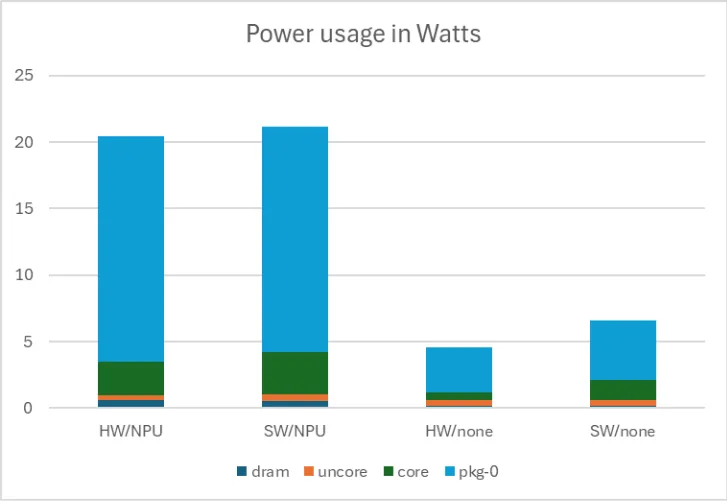
Figure 3. AI video enhancements on consumer-grade hardware. Real-time NNPF inference on modern consumer hardware highlights how dedicated AI acceleration makes standards-based video enhancement practical at scale.
From research leadership to real-world momentum
Nokia has been shaping video technology for decades, from its contributions to historic video codecs to its recent leadership in the era of multimedia AI. Our work on VSEI is particularly important because it extends the established H.26x video standard with synchronized metadata and extensions, allowing video systems to evolve without compromising compatibility. This is exactly the kind of bridge the industry needs as AI becomes part of the mainstream media pipeline.
This public release of software strengthens that position. This shows that Nokia is not only helping define the path to standardization, but also converting those ideas into working software that others can inspect, test, and build on. In a complex field like AI-enhanced video, a combination of standards leadership and implementation leadership can make a big difference in adoption.
Explore public NNPF software releases and test it yourself on GitHub: https://github.com/nokia/fraunhoferhhi-vvdec/blob/master/nnpf/README.md