
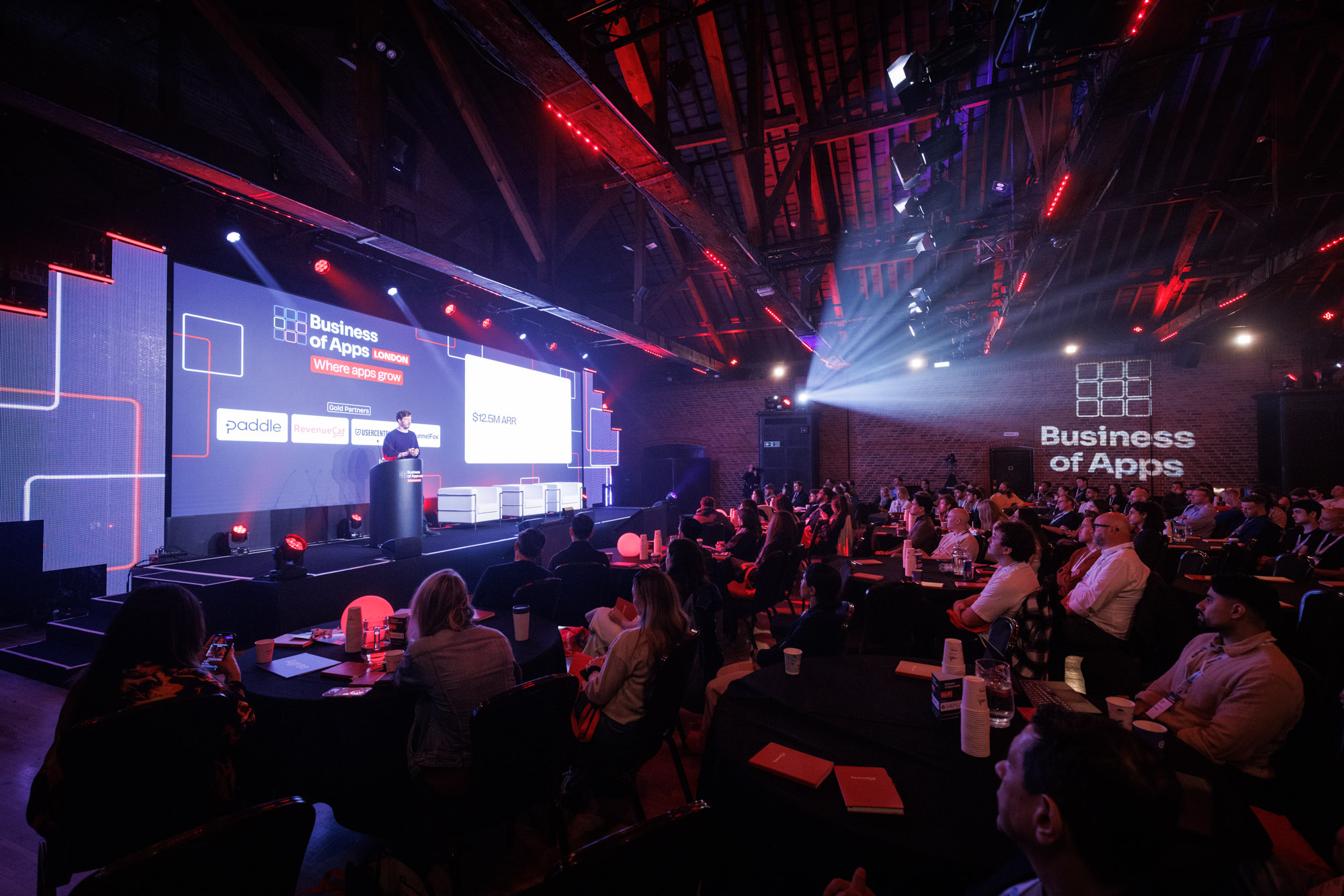

Business of Apps London 2026 has officially ended…and what an event it was…seriously, it was truly amazing.
The audience speaks for itself. In the days leading up to the event, we enrolled over 1,100 senior app leaders in marketing, product, and monetization. Thanks to everyone who registered, we were also able to plant over 1,100 trees through our Treeapp partnership.
More than 900 people gathered at the brewery for a day of learning and networking. More than 73% of attendees represent apps, brands, and mobile games, with 19.3% having more than 10 million monthly active users (MAUs), 63% having more than 1 million MAUs, and 83.3% having more than 100,000 MAUs.
Additionally, 72.8% of participants were budget holders (49.6%) or budget influencers (23.2%). The top app categories represented at the event were Finance, Health & Fitness, Travel, Gaming, and Shopping.

Known for its great networking opportunities, BOA London’s 2026 edition exceeded expectations in every way. Over 31,100 website visitors and over 69,700 page views were registered. Thanks to the event’s dedicated networking app, over 4,900 contacts were created, 4,000 messages were exchanged, and 1,750 discussions were created.
The energy was shocking and, as always, insightful learning. Across eight content stages featuring 50+ sessions and 80+ speakers, we heard deep dives on every topic imaginable, from ASO, retention, engagement, and UA to recent platform changes, growth strategies for 2026 and beyond, and everyone’s favorite AI.
Now that the dust has settled and we’ve all had time to breathe, relax, and collect our thoughts, it’s time to reflect on the day’s sessions and talks and explore the key learnings and trends that were shared.

Lessons from the field: How Mob became the UK’s most popular recipe app
We got off to a great start when Mob CEO Benjamin Lebus took to the stage to deliver this year’s keynote. He shared four important lessons that may seem obvious but are often forgotten or overlooked. In fact, for Mob, they were the difference between being £1.2 million in debt and topping the App Store charts.
Lesson 1) As Ben says, distraction is death. The most important thing when building digital products is to stay focused and avoid shiny object syndrome. Don’t branch out too wide or too quickly.
Instead, figure out the specific problem you’re trying to solve for your users and focus solely on that. Too many side projects can result in a half-baked core product.
Lesson 2) When it comes to solving problems, the product should be a painkiller in the user’s life. You’re probably familiar with the painkiller-vitamin analogy, so I won’t go into details.
In short, we need to pinpoint the pain points people are experiencing in their lives and focus on alleviating them…
And speaking of laser focusing…see lesson 1.

Lesson 3) If you wish, Really good product people Really Please enjoy using it. You need a willingness to experiment. Never stop repeating. You never know when you’re going to find a goldmine… or a duck 🦆… If you’ve been there, you know what I’m talking about. (Okay, okay, I’ll tell you. Mob’s best ads featured dancing ducks.)
Lesson 4) This is primarily for founders. You need to learn when it’s time to stop overseeing everything and let your team do their job. Most of you have built good, reliable teams. They can handle the copy, creative, and pretty much everything else themselves. Your time and expertise are best spent elsewhere. Simply put, don’t interfere too much.
Bringing threads together: big ideas, bold strategies, trends, and more
Besides the keynote speech, many other topics and ideas were considered on the day.
Below is a selection of those that struck us as the most impactful.
Subscription apps are exploding
There was a lot of AI stuff, of course, but let’s put it aside for now and focus on something else. (To allay your fears, yes, I’ll be back to AI soon.)
As ContextSDK co-founder and CEO Dieter Rappold noted in a LinkedIn post, subscription apps are exploding. Dieter is, of course, referring to Rick Herandrikman’s sessions. In this session, the latter beat the benchmark of over 115,000 subscription apps and generated over $16 billion in revenue. (For those of you who don’t know Rik, he’s RevenueCat’s VP of Growth, meaning he’s the guy with the most elaborate booth at the event.)

In recent years, subscription apps have grown from about 2,000 to about 15,000 per month. At the same time, trial periods are becoming exponentially shorter, but churn remains a big problem for most subscription apps. Interestingly, most of these are actually payment failures, suggesting potential infrastructure issues, but also the need for more proactive communication to ensure the app has up-to-date payment details for all users.
Growth continues. As we often say, the sky is the limit. But there’s also a lot of noise, forcing brands to think outside the box if they want to stand out.
Onboarding opportunities
“Onboarding can be your biggest growth opportunity,” said Emily Turner, director of product marketing at Vira Health, in a LinkedIn post. She cites the App Talk interview with the one and only Peggy Ann Salz and Daphne Tideman.
Daphne said in an interview. What do you think? (Bonus points if you catch my literary reference here): Apps and brands should stop chasing growth for growth’s sake and start fixing onboarding. Onboarding is more than just a one-time series of screens that users are forced to swipe through when they start using your app.

On the contrary, it is gradual and may spread over the first few sessions. Certain stages of onboarding may only be unlocked after the user reaches certain milestones or attempts to interact with certain features, but this does not necessarily happen on the first day. The best onboarding adapts to both the nature of the app you’re deploying and the user behavior data available.
Emily says: “The best apps use onboarding to answer implicit questions about value, trust, and what to do next.”
AI was…everywhere.
Okay, let’s talk about AI. As expected, AI is everywhere, and there were many talks about how LLM is changing discovery, engagement, retention, monetization, and more.
The AI coding boom (also known as vibe coding) has led to an explosion of new app releases, and the total number of apps in the Apple App Store has reached a record number. According to our app store data, by the end of 2025, the total number of apps in the Apple App Store will reach 2.28 million, representing a year-over-year increase of 160,000.
New apps released from 2022 to 2025 (%)
Meanwhile, others like Yasin Kheradmand, Head of Growth at Stakemate, took a slightly different approach to AI and shared three practical ways to use AI right now. He advised the audience to think of AI agents as the new “junior marketers,” but this also means training them properly and giving them access to important information such as branding, market positioning, and business goals.

There was a ton of advice and tactics shared, but if I had to pick just one, it would be the biggest lesson we learned on the AI side. Don’t rush, especially if you’re in a small business position, and don’t just follow trends and aim to build your own AI.
Instead, we figure out what specific problem we’re trying to solve, gather all the data available about that problem, and then arrive at a highly compelling AI solution.
Add AI on top of everything and you have a disaster. As the saying goes, garbage goes in, garbage goes out. If you want real results, use AI to bridge the gap between your vision, the real problem in your product, and the available data that your chosen AI can use to help solve the problem.
The main point should be pretty clear by now. Be data-centric and everything should be fine…just fine.
Win a high-profile match
Our economy is an attention economy, baby. The most valuable thing a user can offer a brand before committing to a subscription or creating an in-app subscription is to capture their attention. The question is, is it getting that attention?
With millions of marketing emails sent every day (but the vast majority of them remain unread or unopened) and the average user receiving around 60 push notifications a day, it’s safe to say that simply sending CRM messages won’t cut it. As Emily says, achieving good and effective re-engagement requires more creativity and smarter channel selection across push, in-app, and lifecycle messaging.
Personalization alone is not enough. Personalized communication is now the minimum expectation of almost all users. Winning in the attention economy will require more creativity, more outside-the-box thinking, and an essential human touch to everything businesses do. AI alone cannot solve this problem.
And this is just the tip of the iceberg. There were a wealth of other ideas shared and trends considered, but it’s already quite a long article, so I don’t have the time or space to cover them all.
We encourage you to check out the event agenda. Next week, recordings of all sessions will be published on YouTube, allowing you to catch up on all the action in your own time. You can also follow us on LinkedIn and sign up for our weekly newsletter. In the newsletter, I will be posting summaries of most sessions on my blog.
Thank you to everyone who participated and to everyone who took the time to summarize key points on LinkedIn. We read and rated everything till the end, sorry if we couldn’t mention it.
We look forward to seeing you again in London next year. BOA London is back April 22, 2027you can already get launch tickets here. In the meantime, consider joining us in New York on September 17th or Berlin on November 12th.


