
The explosive growth of artificial intelligence has created an insatiable demand for training data. This is a rich real-world example of how humans move, speak, interact, and behave, not just text from the Internet. This has spawned a whole parallel industry of startups and platforms willing to pay ordinary people (and in some cases, defunct companies) for their personal data.

What began as simple data labeling has evolved into sophisticated “human data farms” where daily life is systematically recorded, annotated, and sold to train next-generation models.
Motion capture farm powers robotics

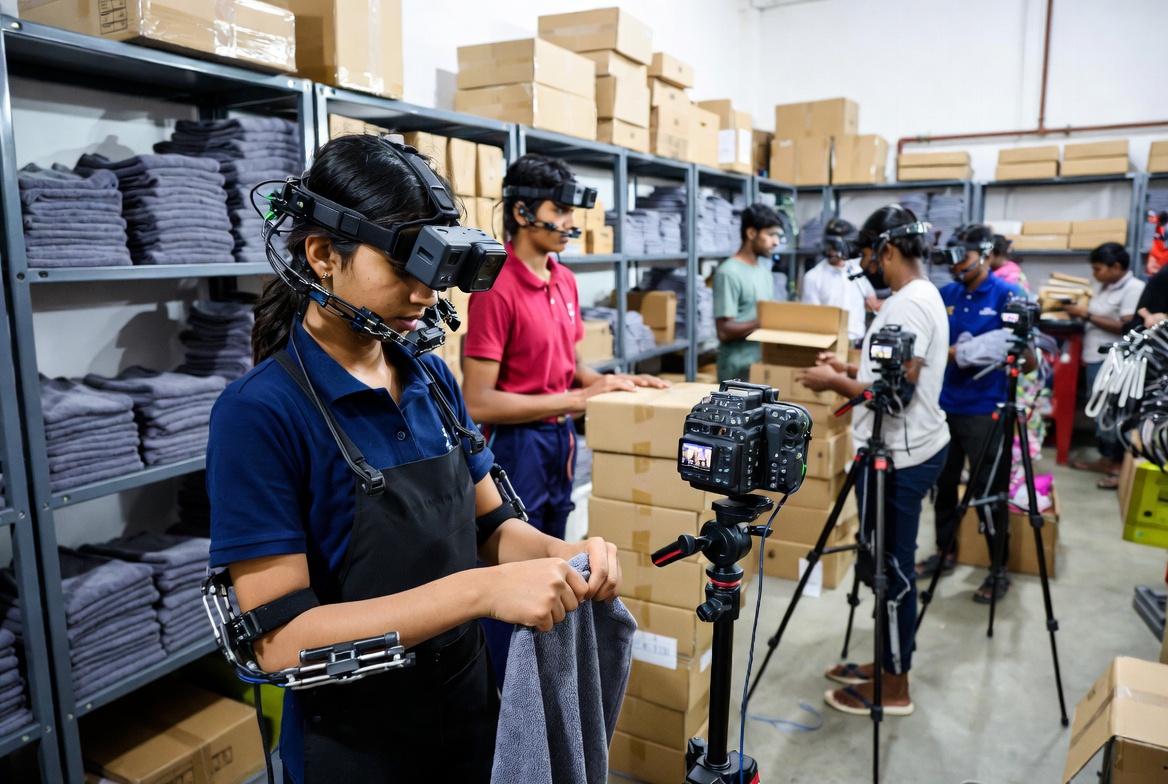
Participants simulate folding towels, stacking boxes, crumpling paper, sorting dishes, or doing housework while wearing a head-mounted camera (such as a GoPro) or motion sensor. The resulting video captures precise finger movements, grip styles, joint angles, and edge cases that cannot be easily reproduced with synthetic data.
These datasets will be sent to an AI research lab in the US to train humanoid robots to perform real-world dexterity tasks such as cooking, doing laundry, and navigating messy homes.
Companies like Objectways have extended this model by having hundreds of employees create batches of videos every day. Similar efforts are being made through platforms like Micro1, which provides people in India, Brazil, and Argentina with AR glasses to record their daily activities.
Payments in these arrangements often range from modest monthly salaries (about $230 to $250 for full-time workers in India) to gig-style incomes, turning low-wage labor into a critical input for multibillion-dollar robotics ventures.
Company Archives Entering the AI Supply Chain

Gig platform for everyday actions

Truck drivers and commuters have been particularly successful in providing valuable data about navigation, object interactions, and environmental context simply by turning on their in-car or cell phone cameras during their daily drives or walks.
Capturing human behavior and interactions

Voice, voice, conversation data

The platform attracts millions of contributors in over 180 countries and is particularly popular in developing countries where even a small amount of revenue matters.
One example reported in India involved a student who earned around $100, enough to cover basic living expenses, just by completing audio and recording tasks.
These datasets can help improve speech recognition, multilingual AI, call center automation, and voice interfaces for robots and wearables.
Expert evaluation: Human-in-the-Loop layer
Not all valuable data comes from raw recordings. Melkor Connect companies with experts (doctors, lawyers, bankers, and other experts) who evaluate and evaluate AI-generated responses. This human feedback loop helps leading research institutions like OpenAI and Anthropic refine their models based on accuracy, safety, and domain-specific knowledge.
A new kind of gig economy

This has created new revenue opportunities, especially in emerging markets where micropayments are rapidly increasing. At the same time, important questions arise about consent, privacy, data ownership, fair remuneration, and the long-term effects of turning our personal lives into fuel for training machines.
As AI continues its rapid advances, the hidden infrastructure of data collection will only grow in size and sophistication, from motion capture labs in India to smartphone apps in Southeast Asia to expert networks in the West. In this new economy, everyday moments are no longer personal. They are the raw materials for the intelligence that will shape the future.
Take advantage of these tools and earn rewards through the Quasa Rewards program.
—
Also read:
—
thank you!


