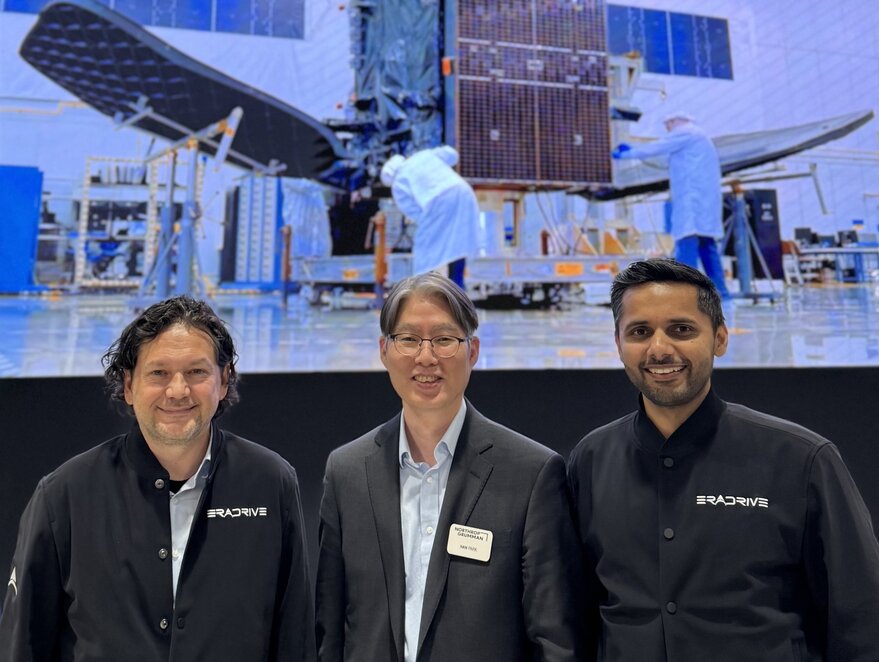
SAN FRANCISCO – Silicon Valley startup EraDrive is working with Northrop Grumman to enhance the autonomy of spacecraft with artificial intelligence.
Han Park, vice president of AI integration at Northrop Grumman, said the teaming agreement “focuses on activities aimed at accelerating spacecraft design, testing and autonomous operations.” space news By email.
EraDrive was spun off from Stanford University’s Space Rendezvous Institute in 2025 and focuses on spacecraft autonomy-as-a-service.
“Today’s robotic spacecraft, including Northrop Grumman’s Mission Expansion Vehicle and upcoming Mission Robotic Vehicles, are among the most sophisticated ever flown, but autonomy remains a bottleneck to operating their fleets at scale,” Sumant Sharma, CEO of EraDrive, said in an email. “Our collaboration with Northrop Grumman is focused on demonstrating AI-enabled rendezvous, close-in operations, and in-flight decision-making that will enable missions that are not possible today.”

EraDrive is working with Northrop Grumman to integrate AI “in smart ways into every phase of a robotic space mission,” including in-orbit operations and support activities on the ground, said Simone D’Amico, EraDrive’s chief scientific officer and associate professor of aerospace at Stanford University. Over the next year, EraDrive and Northrop Grumman will focus on “AI-powered attitude estimation and secure integration.” [of AI tools] It features fleet-wide operationalization of guidance, navigation, control stacks, and autonomous service and inspection capabilities. ”
EraDrive develops compact hardware and software modules that pull information from onboard sensors to enhance satellite autonomy. Customers can also choose how EraDrive’s software interfaces with the data layer, D’Amico said.
Two mission extension vehicles from Space Logistics, a subsidiary of Northrop Grumman, are extending the lives of two Intelsat communications satellites in geostationary orbit. Space Logistics’ mission robotic vehicle, equipped with a robotic arm to perform more advanced tasks, is scheduled to make its first flight later this year.