2025 began on an alarming note for the global economy, with Donald Trump beginning his second term in the White House. During his first presidency, the United States shifted gears from being the custodian of the rules-based global economic order to its enforcer.
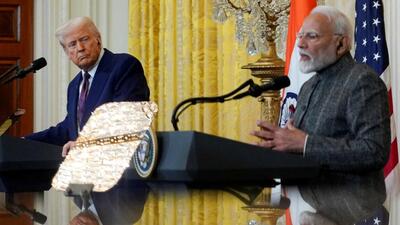
However, the prevailing sentiment within India was not a concern as Trump was perceived as a friend of the Indian government.
By August, President Trump imposed so-called reciprocal tariffs on the world, first announced in April but postponed. This goodwill turned into thin ice when India was slapped with a steep 25% tariff. By the time President Trump imposed 25% tariffs on Russian oil imports, the economic interests of India and the United States had gone under the radar, even though the Biden administration had no problems and larger buyers of Russian oil such as China did not act.
Other economies whose largest export markets were effectively shut down would have suffered tremendously. But India is ending the year in a rare “Goldilocks” zone with growth of 8% and inflation below 2%. To be sure, some of the brilliance of the combination of growth and inflation is statistical and technical, but it would be wrong to say that India is not in a good place.
The question facing the economy heading into 2026 is not whether the 8%-2% combination will continue. No one expects that, including the government (but no one expects the opposite extreme either). The question is whether the domestic economy will be supplemented by external tailwinds, or whether it will continue to face global headwinds.
Trade agreements not only with the US but also with other major trading blocs such as the EU are just one aspect of this. This is not to diminish their importance or the complexity of the trade-offs involved. But the reality is that the global economy is experiencing multivariate fluctuations, and Trump and his many would-be xenophobic and populist Western European politicians are only part of the problem.
The biggest economic question for the proverbial economy worker right now is whether the world will witness the bursting of the artificial intelligence bubble in 2026. The valuation of technology companies is, in the words of Stalin, “blinded by success.” Extraordinary levels of debt, substandard revenue and profit potential, and transactions that have encouraged private credit trading to operate outside the healthy boundaries of banking that were put in place after the 2008 financial crisis all point to a perfect storm brewing sometime in the future.
As Wall Street and Silicon Valley dance the dangerous tango of the AI bubble, China has emerged as a manufacturing behemoth with excess capacity that could overwhelm nearly every industry. As far as China is concerned, 2025 will be remembered as the year in which its merchandise trade surplus surpassed the $1 trillion mark.
India needs to prepare for both these headwinds. Global financial markets in turmoil do not bode well for any economy, especially those running trade deficits and relying on financial sector capital flows as well as greenfield project launches. China's rise as a global economic power, reining in domestic consumption to create a manufacturing powerhouse that ranges from the most mundane to the most cutting-edge products, is also bad news for countries like India, which is on the verge of becoming the third largest economy but remains well below its potential in terms of manufacturing output, employment and exports.
The dilemma of whether to address this problem by terminating separate agreements with the United States and China, or by investing in reviving a dying rules-based order, is not an easy one. This will be the central policy challenge as far as the Indian economy is concerned in 2026.
Success on this front will require not only intellectual clarity but also a hard-working will to stimulate the productive capacity of the economy in order to strengthen the country's bargaining position in international negotiations. Political capital will also need to be hedged wisely to reap realistic benefits in the medium to long term. And most importantly, economies need to maintain macroeconomic stability to minimize damage from a global financial storm (if it materializes).
Can India rise to this challenge? Factors beyond the government's control, such as oil prices and monsoons, should also be taken into account. There are also factors that appear to have been part of a Faustian maneuver to maintain power, such as the trend toward increased cash transfers at the state level, despite the qualitative and quantitative damage to the larger fiscal environment.
In the end, politics, and by extension political economy, comes down to the art of realizing possibilities. That's what separates politicians from politicians.