
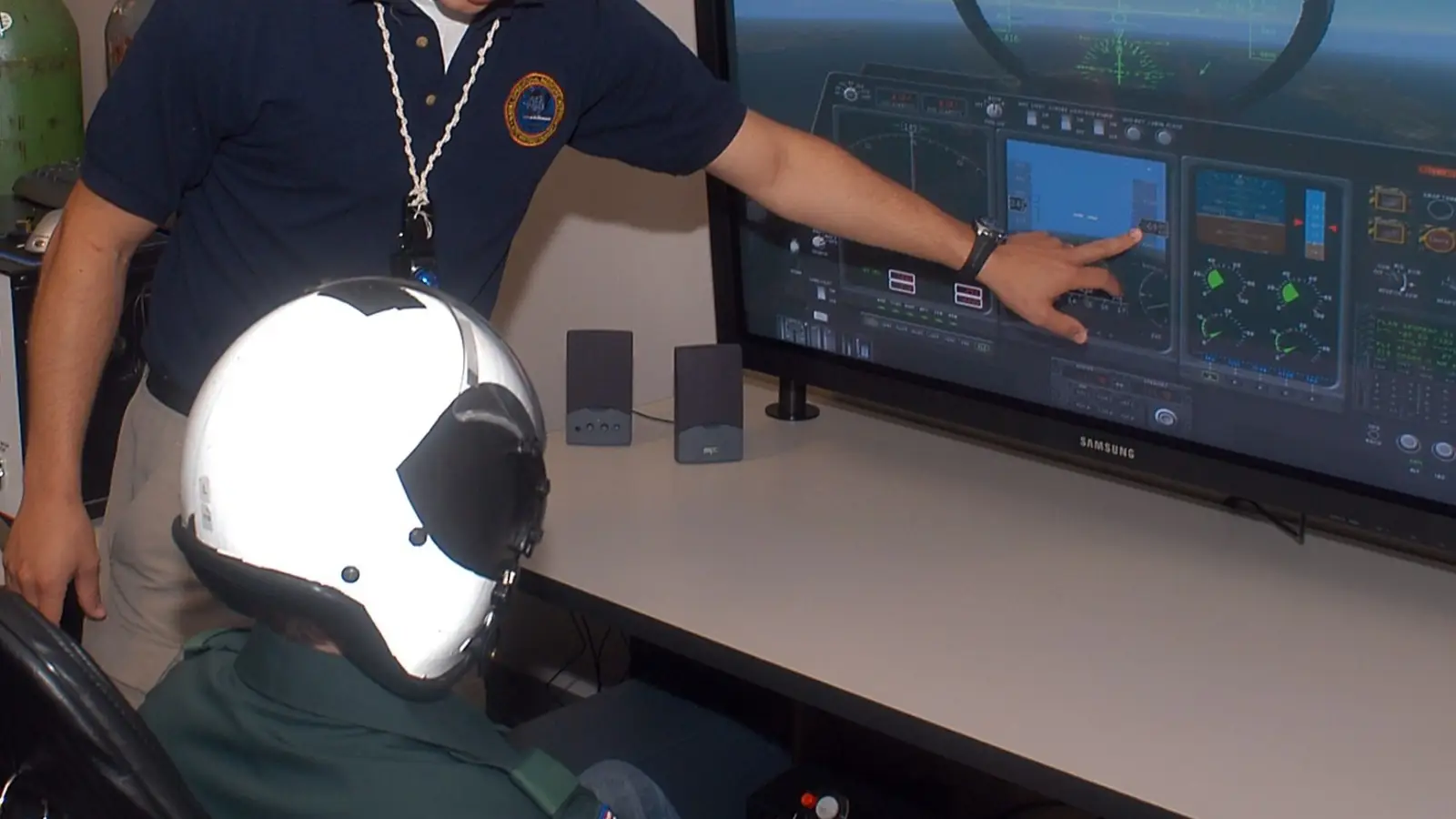
The Royal Dutch Air Force is testing VR pilot training that uses EEG brainwave data and machine learning to automatically adjust the difficulty level, but performance results are mixed.
The Royal Dutch Air Force is experimenting with a new pilot training system that analyzes pilots’ brain activity and automatically adjusts the difficulty of their missions. Training takes place not in the sky, but in virtual reality, the cockpit of a simulator designed to closely replicate a real aircraft.
During VR flights, pilots wear an electroencephalograph (EEG), a device that records brain waves. The data is processed in real time by machine learning algorithms. Its purpose is to determine how difficult the current task is for the pilot. If the system detects that the pilot is taking the exercise too easily, the next task becomes more difficult. If the workload is too high, reduce the difficulty level.
The difficulty level of the simulator changes depending on the flight conditions. For example, visibility deteriorates, fog appears, reference points disappear, and the horizon becomes distorted. These factors create additional challenges and test spatial awareness skills, which are especially important for military pilots.
Pilots from the Royal Dutch Air Force took part in the experiment. They performed the same task in two modes. One was a pre-set difficulty sequence and the other was an adaptive system that adjusted to the conditions. Participants then rated their workload, comfort with training, and their own performance.
The study found that automatic difficulty adjustment did not produce significant improvements in flight skills compared to traditional approaches. However, pilots generally preferred the adaptive system. They said they felt this training format was more logical and more personalized.
The project’s creators point out that using simulators and virtual reality can train pilots cheaper and safer than actual flight. However, effectiveness depends on being able to choose workload levels accurately. Using brain activity data could be one way to make training more flexible, but the technology is still experimental and requires further research.


