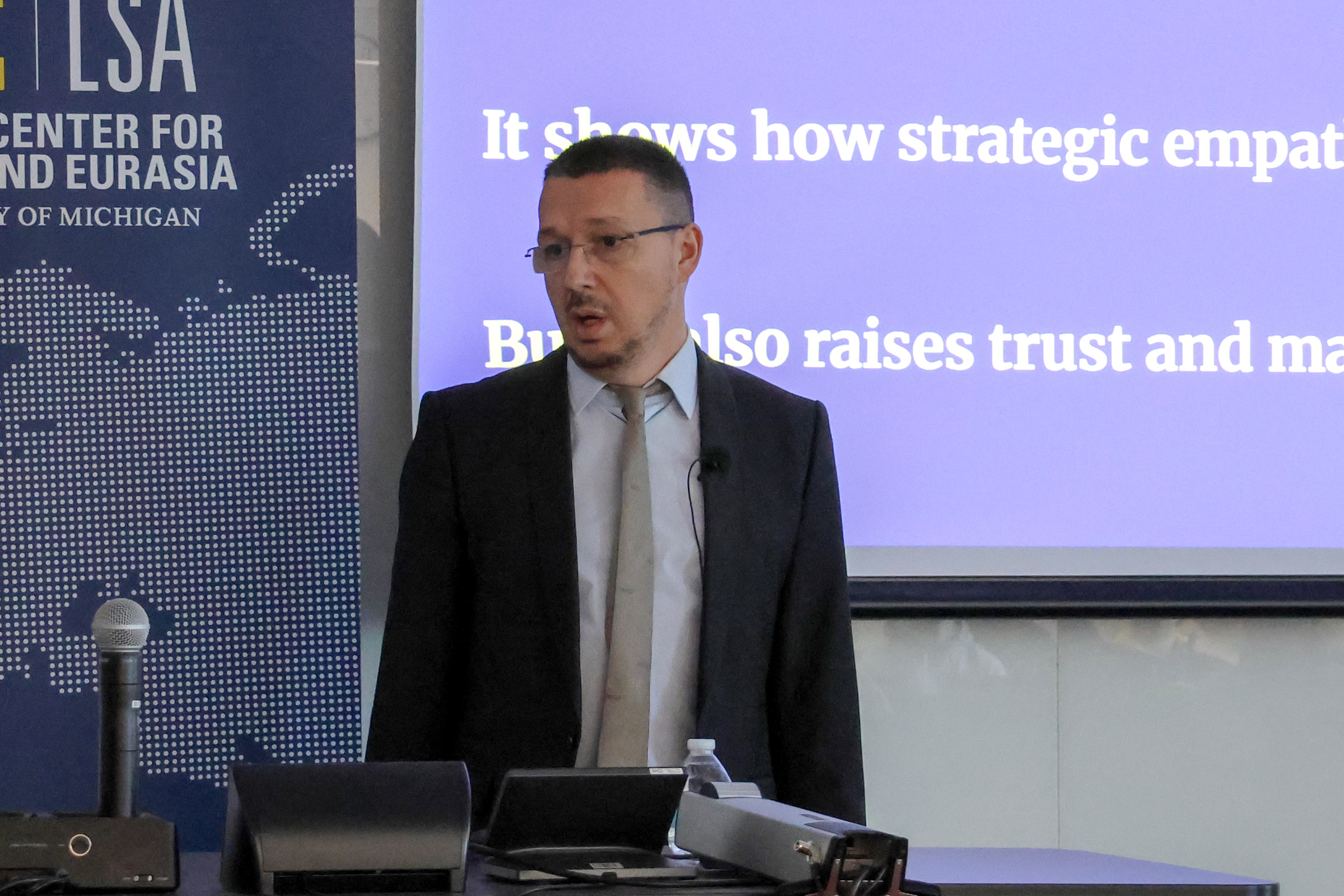
The Europe-Eurasia Wiser Center hosted Doriat Elshani, professor of information and communications technology at American University in Kosovo, on Monday afternoon to discuss the intersection of artificial intelligence and government services. This event, “AI for National and International Security: An Opportunity to Never Lose Control,” is part of a lecture series hosted by WCEE.
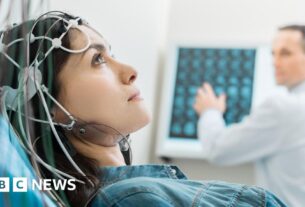
Elshani opened his talk by saying that AI can be used as a tool to support decision-making, and introduced a BBC video about the potential dangers posed by AI. He discussed AI 2027, a release from the nonprofit AI Futures Project that attempts to predict the growth of AI over the next decade, predicting its impact will exceed that of the Industrial Revolution. It also envisions potential future scenarios in which AI becomes too powerful to be regulated.
In an interview with The Michigan Daily, LSA senior Leah Hajredini said the event and video made her focus on the future impact AI could have.
“The future scenario where AI takes over. I don’t use AI a lot, so I feel like I’ve never really thought about it, but now I know it’s clearly a big issue,” Khairedini said. “But when you hear how it could take over if we don’t manage it, I think it’s a little scary to think about.”
Elshani said AI is not inherently good or bad for society, as it is often used in the security field and reflects human choices.
“Security today includes the digital, social and information realms,” said Elshani. “Think in terms of cyberattacks, disinformation, and data warfare. All of these things are transnational and therefore require international cooperation. So think of AI as both a shield and a sword. AI can predict crises and prevent conflict. It can also deepen divisions and automate violence.”
Elshani then discussed two AI tools that can support government decision-making and predict potential outcomes: Cicero and NorthStar. Cicero learns how humans negotiate, forge alliances, and compromise, and understands diplomatic strategies and persuasion techniques. Northstar, on the other hand, profiles world leaders, analyzes them, and predicts the impact of specific government decisions. Elshani said both parties can provide real-time information and thus form a toolkit to gain a competitive advantage in handling issues and international issues.
“Whereas Cicero is conversation-based, Northstar is database-based,” Elshani said. “Together they are forming a toolkit for peace activists, and those who have this toolkit can use it for competitive advantage. … This helps leaders visualize outcomes before they act, because very often those leaders … don’t have the information or the latest information. And these systems can provide real-time information.”
In an interview with the Daily, LSA sophomore Anna Vega said the lecture helped her understand the complexities of AI and its potential applications.
“I think the concept of using AI in diplomacy is something we have never thought of before, especially because AI can be used for ‘what if’ scenarios and answer questions like that,” Vega said. “Especially since I’m not researching a field where AI is the main topic, it would be helpful if you could give me some general definitions.”
Khairedini said he was happy to hear Elshani’s hope and optimism about the future use of AI.
“I like his confidence. Just as he said he was positive or optimistic about the future, he said we can manage it,” Khairedini said. “If we work together and work together internationally as well, we can come up with ways to manage it and use it in a good way… It helps us look at[AI]in a more positive light.”
At the end of his talk, Elshani said that diverse input and prioritization of human values are essential for the evolution of AI.
“Ethical innovation comes from diverse voices, and inclusivity protects against algorithmic injustice,” Elshani said. “Human values should be our guide. Technology must serve humanity, not replace it. Fundamentally, this means that the future of AI is the future of our choices, the future of human choices.”
Daily Staff Reporter Audrey Shabelski can be reached at: audres@umich.edu.