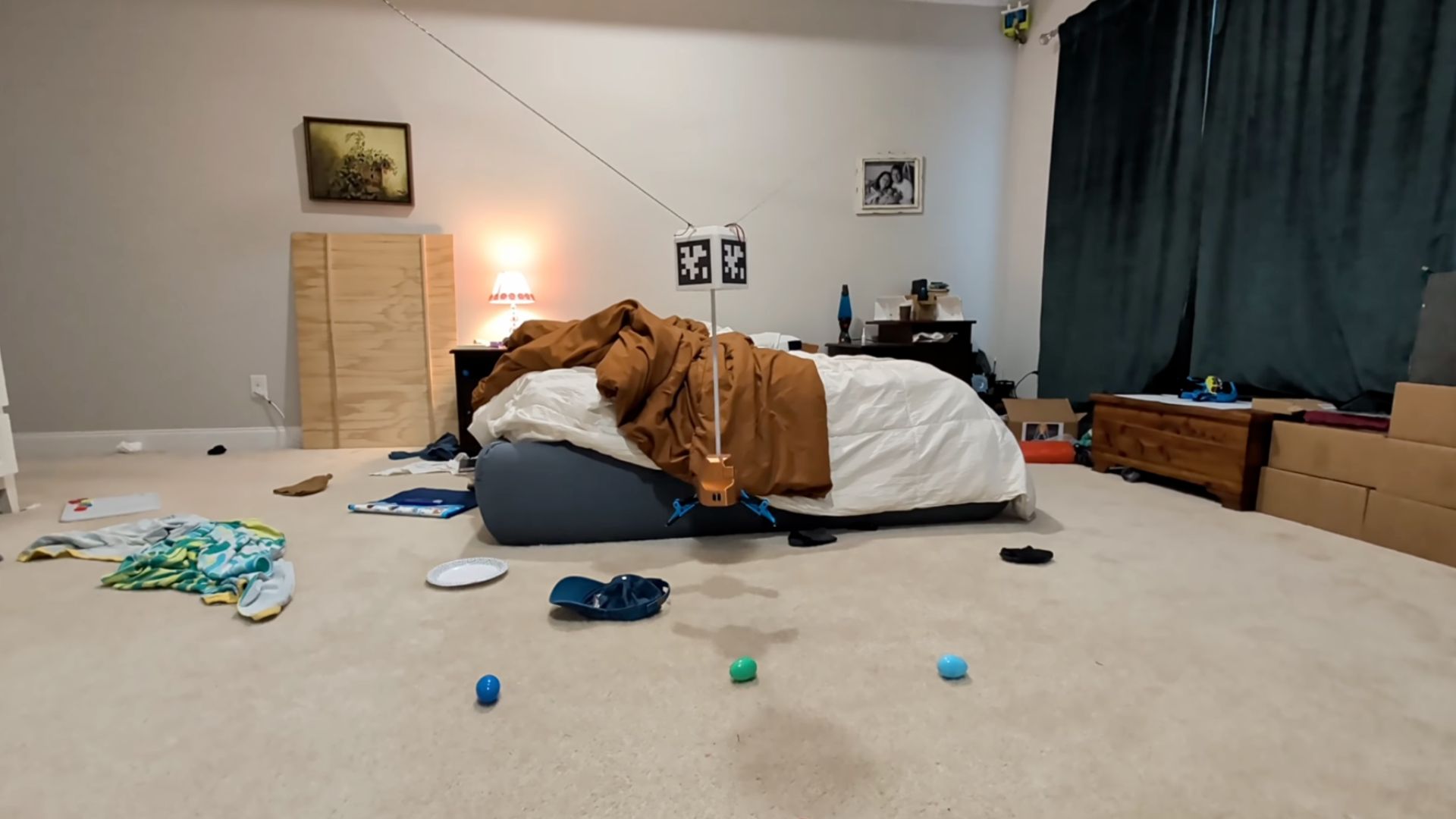
An engineer has developed an open-source ceiling-mounted robotic claw designed to tackle one of family life’s constant challenges: cleaning up clutter.
The system, called Stringman, uses cables suspended from the four corners of a room to move a robotic gripper across the ceiling to locate and collect items such as toys, clothing, and other household clutter.
Equipped with LeRobot-based firmware, the robot can identify objects, pick them up, and transport them to designated drop-off points.
According to the developer, the project’s software, hardware design, and construction instructions are available on GitHub. At the same time, ready-to-use kits are also available for users who do not want to build the system themselves.
Stringman tackles chaos
DIY cleaning robots are designed to tackle one of the most common household challenges: messes left behind by kids and pets.
Stringman is a cable-driven robotic crane that moves around a room using high-strength lines suspended from anchors attached to the four corners. Rather than relying on humanoid designs or mobile robots, Stringman uses lightweight grippers that move through indoor airspace to identify and collect objects on the floor before transporting them to a designated drop-off location.
The project was founded by Nathaniel Nifong, who believes many household tasks can be automated without the complexity and cost associated with humanoid robots. According to the project website, reducing the number of actuators significantly reduces the overall cost of robot hardware. Stringman relies solely on a two-finger gripper with four motors and a wrist mechanism, allowing it to perform basic pick-and-place tasks while remaining relatively affordable.
The robot is built on the open source LeRobot platform and uses imitation learning to improve its grasping abilities. Users can train the system through remote control and teach it how to pick up different objects around the home. The software, firmware, mechanical design, and construction instructions are published under the Apache 2.0 license, allowing hobbyists to build, modify, and contribute to the project.
To organize items, users simply use clip-on fiducial markers to designate destinations such as laundry baskets, toy boxes, trash cans, and more. Stringman’s vision system maps these locations and generates a list of objects it thinks need to be collected. Users can review and change these selections through the interface, or manually click on the objects they want the robot to remove.
open source robot
One of the biggest advantages of this system is its reach. Unlike a robotic arm, which is limited to a limited working space, a stringman can access a large portion of the entire room. Cable-driven architecture allows movement from floor-level pickups to high shelves without the need for rails, wheels, or articulated limbs. Powered directly from the wall outlet, it also avoids the charging downtime that limits many mobile robots.
This design incorporates an active swing cancellation algorithm to ensure stability as the gripper moves. This is especially important because the gripper hangs about 50 centimeters below the hanging point, allowing it to reach under furniture and next to obstacles. According to the company’s website, the software continuously compensates for momentum and helps maintain precise positioning while moving.
Privacy is also a focus of the project. Stringman supports a fully local mode of operation where video processing and telemetry remain within your home network. Users who prefer remote access can connect the robot to their online account and monitor or control the robot through a web-based interface.
Despite its promise, the system is still in development. Machine vision models still need improvement, and certain objects, especially flat items such as books, can be difficult for grippers to handle reliably. During robot operation, suspended cables also descend into the room, creating practical limitations on the space occupied.
Despite these challenges, Stringman offers an interesting alternative to humanoid domestic robots. By focusing on single household tasks and simplifying the hardware, this project shows how practical home automation can come from a specialized, low-cost design rather than an anthropomorphic machine. Future developments could allow robots to not only collect garbage into trash cans, but also return items directly to their appropriate storage locations.