Pegasystems, a leader in the workflow automation and CRM technology space, says it is focused on AI that provides real-world results and predictable outcomes—including in the new products that debuted at last week’s PegaWorld event. And the company is vowing no “AI token tax” on customers.

Software giant Pegasystems is all onboard with the artificial intelligence wave, including unveiling a slew of new AI-infused products and capabilities at the company’s recent PegaWorld event—all designed to provide streamlined workflow capabilities that deliver predictable outcomes.
But Pegasystems executives are making it clear that the company’s goals are to leverage AI for real-world business processes, avoiding AI hype and instead promising AI capabilities with accountability, governance and financial sustainability.
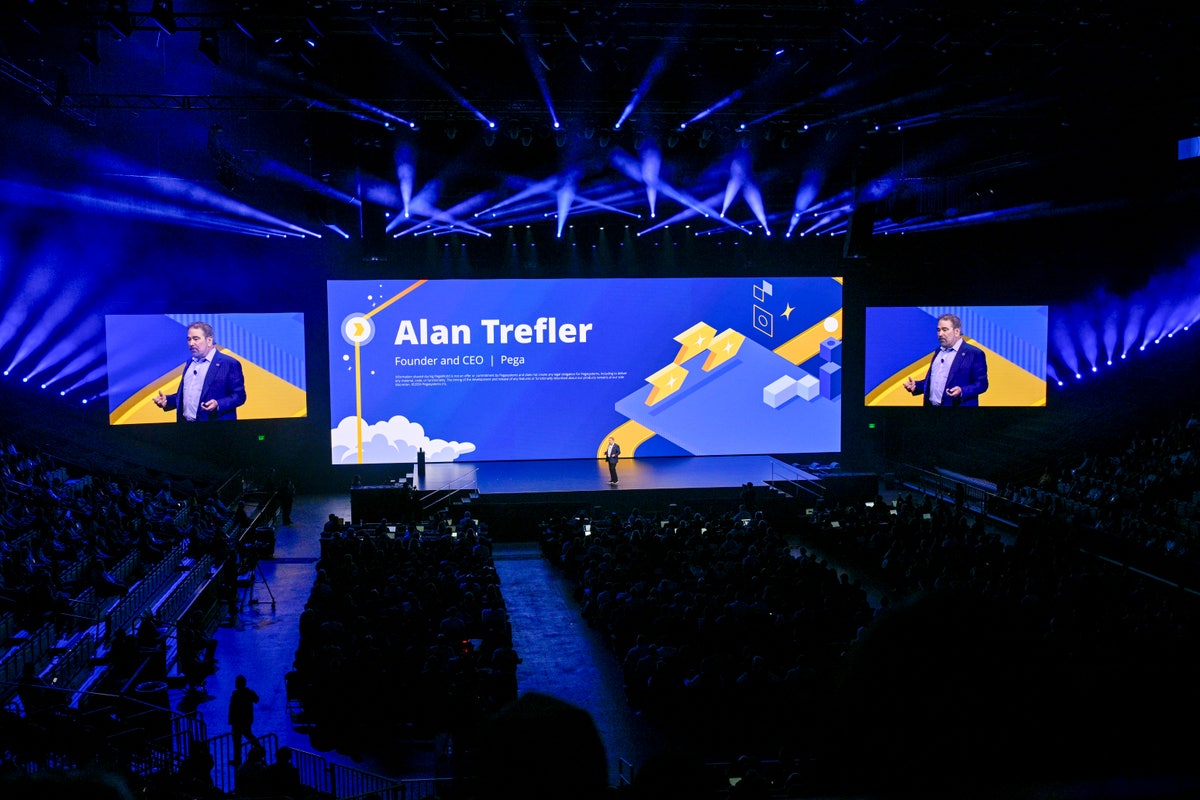
“What Pega believes firmly is that if you use Pega to re-imagine your AI, you will be able to achieve predictable outcomes. That is, the AI will give you the answers you want to give your customers on a consistent basis, and you’ll be able to do it with predictable costs. Being able to do that, we think, is absolutely critical,” CEO Alan Trefler (pictured) said in an opening keynote at PegaWorld, held in Las Vegas last week.
[Related: Pega’s AI Innovation And AWS Partnership Roar As Total Contract Value Hits $1.56B]
“I will tell you, this is an enormously fraught, enormously confusing, and enormously important time,” Trefler said in his keynote, speaking of the rapid pace of change AI has brought across the IT industry. He said a goal of Pegasystems is to “completely change” how customers and partners think about the IT world today and “how you choose to apply and evaluate AI in your organizations.”
“I think there is increasing concern in the marketplace about the amount of money that’s being spent on AI and the actual value that it’s returning,” said Don Schuerman, Pegasystems CTO and head of marketing, during a press pre-briefing prior to PegaWorld.
“And I think that people are realizing that if you’re not careful, you can send agents off to burn a lot of [AI] tokens without making a meaningful difference in the efficiency of your business or in the experiences that you deliver to the customers. That’s what we’re hearing from our customers [and] that’s what we’re seeing in the broader market,” Schuerman said.
A study that Pegasystems conducted with research firm Savanta concluded that agentic AI success only comes about by reimaging existing business processes and forcing a cultural reset to maximize project benefits and achieve consistent, predictable outcomes—the overall theme of the PegaWorld event.
“The value happens when you move past bolting on or, even worse, what I would call spray washing your business with agents, throwing 1000s and 1000s of AI agents out there, but actually get into the work of reimagining the way you get work done, rethinking and redesigning your mission-critical processes to use them in the AI world,” Schuerman said. “And doing that in a way that gives you predictability across both the outcomes you deliver, and also predictability in terms of what your spending looks like and how you use AI in the most efficient way possible.”
Increased Channel Focus
All this comes as Pegasystems, once a predominantly direct sales organization, continues its expansion in the channel and today works with some 400 partners including global, regional and boutique systems integrators and solution providers.
Pegasystems works more directly with its 1,000 biggest enterprise accounts, often with the involvement of one or more global systems integrator or IT service provider.
But the company has taken steps in recent years to help partners close more deals on their own, including last year’s launch of Powered by Pega Blueprint (sometimes called Partner Pega Blueprint) that partners use to add their own intellectual property and industry expertise to solution designs developed using Pega Blueprint. That helps partners differentiate themselves and sell more effectively, noted John Higgins, Pegasystems chief of client and partner success, in an interview with CRN.
“There is a lot of other enterprise prospects that we don’t have sales teams on, and our autonomous partner sales initiative is [built] around how we equip our partners when they identify an opportunity for Pega, how they can source it, design it, deploy it, and prime it,” Higgins said. “So we are effectively creating an indirect business through our GSIs to go after the organizations that aren’t direct customers for us today.”
At the PegaWorld event Pegasystems showed off partner-branded blueprints with partners’ own intellectual property and knowledge bases, letting partners present AI-driven workflow designs to their clients under the partners’ own logos.
IT services giant Cognizant, a major Pegasystems partner, is working with the software company to help bridge the gap between AI capability and the “production value” of most AI implementations, said Cognizant CEO Ravi Kumar, during a panel discussion in a keynote session during the second day of PegaWorld.
“Why is there a gap between the capability and the production value? That is because we don’t use this technology to reinvent businesses, reimagine businesses. You can’t apply this on old processes and assume there is going to be magic coming out of it,” Kumar said. “If you’re taking this technology and putting it into old processes, you’re really not going to get the productivity you’re looking for. You’re really not going to get the throughput you’re looking for.”
Kumar said Pegasystems’ approach with the company’s Blueprint AI software, which moves the use of AI to system design rather than late-stage runtime, is an example of how businesses need to rethink how they use AI.
Here’s a look at the major announcements and the key takeaways from the PegaWorld event.
Eliminating The ‘AI Token Tax’
Pegasystems announced that clients can now design, build and run agentic workflows across Pega Infinity 26 without any per-token charges.
The move comes as an increasing number of IT vendors are charging fees based on surging AI token usage. With the explosion of generative AI applications and autonomous AI agents, more vendors are adopting consumption-based token billing as the economic model for software-as-a-service applications, features, development tools and even cloud infrastructure.
In the PegaWorld opening keynote session, famously outspoken CEO Trefler noted the sudden trend toward IT companies charging for AI tokens.
“This idea that these things will cost something should not surprise any of us, because we’ve been reading about the trillion dollars-worth of data centers that are getting built. I mean, somebody’s got to pay for these,” Trefler said.
In May, Pegasystems unveiled Pega Predictable AI Agents, technology that the company says provides organizations with control and visibility as they design and deploy AI-optimized business processes. The company at the time touted the technology as providing consistent, predictable outcomes for workflow automation.
At PegaWorld, executives said the Pega Predictable AI architecture shifts heavy AI reasoning to the workflow design tasks carried out by the company’s Pega Blueprint AI and the new Pega Infinity Studio. Once workflows are designed and deployed, Pegasystems shifts to a lighter weight semantic AI mode that makes runtime agents “fast, reliable and dramatically cheaper to run,” the company said in the event announcement.
Pegasystems said its outcomes-based approach charges customers per completed case—a task executed from start to finish—rather than per seat or per AI token. Starting in the third quarter of this year, Pega Infinity 26 clients will pay a single, flat price per completed case, regardless of how much Pega AI is used behind the scenes, according to the company announcement.
Pega Infinity Studio
Pegasystems describes its new Pega Infinity Studio as an intuitive, AI-powered development environment for quickly building mission-critical applications without AI coding risks or extended learning curves.
AI coding tools have accelerated application development—code generation, specifically. But producing a reliable enterprise application also requires that processes and workflows be designed for, and aligned with, stakeholder teams, according to Pegasystems. And applications must be secure and validated to run at scale.
Pega Infinity Studio includes AI coding agents and incorporates the design capabilities, simplicity, industry standards, and architectural best practices of Pega Blueprint AI, the company’s cloud-based workflow design agent for solution designers that uses generative AI to accelerate the design and prototyping of agentic workflow applications.
The produced blueprint designs automatically generate a Pega Infinity Studio implementation plan that guides developers to quickly deploy production-ready applications, according to the company, and streamlines complex integrations.
The new software’s embedded AI assistant guides developers using Pega AI or another coding agent, including GitHub Copilot, Anthropic Claude AI, and OpenAI Codex, according to the company.
Pega Infinity Studio will be available with the launch of the full Pega Infinity 26 suite, which is expected in the third quarter.
At PegaWorld Pegasystems also announced added support for the Model Context Protocol (MCP) standard in a move the company said would enable enterprises to use custom-built AI agents to drive essential business processes without sacrificing governance, compliance, or cost controls.
With the extended MCP support, Pega processes and workflows can be discovered and executed by authorized third-party agents, including those built on Anthropic Claude, Google Gemini, OpenAI, AWS AgentCore and others.
Customer Engagement Studio
Pegasystems launched Customer Engagement Studio, a new AI agentic-based marketing operations workspace for the company’s Pega Customer Decision Hub, the company’s real-time decision engine for customer engagement activities and customer data analysis.
Customer Engagement Studio combines Pega agents and third-party agents across marketing strategy, creative execution, data science, performance and compliance in a single workspace the company said helps marketers rapidly generate marketing content, identify performance gaps, and refine strategies in real time.
The underlying Customer Decision Hub continuously analyzes customer signals and helps determine the next best steps in a marketing initiative. Pegasystems said the new Customer Engagement Studio, with its unified agents and intuitive user interface, provides the capabilities that Customer Decision Hub needs to best orchestrate agents and workflows.
Pega Customer Engagement Studio will be available later this year with the release of Pega Infinity 26 and will come standard with Customer Decision Hub on Pega Cloud.
Solution Designer Initiative
Pegasystems launched the Pega Solution Designer Initiative, an effort the company described as “establishing a new generation of solution designers” to overcome a major barrier to AI success—the gap between business intent and production-ready execution.
The new skills-based program will equip solution designers of any skill level with free credential-based training, hands-on workshops, and a global community for support.
Solution designers today manage the early stages of software design, including discovery, requirements definition and capturing business intent, that are ultimately used to develop a blueprint of a planned application.
But Pegasystems said it has identified a gap between business ideas and technical execution because design thinking, cross-functional fluency and production readiness are split across disconnected roles, teams and tools, according to the company.
Closing that gap requires skilled practitioners who can better align stakeholders, guide requirements discovery, translate ambitious goals into actual outcomes, and turn AI-generated ideas into blueprints that developers use.
The Pega Solution Designer Initiative builds on Pega Blueprint AI and expands on Blueprint Delivered, the company’s application delivery methodology that also uses generative AI, for quickly converting business design concepts into production-ready software.
Through the initiative, Pegasystems is offering free, progressive credentials through Pega Academy to train and validate proficiency in Pega Blueprint AI, its methodology, and the capabilities needed to guide AI-driven transformation. Pegasystems said the credentials replace more role-based certifications.
The company is also offering a series of in-person workshops around Blueprint Delivery that go beyond technical training to build core capabilities from facilitation and stakeholder alignment to outcome-driven execution. And the new Pega Blueprint AI and App Design Expert Circle community will provide a network of practitioners to share knowledge, patterns and expertise through peer conversations, blogs, videos and webinars.
Pegasystems And AWS Alliance
Pegasystems and Amazon Web Services announced an expanded alliance through which the Pega Blueprint AI application design agent has been integrated into AWS Transform in a move the two IT companies say will help businesses and organizations modernize legacy mainframe applications more quickly and with less friction.