Reinforcement learning (RL) is based on the premise that an agent learns to make decisions by interacting with its environment. RL has shown remarkable success in a variety of applications, including games, robotics, and autonomous systems. The goal is to develop algorithms that allow agents to perform tasks efficiently by maximizing cumulative rewards through trial-and-error interactions. These algorithms help improve their performance over time by continually adapting to new data, making RL an essential part of developing intelligent systems.
A major challenge in RL is sample inefficiency, meaning that the agent must interact extensively with the environment to learn an effective policy. This limitation makes it difficult to practically apply RL in real-world scenarios, especially in environments where obtaining samples is costly or time-consuming. Addressing this issue is essential for deploying RL in real-world applications such as autonomous driving and robotics automation, where real-world testing can be costly and time-consuming.
Existing work includes world models such as SimPLe and Dreamer that train RL agents in simulated environments. SimPLe applies a world model with an emphasis on sample efficiency to Atari, while Dreamer introduces learning from latent spaces. DreamerV2 and DreamerV3 improve on this further with discrete latent variables and fixed hyperparameters. Other models such as TWM and STORM adapt Dreamer's architecture using transformers. IRIS uses discrete autoencoders and autoregressive transformers to model environmental dynamics over time.

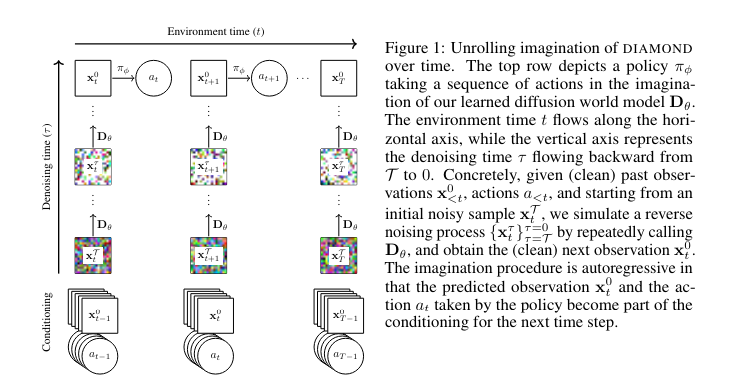
Researchers from the University of Geneva, University of Edinburgh, and Microsoft Research have presented DIAMOND (DIffusion As a Model Of eNvironment Dreams), a new RL agent trained using a diffusion-based world model. DIAMOND leverages the strengths of diffusion models, which are prominent in high-resolution image generation. By integrating these models into world modeling, DIAMOND aims to preserve visual details that are often lost in traditional methods, improving the fidelity of the simulated environment and the overall training process.
The DIAMOND methodology trains agents on a diffusion-based world model that better preserves the visual details of the environment compared to traditional discrete latent variable models. The diffusion process reverses the noise-handling procedure to create a detailed and accurate environmental simulation that benefits agent training and performance. This approach requires careful design choices to ensure that the diffusion model remains stable and computationally efficient over time. The research team made several key design choices to optimize the diffusion process of world modeling, including enhanced visual representation techniques and an adaptive noise schedule.

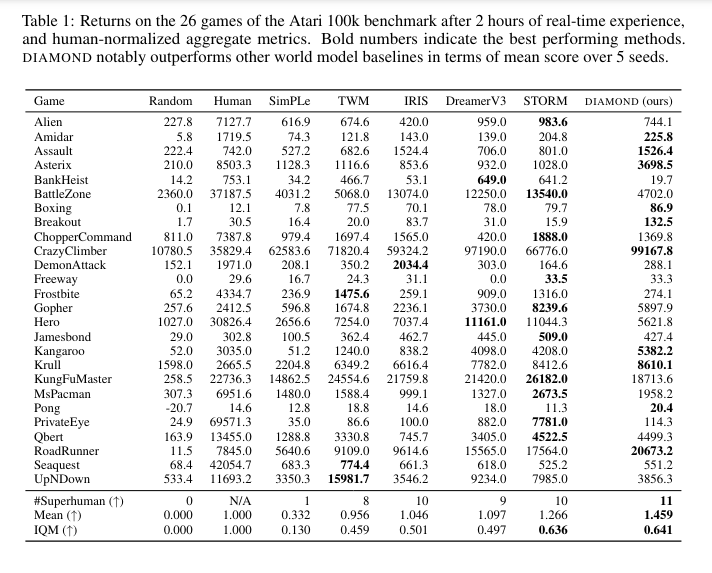
DIAMOND's performance was evaluated on the Atari 100k benchmark, where it achieved an average human normalized score of 1.46, setting a new benchmark for agents trained entirely within world models. The benchmark includes 26 games, each testing different aspects of the agent's capabilities. DIAMOND's performance significantly outperforms other world model-based agents. For example, it achieves scores of 4031.2 on Breakout and 12250 on UpNDown, highlighting its superior ability to learn and adapt in complex environments. This performance improvement is due to the increased visual detail and stability that the diffusion model provides, which improves the efficiency of decision-making and learning. The researchers demonstrated that DIAMOND not only performs well in scores, but also shows consistency in its decision-making process across different games.
In conclusion, DIAMOND represents a major advancement in RL by addressing the challenge of sample inefficiency through improved world modeling. The researchers' diffusion modeling approach increases visual detail and stability, resulting in superior performance in training RL agents. This innovative method has the potential to revolutionize how RL agents are trained, making them more efficient and able to operate in complex real-world environments. Integrating diffusion models into world modeling is a step toward developing more robust and effective RL systems, paving the way for wider applications and improved AI performance.
Please check Papers and GitHub. All credit for this research goes to the researchers of this project. Also, don't forget to follow us. twitter. participate Telegram Channel, Discord Channeland LinkedIn GroupsUp.
If you like our work, you will love our Newsletter..
Please join us 42,000+ ML subreddits


Nikhil is an Intern Consultant at Marktechpost. He is pursuing a dual degree in Integrated Materials from Indian Institute of Technology Kharagpur. Nikhil is an avid advocate of AI/ML and is constantly exploring its applications in areas such as biomaterials and biomedicine. With his extensive experience in materials science, Nikhil enjoys exploring new advancements and creating opportunities to contribute.