
Data centers require large amounts of electricity. Transmission networks need cables, while solar and wind projects and electric vehicles depend on extensive electrical infrastructure and components.
Copper is central to that transformation because of its strong electrical and thermal conductivity, making it essential to electrification and many emerging technologies.
The International Energy Agency (IEA) identifies copper as one of the key minerals. Under its Stated Policies Scenario, total copper demand is projected to rise from about 25.9 million metric tons in 2023 to 31.1 million tons in 2030 and 36.4 million tons in 2040. Demand from clean energy technologies alone is projected to increase from 6.3 million tons in 2023 to 12 million tons in 2030.
This means the race for copper is no longer simply a matter of mining commodities. The metal is becoming part of the race to build the digital economy and the energy infrastructure of the future.
For Indonesia, that opportunity comes with a paradox. The country has substantial copper resources but has yet to become a major player in either mine production or downstream copper industries.
Data from the Investment and Downstreaming Ministry/Investment Coordinating Board (BKPM) show that Indonesia ranks among the seven countries with the world’s largest copper reserves, accounting for about 3 percent of global reserves. However, Indonesia ranks 11th in mine production and 18th in downstream copper industries.
That gap gives copper downstreaming strategic importance.
Pri Agung Rakhmanto, founder and adviser at the ReforMiner Institute, said at least three sectors would become major drivers of copper demand: infrastructure and electricity, including cables and transformers; new and renewable energy, such as solar and wind power plants; and the automotive industry, particularly electric vehicles (EVs).
All three share one characteristic: they require electrification on a large scale.
The IEA estimates that annual copper requirements for electricity grids under a sustainable development scenario could approach 10 million tons by 2040, compared with around 5 million tons in 2020.
At the same time, data centers built to support AI computing are adding pressure on electricity infrastructure. The AI story, therefore, is not only about software but also about the physical requirements for energy, grids and minerals.
For countries with copper reserves, this presents both an opportunity and a challenge.
Pri Agung said the government needs to build an industrial ecosystem capable of absorbing domestically processed copper.
“That will eventually absorb copper and processed copper (cathode) production from copper smelters operating in Indonesia,” Pri Agung said.
If domestic copper-consuming industries remain underdeveloped, he said, increased production would largely be directed toward exports.
Building smelters, therefore, increases value added but does not solve the entire downstreaming challenge. Indonesia also needs cable manufacturers, electrical component producers, energy equipment makers, EV manufacturers and other industries that use copper as a raw material.
A country cannot rely solely on mines and smelters. The challenge is to keep copper circulating longer within the domestic economy.
From Batu Hijau to Cathode, From Data to Efficiency
AMMAN stands at the intersection of rising copper demand and Indonesia’s downstreaming agenda.
The company operates the Batu Hijau mine, one of the country’s strategically important mineral assets. A new mining phase, expanded processing operations and the operation of its smelter have created a value chain stretching from the upstream mine to processed products downstream.
Rachmat Makkasau, president director of Amman Mineral Nusa Tenggara, expects AMMAN’s copper cathode production to reach 162,662 tons in 2026. The figure is projected to nearly double to 310,256 tons in 2027.
Gold production is projected to increase from about 16.1 tons to 28.67 tons, while silver production is expected to rise from 45.4 tons to 82.4 tons.
“Production will increase over the next three years because we will begin processing more ore,” Rachmat said at a hearing with Commission XII of the House of Representatives (DPR RI) recently.
The targets follow the completion of the capacity ramp-up at AMMAN’s smelter. Cathode production stood at around 79,848 tons in 2025 before being targeted to increase to 162,662 tons in 2026. The smelter has a processing capacity of about 900,000 tons of copper concentrate per year.
At the mine, AMMAN is targeting about 900,000 dry metric tons (dmt) of Batu Hijau concentrate production in 2026, containing about 485 million pounds, or around 220,000 tons, of copper and approximately 579,000 ounces of gold.
But higher production does not automatically translate into greater efficiency. Large-scale open-pit mining involves thousands of variables every day, ranging from ore characteristics and mineral grades to equipment conditions, weather, material flows, reagent consumption, water and energy use, and downtime.
This is where technology comes in—not simply to replace people but to help workers make decisions based on volumes of data that would be difficult to process manually.
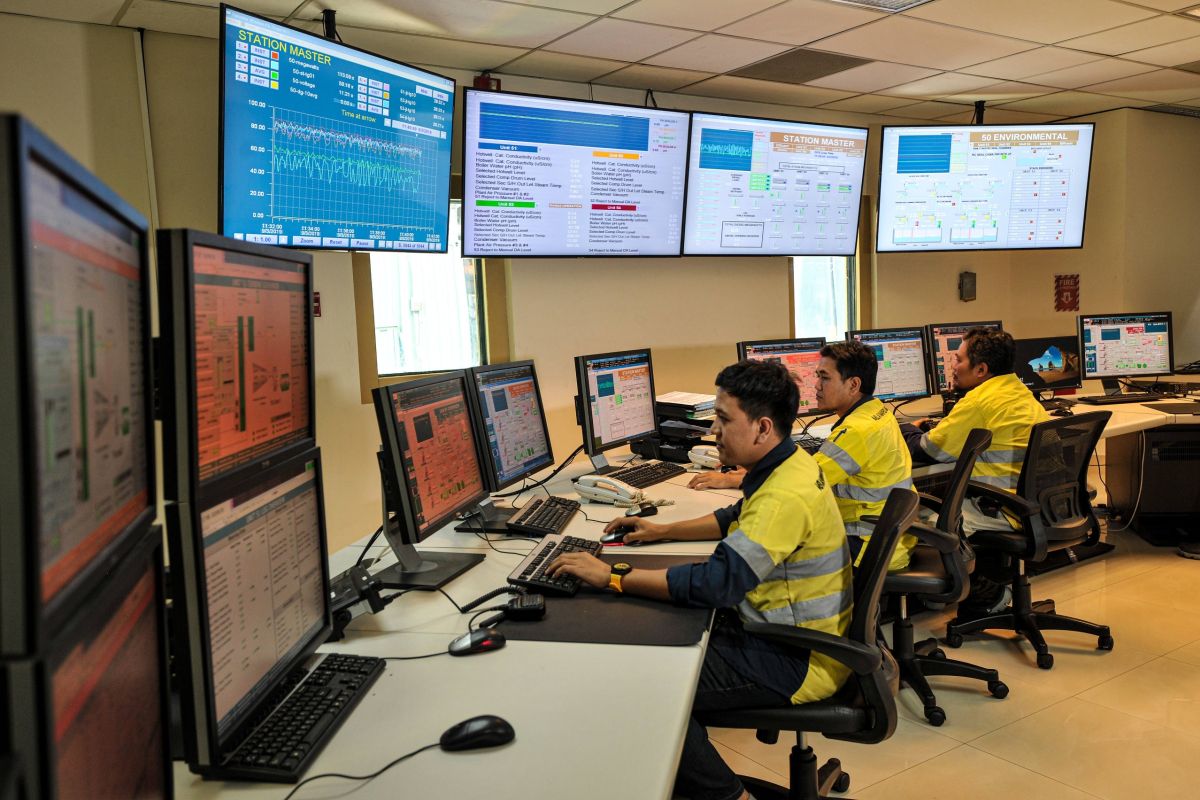
At the Batu Hijau processing plant, AMMAN has developed the Artificial Intelligence Dashboard Automation (AIDA). The system uses historical and real-time operational data to analyze mineral-processing conditions and recommend operating parameters, including reagent dosage and water flow rates.
According to Vice President of Corporate Communications at AMMAN Kartika Octaviana, the transformation is part of a broader change.
“AMMAN’s digital transformation encompasses two main layers,” Kartika said.
The first is the digitalization of business processes through a cloud-based ecosystem integrating finance, procurement, human resources, data management and analytics. The second operates in the field, covering mineral processing, fleet management, equipment maintenance and supporting facilities.
AMMAN began building the foundation for its digital transformation gradually in 2020.
Under AIDA, algorithms do not take over decision-making entirely. System recommendations are reviewed by operations and metallurgy teams every four hours before operating parameters are adjusted. AI identifies patterns in large volumes of data, but decisions still require human context and experience.
AMMAN has reported that the combination of process improvements and AI-based optimization helped increase mineral recovery by about 2.5 percent.
The company also received the 2025 ASEAN Mineral Awards for mineral-processing practices. In that assessment, AMMAN said various AI-based innovations, equipment modifications and process optimization helped increase recovery by 5.6 percent compared with the company’s historical average.
The two figures have different contexts. The 2.5-percent figure refers to the impact of the combination of AI-based optimization in recent developments, while the 5.6-percent figure represents an improvement over the historical average in the context of the ASEAN assessment.
At a mine where recovery rates are already high, an increase of several percentage points can generate new economic value because more minerals are recovered from material that has already been mined, leaving less valuable mineral behind in tailings.
The transformation also includes predictive maintenance to detect early signs of equipment failures. Fleet dashboards are used for predictive analytics, while 3D laser scanning helps detect oversize material or foreign objects before they enter the primary crusher.
According to technical data provided by the company in its transformation materials, the system was associated with an approximately 90-percent reduction in total downtime caused by foreign objects and oversize material based on 2024-2025 data, Kartika said.
The company also uses wireless detonators with encrypted trigger signals to support blasting safety. On the operational side, the company has developed AI-based models to optimize ore transportation by taking into account road conditions, weather, material density, heavy-equipment performance and tire age.
Beyond the pit and processing plant, digitalization has been implemented through several SAP systems, including SAP S/4HANA, SAP Integration Suite, SAP Datasphere, SAP Analytics Cloud, SAP SuccessFactors, SAP Business Network and SAP Ariba.
Procurement digitalization reached 100 percent for goods procurement through SAP Business Network within nine months of implementation. The system processes more than 1,500 purchase orders per week and saved more than 214,000 sheets of paper within six months.
The transformation shows that mine digitalization is not limited to automated heavy equipment. It also concerns how companies purchase spare parts, manage workers, record transactions, monitor assets and use data.
Mining 4.0 and the Question of Value Retained in Indonesia
For Chairman of The Indonesian Mining Institute (IMI) Prof. Dr. Ir. Irwandy Arif, M.Sc., digitalization is no longer simply a technology choice. The shift toward Mining 4.0 has become part of the need to improve the competitiveness of Indonesia’s mining industry.
Data from the Investment and Downstreaming Ministry/Investment Coordinating Board (BKPM) show that Indonesia has world-class mineral and coal reserves with potential investment value estimated at US$498.4 billion. Indonesia is also a major producer of nickel, tin, cobalt, bauxite, copper and coal.
But resource wealth does not automatically translate into industrial competitiveness.
Irwandy said AI could be used for applications ranging from geological data analysis to predict the location of deposits to heavy-equipment automation to improve workplace safety. Autonomous Fleet Management can optimize fleet utilization, while Digital Twin technology can create digital representations of processes or assets to support analysis and decision-making.
AI can also be used for environmental monitoring, including water and air quality.
The challenge is human resources. Digital mining requires workers who understand not only heavy equipment, geology or metallurgy but can also interpret data, understand digital systems and work with analytical technologies. Cybersecurity and high upfront investment costs are additional challenges.
The transformation therefore requires collaboration among the government, companies, academics and technology providers.
“Sustainable mining practices can only be realized through the implementation of Good Mining Practice supported by cutting-edge technological instruments,” Irwandy said.
At AMMAN, digital transformation is progressing alongside production, energy and environmental agendas, Vice President of Corporate Communications at AMMAN Kartika Octaviana said.
The company’s copper smelter can process up to 900,000 tons of concentrate per year from the Batu Hijau and Elang mines using double-flash smelting technology, which is designed to improve energy efficiency, capture sulfur and control emissions.
In the energy sector, AMMAN operates a solar power plant with a peak capacity of 26.8 megawatts. In 2025, the facility generated 36,629 megawatt-hours of renewable electricity and contributed to the avoidance of approximately 34,794 tons of CO2 equivalent emissions.
The company also operates a 450-megawatt liquefied natural gas (LNG)-based gas and steam power plant to support its mining operations and processing facilities.
In reclamation, AMMAN said it had reclaimed 799.53 hectares of land in 2025 and planted about 1.8 million trees from 99 seedling varieties. The company also said water-use efficiency had improved by 40 percent since 2016, Kartika said.
These initiatives show that digitalization is being positioned within a broader operational framework encompassing production, efficiency, safety and the environment.
The changes are taking place as the global copper market faces supply challenges. The IEA estimates that the existing mining project pipeline could face a potential shortfall of about 31 percent against copper mining requirements by 2035 under the Stated Policies Scenario.
New mines take years to develop, while demand from electricity systems, data centers, renewable energy and electric vehicles could grow more rapidly.
This makes every improvement in recovery increasingly significant. For Indonesia, the opportunity is clear: the country has the reserves and production base. But that opportunity will only become a strategic advantage if it can be translated into efficient production, value-added products and a competitive industrial ecosystem.
Pri Agung has urged the government to facilitate investment in copper-consuming sectors so domestic production can be absorbed within the country. Irwandy, meanwhile, views digitalization as part of the broader need to improve the competitiveness of Indonesia’s mining industry.
AMMAN sits between these two agendas. The company is seeking to increase production through Phase 8 of the Batu Hijau mine and optimization of its smelter, while also improving the efficiency of every ton of ore through data, AI, automation and digital systems.
Its production targets illustrate the scale of the change: from 162,662 tons of copper cathode in 2026 to 310,256 tons in 2027.
But production figures are not the end of the story.
The bigger question is how much economic value can remain in Indonesia.
If cathode is simply exported, Indonesia gains value from processing, but much of the value chain remains overseas. If cathode is instead transformed domestically into cables, electrical components, renewable energy equipment, EVs and other manufactured products, the economic impact could multiply.
That is where copper moves beyond being a mining commodity and becomes a foundation for industry.
At Batu Hijau mine, that transformation begins with the ability to understand every ton of ore more effectively.
AI reads the data. Sensors read the machines. Digital systems read the operation. But the final decisions remain in human hands.
For AMMAN, this represents the future of mining: not a mine controlled entirely by machines, but an operation that combines human experience with technological capabilities to make decisions faster, recover more minerals from the same resources, reduce waste and improve safety.
Ultimately, the race for copper in the AI era is not simply about who has the largest reserves.
The real race is about who can turn those reserves into efficient production, technology, value-added industries and longer-lasting economic benefits for Indonesia.
Related news: Amman Mineral joins global copper body as first ASEAN member
Editor: Rahmad Nasution
Copyright © ANTARA 2026


