image:
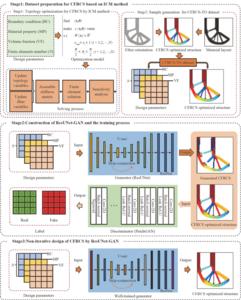
Flowchart of non-iterative CFRCS topology optimization based on deep learning.
view more
Credit: Acta Mechanica Sinica
Although advanced composite materials are prized for their light weight and strength, their design remains time-consuming and difficult, as both material layout and fiber orientation must be simultaneously optimized. In this study, we introduced deep learning techniques that tackle both problems simultaneously, allowing engineers to generate optimized continuous fiber composite structures much more efficiently than before. The method uses a ResUNet-based generative adversarial network to learn from simulated topology optimization data and directly predict high-performance structural layouts. By combining faster design with stronger accuracy and experimental validation, this effort paves a practical path to more agile composite engineering in real-world manufacturing settings.
Continuous fiber-reinforced composites are of wide interest in aerospace, defense, automotive, and infrastructure because their mechanical performance depends not only on where the material is placed but also on the orientation of the fibers. Topology optimization is therefore particularly valuable, but also particularly costly. Continuous fiber angle optimization adds many variables, increases nonlinearity, and increases computational time over repeated iterations, while confining traditional methods to a local optimum. Previous deep learning efforts have mainly focused on simpler single-material layouts, with less consideration given to the combined design of shape and fiber orientation. Because of these challenges, non-iterative optimization of continuous fiber composite structures requires deeper research.
Researchers from Beijing Science and Technology University, along with collaborators from Tsinghua University and Beijing Weixing Manufacturing Factory Co., Ltd., reported this new method in 2013. Acta Mechanica Sinicapublished online on September 4, 2024 (DOI: 10.1007/s10409-024-24207-x). The team built a deep learning framework called ResUNet-involved Generative and Adversarial Network (ResUNet-GAN) to predict both structural topology and continuous fiber orientation in one step. To train it, we generated a large-scale optimization dataset using an independent continuous mapping technique together with an improved principal stress orientation interpolation continuous fiber angle optimization strategy designed to reduce the risk of local optima.
This method works in three linked stages. First, the team built a dataset of continuous fiber-reinforced composite structures optimized across three classic design domains: cantilever beams, Messerschmitt-Bercow-Blohm (MBB) beams, and L-brackets. Each domain provided 9,000 samples, resulting in a total of 27,000 training cases. We then also created a fiber orientation chromatogram that encodes continuous fiber angles as colored pixels, and a parametric optimization information method that converts the geometry, boundary conditions, and loads into a three-channel input tensor for the network. Third, ResUNet-GAN has learned an end-to-end mapping from design parameters to the optimized structure. Numerical testing In tests, the trained model produced results that closely matched traditional optimization while significantly reducing time. Designs that would have taken traditional methods 47.075, 39.542, or 26.569 seconds were generated in just 0.006, 0.009, or 0.006 seconds, depending on the structure. The reported topology errors were low at 5.12%, 3.81%, and 5.22%, and the fiber orientation errors were 4.01%, 3.59%, and 2.11%.
The authors said the real value of this work is not simply that AI speeds optimization, but that it makes joint design practical in composite structures, where fiber path is as important as shape. They said this framework shows that trained models can be directly transferred from design conditions to manufacturable layouts while maintaining the ordered fiber patterns needed in high stress regions. In that sense, this study marks a shift from time-consuming and iterative optimization to a more direct design workflow that can better fit engineering and factory timelines.
Its impact extends far beyond numerical speed. The team manufactured the AI-designed structure using additive manufacturing and tested it in compression, which showed clear mechanical improvements. In the best performing configuration, the peak load reached 2.927 kN and the stiffness reached 1.505 kN/mm. Compared to the reinforced structure with fixed fiber angles, the AI design model improved the peak load by 209.5% and 174.0% and the stiffness by 244.7% and 176.4%, respectively. These results suggest that AI-assisted topology optimization may help incorporate stronger, lighter, and more customizable composite parts into real-world engineering applications, especially when both rapid turnaround time and performance tuning are important.
###
References
Toi
10.1007/s10409-024-24207-x
Original source URL
https://doi.org/10.1007/s10409-024-24207-x
Funding information
This research was supported by the National Natural Science Foundation of China (Grant No. 11872080) and the Beijing Natural Science Foundation (Grant No. 3192005).
About Acta Mechanica Sinica
Acta Mechanica Sinica, is an international journal sponsored by the Chinese Society of Theoretical and Applied Mechanics. It publishes high-quality original research from contributors around the world and serves as an important platform for scientific exchange between domestic and international Chinese scholars. The journal focuses on recent advances across the full spectrum of theoretical and applied mechanics, covering classic fields such as solid mechanics and fluid mechanics, as well as emerging fields such as interdisciplinary mechanics and data-driven mechanics. Focuses on analytical, computational, and experimental advances in mechanics and related fields. By encouraging interdisciplinary research, the journal also helps connect mechanics with the broader fields of engineering and science through articles, reviews, rapid communication, comments, experimental techniques, and special topic features.
journal
Acta Mechanica Sinica
Research theme
not applicable
Article title
Efficient deep learning-based topology optimization method for continuous fiber composite structures
Article publication date
September 4, 2024
Conflict of interest statement
The authors declare that they have no competing interests.
Disclaimer: AAAS and EurekAlert! We are not responsible for the accuracy of news releases posted on EurekAlert! Use of Information by Contributing Institutions or via the EurekAlert System.