

atlassian (team 1.46%) has created a series of software products aimed at increasing productivity in companies by fostering collaboration among employees and streamlining workflows. The company’s stock price has already plummeted 57% this year and is down a whopping 85% from its all-time high in 2021 — even though the company’s business looks stronger than ever.
Stocks are falling because Wall Street believes artificial intelligence (AI) is about to disrupt the software industry, and that fear seems quite logical. AI has the potential to replace large parts of the workforce, threatening companies like Atlassian that charge enterprise customers on a per-user basis. Companies could also use AI to create their own software tools, replacing expensive third-party providers like Atlassian.
But evidence so far suggests these concerns may be overstated. Atlassian uses AI to enhance its existing software products, and this strategy has led its customers to spend even more money than before. Atlassian stock has never been this cheap, so here’s why this selloff is actually a buying opportunity.

Image source: Getty Images.
Atlassian is actually using AI to its advantage
Atlassian’s two flagship software products are Jira and Confluence. Jira is a digital space where software development teams can collaborate to quickly troubleshoot bugs and initiate upgrades. Confluence, on the other hand, is a digital space for the entire organization, where employees from all departments can share important documents and discuss work progress.
The company has added two AI products to its portfolio starting in 2024. The first is an innovative platform that allows employees to create short videos to convey messages and instructions to colleagues, eliminating the need for formal meetings. You can also use AI to autonomously create chapters and summaries, and post transcripts directly to Confluence for employees to read.
The second is Rovo, a platform that specifically powers Jira and Confluence. It includes powerful search capabilities that let you instantly find information across your organization, whether stored in Atlassian software apps or third-party apps, including: microsoft One drive. In addition to a development studio where you can create AI agents that automate specific workflows, Rovo also features a chatbot that allows employees to collaborate on projects.
As of the end of Atlassian’s fiscal second quarter 2026 (ending December 31), Rovo had more than 5 million monthly active users, an impressive number for a product less than two years old.
AI products are driving Atlassian’s revenue
Atlassian’s annual run-rate revenue was $6 billion at the end of the second quarter of fiscal 2026, a record high. Additionally, the company’s cloud business, where most of its customers now use Atlassian software, had a net revenue retention rate of 120% in the quarter, marking its third consecutive quarterly increase.
This means existing customers are spending 20% more compared to the same period last year, and management said the increased use of its AI platform was the main reason.

Today’s changes
(-1.46%) $-1.01
current price
$68.36
Key data points
Market capitalization
$18 billion
daily range
$66.94 – $69.90
52 week range
$64.30 – $242.00
volume
263K
average volume
6.4M
gross profit
83.80%
But that wasn’t the only sign of Atlassian’s business momentum. Number of deals the company has entered into with annual revenue exceeding $1 million. doubled Year-over-year in Q2, the highest spenders clearly have a lot of demand for products like Jira, Confluence, Loom, and Rovo.
However, Atlassian is not completely out of the woods. AI is steadily increasing employee productivity in many organizations, and downsizing the workforce may be inevitable in the future. Therefore, Atlassian may see its revenue decline if it continues to charge its customers on a per-user basis. Management has not yet outlined any plans to change its revenue model, but the bottom line is essentially set in stone, so we expect some news on this front in the coming quarters.
Atlassian stock has never been this cheap.
When Atlassian’s stock price hit an all-time high during the tech frenzy of 2021, the company’s price-to-sales (P/S) ratio soared nearly 50 times, which was completely unsustainable. However, since then, the stock has fallen 85%, and the company’s consistent earnings growth has reduced its P/S ratio to just 3.1x. Atlassian is never This is the lowest price since IPO in 2015.
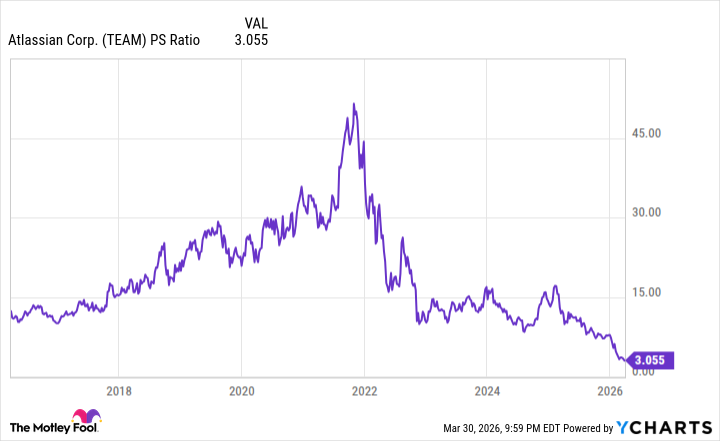
Team PS ratio data by YCharts
So far, there are no signs of software spending slowing down among Atlassian customers. In fact, as I emphasized earlier, quite the opposite is true. Even as AI coding assistants become more adept at creating easy-to-use software, I don’t think companies will rush to abandon valuable providers like Atlassian. Remember, this is not just a product issue. Atlassian also provides technical support, data center infrastructure, and security, which cost a truckload of money.
Most companies don’t have the money or technical expertise to build what Atlassian offers, even if they could create software similar to Jira or Confluence. As a result, I think Atlassian’s sharp decline in stock price presents a great buying opportunity for long-term investors.

