
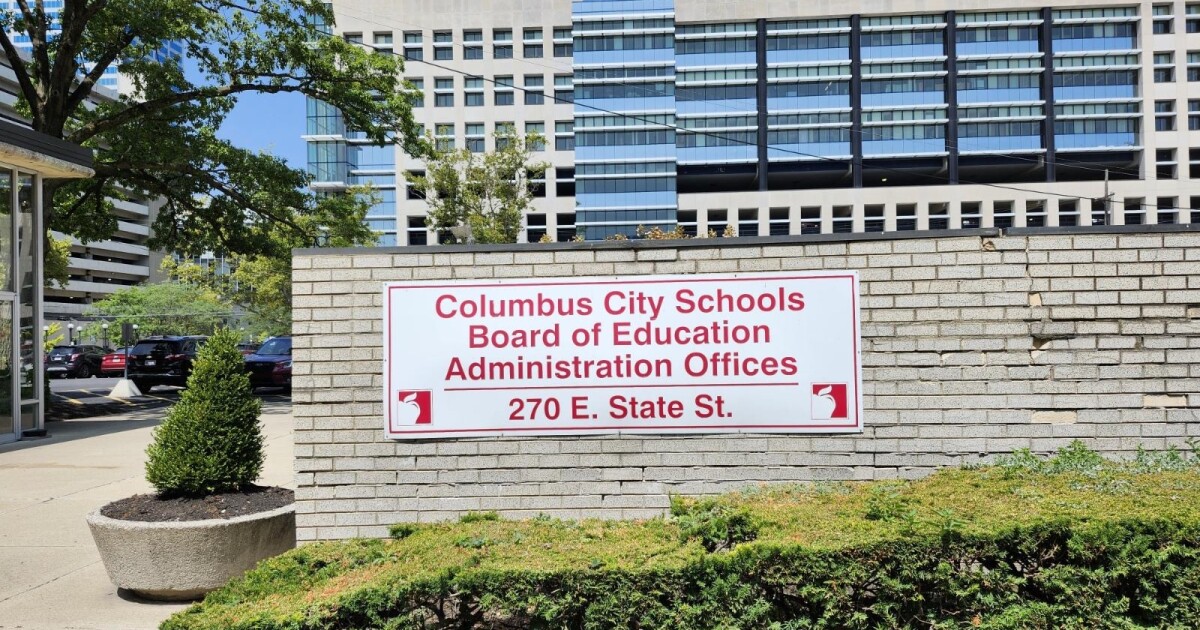
The Columbus City Schools Board of Education voted to adopt a new artificial intelligence use policy for teachers, staff and students during Tuesday night’s board meeting.
Ohio’s largest school district aims to put humans at the center of all AI-related decisions, while giving teachers discretion over whether to allow students to use AI in assignments. The policy states that AI is a tool that supports learning and teaching and does not replace student efforts or the role of educators.
The district considered the policy for about a year and also got guidance from the state of Ohio before finalizing the policy to be voted on Tuesday.
The policy passed unanimously Tuesday night. Board Vice President Sarah Ingles said this is a topic she hears frequently as the community considers it.
Christopher Lockhart, the district’s director of information technology, said teachers will have “guidance” on whether students can use AI for specific assignments.
“We’re giving[teachers]the control to say, ‘Okay, we can use AI to brainstorm this,’ or ‘Once the document is created, we can use AI to review it,’ or ‘Here’s the challenge. Use whatever tools are available to you to get the answers, use the approved tools,'” Lockhart said.
Lockhart explained that some teachers remain AI skeptics and may not allow the use of AI at all, while others are AI advocates. He said the district is providing professional development and the necessary tools and guidance for all teachers, and that even teachers who are new to AI have a path they can take to become familiar with the technology.
The largest section of this policy focuses on “acceptable uses” of technology. This section outlines how students can receive age-appropriate instruction on responsible AI use, digital citizenship, privacy, and AI risks/limitations.
“Students are expected to develop their own knowledge, skills and understanding of the material, rather than relying solely on AI tools, and should ask their teachers if they have questions or need assistance,” the policy states.
The policy document also has a section on academic integrity. This section describes how the district establishes procedures for investigating and addressing allegations of abuse consistent with existing academic integrity policies.
It states that any unauthorized use of AI tools by students will be considered plagiarism, unauthorized collaboration, or misrepresentation of AI-generated content as an original work, and students found using these tools without authorization or in a prohibited manner may be subject to discipline according to the Student Code of Conduct.
Lockhart said the rules around the use of AI and whether it is permissible will need to evolve and change in response to changes in technology, which he called “disruptive.”
“We’re in a disruptive era with AI, so we’re still figuring out what that looks like as far as dealing with students who are using tools that probably don’t even exist as of today,” Lockhart said.
Another section of the policy refers to “non-academic” uses of AI, such as creating fake images that mimic other students, staff, or faculty. Lockhart said this section is based on a model policy developed by the Ohio Department of Education.
This policy prohibits students and employees from using AI to generate false or intentionally misleading representations about other students, employees, volunteers, or board members that could reasonably be interpreted as derogatory, threatening, or otherwise offensive to a reasonable person. This includes visual or verbal depictions of these individuals, or when students or staff disseminate such depictions on social media.
Lockhart said the policy also outlines restrictions on the use of the AI platform and protections to ensure student and staff data is not used to train AI models.
Similar to CCS, school districts across the state are required by the Ohio General Assembly to pass AI policies by July 2026.


