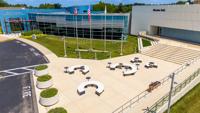
Clark State University’s Springfield campus.
Clark State University has been awarded a $100,000 grant to prepare students, faculty and staff to use artificial intelligence responsibly.
“(AI) is transforming higher education and the workforce at an unprecedented pace. This grant will allow Clark State University to proactively prepare students and faculty for those changes while ensuring we integrate AI in ways that are thoughtful, ethical, and support learning,” said Adrian Forget, provost and vice president for academic affairs.
“It also creates opportunities to develop new workforce training that will help local employers and workers adapt to new technologies and strengthen Clark State’s ability to respond to evolving workforce needs,” she continued.
University officials said the grant, awarded by the Ohio Department of Higher Education’s AI Integration in Community Colleges Program, will enable the university to take a leadership role in integrating AI literacy across partner institutions and the region.
According to Forgette, Clark State University is a leading AI education institution in the region, which includes Southern State University and Edison State University community colleges. The university will oversee the implementation of this initiative, coordinate faculty development efforts, and facilitate the sharing of educational resources and best practices.
This grant will focus on AI in general education courses, including courses aligned with College Credit Plus, as a way to help create new workforce training opportunities. With AI becoming a foundational skill in nearly every industry, this will help students graduate with an understanding of how to use AI effectively, ethically and responsibly, Forget said.
“Artificial intelligence is rapidly changing the way we learn, work and solve problems,” she said. “This grant will ensure that our students and faculty have the knowledge and skills to use AI effectively, ethically, and responsibly, preparing graduates for the evolving workforce.”
As part of this project, Clark State University will incorporate AI competencies into highly enrolled courses that are also taken by CCP students, including English composition, psychology, medical terminology, and biology. According to Forgette, this means integrating instruction on the appropriate use of AI into existing coursework rather than teaching it as a standalone topic.
“The goal is to help students develop practical AI literacy in addition to the learning outcomes already established in each course,” she said.
Forget said the university is working on developing a basic AI literacy course that can be offered as workforce training to employers and community members. This course will introduce you to the basics of AI, responsible and ethical use of AI, rapid writing, evaluating AI-generated content, privacy and security considerations, and practical applications in the workplace.
Additionally, 10 faculty members will earn AI certifications for higher education through the Digital Education Council. This prepares us to incorporate AI into education with an emphasis on competent, efficient and ethical use of AI. After completing the certification program, faculty share their knowledge with their colleagues through a trainer model.
To support this new instruction, the college will buy 300 Nectir AI licenses to provide faculty with a secure, education-focused AI platform that integrates AI into teaching and create course-specific learning assistants for student.
Finally, the project will include professional development activities where faculty will exchange teaching materials, research, and results developed through this initiative.
“Rather than replacing the need for critical thinking, communication, and problem-solving,[AI]is changing the way these skills are applied,” Forget said. “This grant will enable the university to prepare graduates with the knowledge and skills that employers increasingly expect from today’s workforce.”
The grant period is until June 30, 2027, and all project activities and funding must be completed within that period.