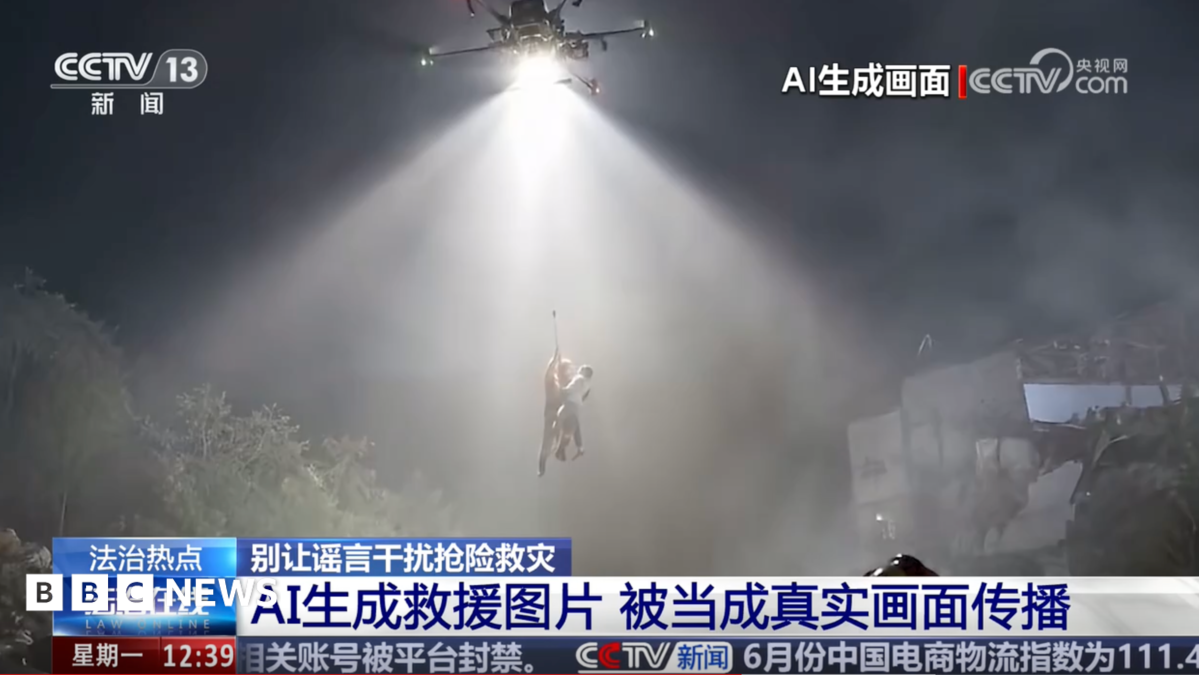
And this is not an isolated incident.
A local official was arrested on suspicion of concealing or underreporting 139 deaths in Henan province in 2021.
Incidents like this created a trust vacuum, making it much easier for malicious actors to spread fake content.
However, police are urging the public to trust reliable sources of information in times of emergency.
“When you come across disaster-related information from unknown sources, please treat it with skepticism and trust official announcements,” said Gao Cai of the Ningbo City Public Security Bureau.
“The Internet is not a lawless zone. Public security authorities will continue to intensify efforts to crack down on illegal activities online,” he said, seeking to reassure the public that creators of false information will be arrested.
“We have established a specialized unit to closely monitor social media, especially short video platforms. They will quickly investigate and handle these incidents and crack down on them in a very strict manner.”
If the consequences of misinformation are severe, the penalties range from fines to up to seven years in prison.
On July 23, the Cyberspace Administration of China also announced a nationwide crackdown on fake internet content related to floods and other disasters, ordering local bureaus to focus on busting fabricated data, malicious editing, staged scenes, false historical events, and people impersonating officials. It also called on social media platforms to step up their review of the content they publish.
Professor Gao believes that “the answer is a combination of public education and law enforcement,” and said, “We need to publicize actual cases where people have been punished.”
“The harm caused by AI-generated fake content is ultimately the result of how people choose to use that technology, not the technology itself,” he added, adding that existing laws are sufficient to address this.
But others are less confident. Professor Chen pointed out that “AI technology continues to evolve much faster than legal frameworks. As new legal issues emerge, AI misinformation remains a major challenge.”
Peter Pan, a lawyer based in Shanghai and Washington, said lawyers around the world are seeing an explosion in the number of cases dealing with these issues.
He believes companies that create AI apps and the platforms used to publish fake videos and other materials should also be held legally accountable, along with those who create misinformation.
“The first line would be the platform, because the platform is the enabler. They are the ones who will be able to make this happen,” he told the BBC.
He gave the hypothetical example of a person running over a pedestrian as a result of panic caused by a fake post on social media.
“The video creator might say, ‘You ran someone over. That’s your problem. I didn’t do it.'” But think about it. You created the foundation for people to respond. If you caused the panic, you need to take responsibility for the consequences. ”
Professor Xu also warns that “the false information generated by AI is likely to increase not only in volume but also in the speed at which it spreads.”
“Looking to the future, political elections, public health emergencies, armed conflicts, natural disasters, and issues that impact people’s lives could all be high-risk areas for AI-generated misinformation.
“Instead of waiting for misinformation to spread and then trying to contain it, governments and platforms should prepare in advance.”