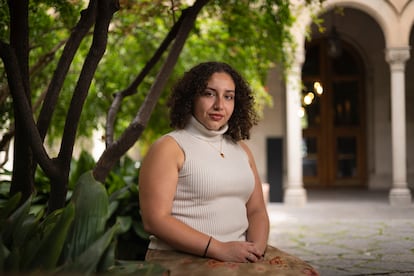
“I started using ChatGpt during my second year at university, during my extremely stressful time juggling internships, assignments, research and extracurricular activities. To alleviate this burden, I started using it on small tasks. [that it was remembering] Details of my writing style and previous text. So I quickly integrated it into everything… my job [became] It's as easy as clicking a button,” explains Mónicade Loságeles Rivera Sosa, a 20-year-old political communications student at Emerson College in Boston, Massachusetts.
“I managed to get through the course, but writing my own essay was my favorite activity. This was the catalyst for stopping using the app,” she asserts.
This student's view is the least common, but it is no exception. More and more students are stopping using artificial intelligence (AI) for their tasks. They feel that this technology makes them more thin, less creative and less capable of thinking for themselves.
“I stopped working with artificial intelligence to do university work. That's no use for me. Last year I felt less creative. I rarely use it this year. “In college, you need to encourage experimentation, learning and critical thinking, rather than copying and pasting questions onto a machine,” she adds.
Microsoft recently published a study that interviewed 319 workers to investigate how the use of AI tools affects critical thinking and how this technology affects labor. The results show that AI users produce less diverse sets of results for the same task. This means that workers who trust machines don't make much effort to contribute to their ideas. But who will delegate to the machine? And why do they do that?
The workers who are most critical of AI are those who demand themselves the most. In other words, the more confident a person is, and the more confident they are in the tasks they perform, the less they rely on technology. “We're talking about overqualification [individuals]…In other words, Francisco Javier Gonzalez Castaño, a professor at the University of Vigo in Spain, is “a student or worker who stands out with his high AI capabilities and his limitations.” He took part in the development of an AI chatbot.
“If university assignments can be easily solved by machine, it's not a student's problem. Rather, the education system [is at fault]says Violeta Gonzalez, a 25-year-old pianist and graduate student in education in Brussels Royal Subjects. “But things change if the task requires critical thinking to implement. The ChatGPT response is a blank canvas to work on. It's just the collected data used to decide what to do. By itself, nothing new contributes.”
Despite criticism, generative AI is widely used in universities. A recent survey by the CYD Foundation shows that 89% of Spanish undergraduates use some of these tools to resolve questions (66%), surveys, data analysis, or information gathering (48%), or writing an essay (45%). Approximately 44% of students use the AI tool several times a week, while 35% use it every day.
Toni Rozano, a professor at the Autonomous University of Barcelona, acknowledges that these tools pose challenges to the education system. “[AI] It can be useful for students who want to improve the quality of their work and develop their skills. [But it] It can be harmful to people who don't want to make the effort or lack motivation. It's just another tool and it's similar to a calculator – and it all depends on how you use it. ”
“There are students who attend college just for their degree,” he points out.
AI for critical thinking
In an age of automation and uniformity in outcomes, promoting critical thinking is a challenge for both universities and technology companies. These agencies are trying to develop generic AI tools that motivate users to think for themselves. They also enter the AI-affected job market, insisting on helping them tackle more complex issues. This is clear from the aforementioned Microsoft research and from recent announcements by two major AI companies, Openai and humanity.
Openai launched its ChatGpt Edu, a version of its chatbot for students, in May 2024. Meanwhile, humanity has launched Claude for Education, a version of a university-focused chatbot. Claude raises Socrates' questions (“How do you approach this?” or “What evidence do you support your conclusion?”) to guide students to problem-solving and help them develop critical thinking.
When Google first burst on the scene, there were similar claims about it. What is the difference between using a search engine or generating AI to complete a project? “There are a lot,” McCarena Paz emphasizes. “Search engines enter questions, browse through different pages to build answers, add and discard what they think is appropriate,” she elaborates.
Paz explains that Google is choosing other types of search engines as it integrates AI through its overview. These are automated answers that appear at the top of the page in some search results. Instead, she uses Ecosia. This promotes Google's status as a sustainable alternative. This is because they use the advertising revenue generated by search to fund planting projects. All students interviewed for this report expressed concern about water consumption associated with each search performed with the AI tool.
“One of the biggest limitations I've found in ChatGpt is that I don't know how to say 'no'. If you don't know the answer, this is extremely dangerous. “[ChatGPT] When you choose information for you, you lose that decision-making ability. It's not only faster, it's more limited,” she clarifies. “Critical thinking is like an exercise. If you stop it, your body will forget it and lose its talent,” warns Monica de los Angeles Rivera Sosa.
Plus, there are restrictions. “In programming, you need to distinguish between coding and programming. Generating AI is ideal for automating thousands of specific tasks performed on a single line of code. But when it comes to solving complex and original problems, it still shows a major limitation,” adds Toni Lozano. In the humanities, it can write a report or email appropriately and correctly, but not in its own style. There is already an established way to write in ChatGpt tones. Again, this is a standardization issue.
“People have never been as educated as they are now. But do we all need to hypereducate for the system to work?” asks Francisco Javier Gonzalez. “Obviously not. AI can reduce skills that are not as necessary as we think. There was a period in ancient times. I'm not saying that it's good, when only a few monks had critical thinking skills. Five years later, there's no need to learn a language. [At that point]something will be lost,” he admits.
There is scientific research that confirms the negative impact of generative AI on memory, creativity, and critical thinking. Before generative AI entered our lives, American writer Nicholas Kerr had already warned of the epistemic impact of the Internet. “Once upon a time I was a scuba diver in the sea of words. Shallows: What the Internet does to our brains (2011). “Our windows show the world and ourselves, the popular medium molds show us what we see and how we see it.
If generative AI removes us original and not lazy and critical thinking skills, what does this have on our brains? Do we all have the same answer to different questions? Will everything be more uniform and less creative? Only time can be seen. But when we wait for the future to speak, this is what ChatGpt says: “The advancements in generative artificial intelligence bring about an unsettling paradox.
Sign up Weekly Newsletter To get more English news coverage from ElPaís USA Edition