

LG launched Korea's first AI graduate school, combining real-world industrial challenges with academic training
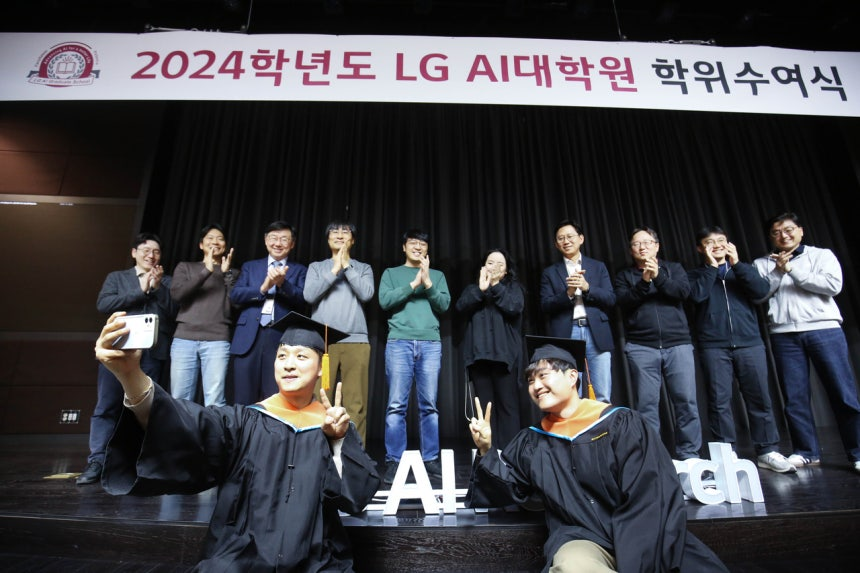
When Shin Dong-Hwa, a senior researcher at LG Energy Solution, began his lessons at LG AI Research's new graduate school, his focus was not on abstract papers, but on stubborn challenges from his lab.
“In the workplace, there was little opportunity to study theory, and we focused mainly on applying pre-built models,” said Singh, who graduated from the program in February this year. “Through the Masters program, I have finally been able to deepen my studies of AI theory and cutting-edge model structures, and now I have gained the knowledge and ideas that I can use directly in my work,” Singh said.
New model: Company-led higher education
Such real-world problem solving lies at the heart of LG's experiments. In 2022, LG AI Research launched its graduate program, and this August became the country's first government-recognized graduate school of AI.
The institute is designed when global races for AI professionals are intensifying, and even the tech giants struggle to secure talent while restraining Brain Drain while building key skills for LG's future.
The accredited master's programme is scheduled to begin in March next year. LG said it is working with the Ministry of Education to obtain doctoral approval, while also ensuring that employees who have registered before accreditation can still be granted degrees.
Unlike traditional universities, enrollment requires employees to bring clearly defined problems from factories, labs, or design teams, solve with AI within a year, over three semesters, and reintegrate the solution into work.
“Applicants must either present the research project they are pursuing, or have a plan to pursue within the company. It is carefully reviewed not only for ambition but for feasibility,” explained LG AI researchers, emphasizing that the focus of the program is not on providing a “fantastic title,” but on producing concrete results.
The program also highlights how LG allows participants to access cutting-edge equipment and data that are rarely available in universities, but applies AI directly in areas such as material design and smart manufacturing.
“That is the important differentiator for the university. To compete globally, South Korea needs trained talent to tackle industry-specific issues across manufacturing, materials and design,” the official added.
Balance of real-world needs and academic rigor
Not everyone is sure. While some scholars welcome the initiative as one way to address Korea's intense talent race, they also question whether companies are consistent with universities in providing education based on a wide range of theory. They will warn that they may be leaning too strongly towards project-based problem solving at the expense of long-term basic research.
“Corporate Graduate School can provide powerful one-off lectures from practitioners,” said Lee Kyoung-Jun, AI and business professor at Kyung Hee University. “But maintaining a strict curriculum is different. Universities exist for independent research. Companies run the risk of focusing on immediate needs.”
He noted that companies are already working closely with academia by collaborating with universities to provide degrees through collaborative research projects.
There are also broader concerns. Korean universities rely heavily on government research grants, and if corporate institutions start to compete for the same limited funding, an already tense budget could face additional pressure.
Korea's battle to train AI experts
LG's graduate school is the first in Korea and possibly in the world. Its launch was made possible by special acts on innovation for advanced industrial human resources, a law that allowed companies to establish in-house graduate schools in January. Previously, companies were allowed to run in-house universities that granted degrees equivalent to junior colleges or four-year universities.
Due to a lack of talent across the industry, other conglomerates reportedly weighing similar ideas. Hyundai Motor and SK Hynix investigated the in-house graduate model.
SK Hynix, the world's second largest memory chip manufacturer, has been running its own employee training program, SK Hynix University since 2017. Although not an accredited body, it offers short-term courses and workshops to train semiconductor experts. The company also sponsors the Bachelor of Arts in Semiconductor Education programmes at Korean University, Saogan University and South University.
Samsung Electronics, the largest conglomerate in Korea, operates the Samsung Semiconductor Technology Research Institute, the first certified in-house university in Japan, founded in 1989.
“We hope that by combining advanced technology-focused education and academic research, businesses can lead the training of the specialized professionals they need in the high-tech industry,” said an education ministry official.
herim@heraldcorp.com


