

JPMorgan has defined 2026 as the “year of activation” for consumer AI. As the application layer moat is not yet firmly established, the report advises investors to avoid betting on single application winners and instead focus on “secondary beneficiaries” characterized by surging token consumption, buying volume dividends in marketing wars, and compressed content production cycles through AI. Companies mentioned include Alibaba, Tencent, Baidu, NetEase, and Kuaishou.
Author of this article: Long Yue
Source: Hard AI
 As the ‘AI applications race’ unfolds overarchingly, JPMorgan has avoided betting on a single winner, choosing instead to focus on secondary beneficiary areas that are more likely to materialize and have higher profile.
On January 30, JP Morgan’s China securities research team released a research report on China’s internet industry titled “2026 Outlook: Secondary Beneficiaries of Trading AI.” This report considers multiple directions, including consumer-level AI, enterprise AI, agent commerce, and gaming in China. Its core assessment is not “who wins,” but “which segment will benefit first and make it easier for the market to trade.”
Don’t rush to judge “application winners” – the market isn’t ready for pricing yet
JP Morgan clearly states in its report:
“It is still too early to trade on ‘AI application winners and losers’ in China’s chatbot market as the trend is still brewing. Short-term share fluctuations reflect distribution and product iteration rhythms rather than a solid moat.”
In its view, early user metrics and market share changes are insufficient to support judgments about structural outcomes. The report highlights:
“In our opinion, a viable investment approach at this stage is to avoid black-and-white bets that determine winners at the application level, and instead focus on the beneficiaries in the process of advancing AI interactions within the industry. The upside potential of the latter depends more on the breadth of adoption than on the market share of any single application.”
2026 could be the “Year of Activation,” entering a phase where chatbots are heavily used.
At the consumer AI level, the report defines 2026 as a key tipping point.
We believe 2026 could be the “year of activation” for consumer AI in China, as chatbots move from novelty to habit and begin to reshape how users discover information, evaluate options, and initiate action.
JP Morgan cited concrete data showing that ByteDance’s DouBao user base has reached breakthrough size.
Developed by ByteDance, DouBao has reached nearly 100 million daily active users, a milestone that marks the passing of the “good enough” threshold for ubiquitous chat interactions for mass-market applications.
The report also places this trend in a global context, citing a Reuters report.
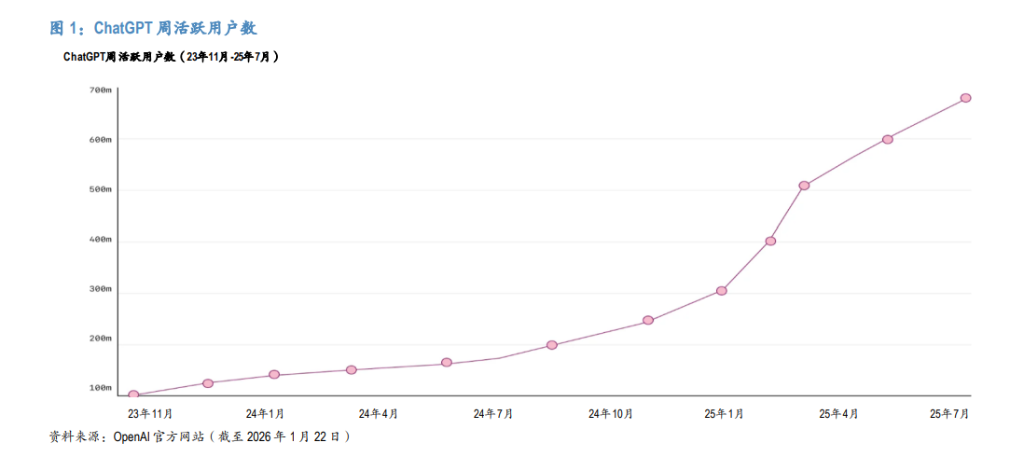
ChatGPT has reached 800 million weekly active users, highlighting how quickly consumer AI can grow once product utility and distribution are aligned.
JPMorgan assesses that chatbots are evolving into “high-frequency traffic portals upstream from numerous AI use cases” and will directly change the competitive dynamics between platforms.
Secondary transaction logic: tokens, marketing, productivity
JPMorgan bases its trading logic on secondary exposure without betting on the ultimate winner.
Instead, we lock in operational recommendations regarding quadratic correlation exposure. 1) AI infrastructure and cloud providers. Capture growing inference workloads. 2) Advertising Platform. Benefit from enhanced industry sales and marketing.
in particular:
-
AI Infrastructure Level (Oversold: Alibaba, Baidu): The report claims that “the increase in daily multi-turn chatbot conversations will directly increase inference demand and token throughput.” As agents evolve from conversation to execution, token consumption is expected to increase exponentially, creating value for scaled infrastructure and ecosystem integrators.
-
Network advertising platform level (overweight: Kuaishou Technology): Leading platforms will significantly increase customer acquisition spending in the race to dominate AI mindshare. JPMorgan predicts that “performance-driven channels will capture a larger share of budgets,” and Kuaishou, if not the ultimate winner of chatbot adoption, will benefit from increased marketing intensity across the industry.
Large platforms are expected to increase spending on customer acquisition and repetitive interactions as they compete for mindshare in chatbot deployments.
-
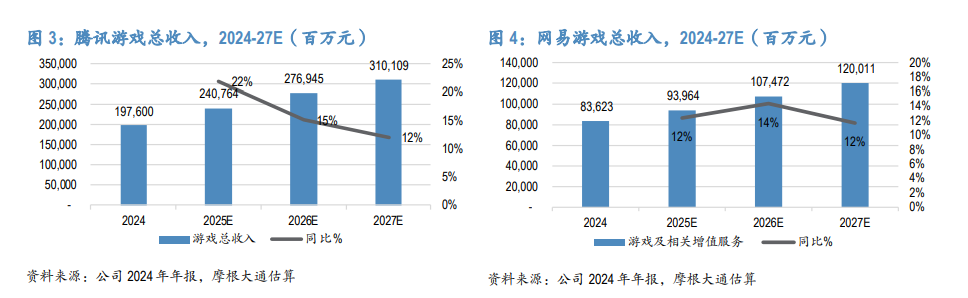
Online gaming industry level (overweight: Tencent, NetEase): AI shortens the “idea-to-market” cycle and improves R&D ROI. Tencent has released an open-source 3D generation model that quickly converts text/images into high-quality 3D visuals. This is a structural advantage to content supply that is currently undervalued in the market.
-
JPMorgan also emphasized that performance-driven channels will be the main beneficiaries.
Enterprise AI: Moving from “experimentation” to “measurable outcomes”
When it comes to enterprise AI, the report highlights that tangible results in high-stakes workflows are at a tipping point.
We believe the tipping point for enterprise AI adoption will occur when value propositions become measurable in high-stakes workflows.
JPMorgan cites several publicly available information as examples, including:
More than a quarter of new code at Google is first generated by AI before being reviewed and approved by engineers.
Developers using GitHub Copilot complete standardized coding tasks 55.8% faster than a control group.
Regarding the Chinese market, the report quotes Tencent’s disclosure as follows:
“Their AI coding tool CodeBuddy reduced coding time by 40% and increased R&D efficiency by 16%.”
JPMorgan also warned of the need for caution when disclosing corporate information, which it considered an important signal.
“This shows that suppliers are now actively pursuing the operational value proposition of AI (time savings, efficiency gains), which is typically a precursor to broader procurement and implementation.”
Agent Commerce: Conversion Layer from “Interaction to Execution”
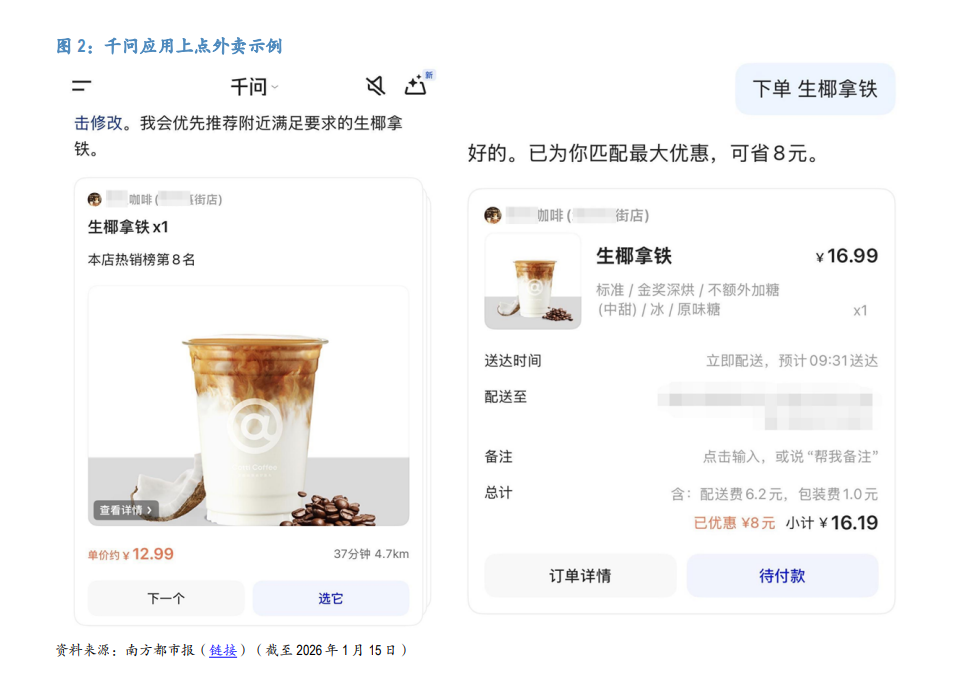
JPMorgan views Agents as the core next step transformation layer. Alibaba has already enabled food delivery, travel booking, and payment integration within a chat interface through its Qwen application.
“Conversational interfaces can reduce friction between discovery, comparison, and checkout,” the report states.
However, JP Morgan also took a cautious stance.
“Given the limited disclosure of information at this early stage, we would like to avoid drawing premature conclusions about who will win or lose.”
The report believes that near-term opportunities are reflected by:
“Focus on funnel efficiency rather than immediately destroying market share.”
Although it is difficult to immediately destroy market share in the short term, the primary benefit is that the value of each incremental user session increases. The risk for a vertical leader like Trip.com is that the traffic entry point moves upward. However, you can protect high-frequency use cases by embedding an intelligent agent layer within your own apps.
Reset Ratings: Discounts compared to global peers
Looking back to 2025, the main factor for Chinese internet stocks was a “change in the narrative” rather than an adjustment in earnings forecasts.
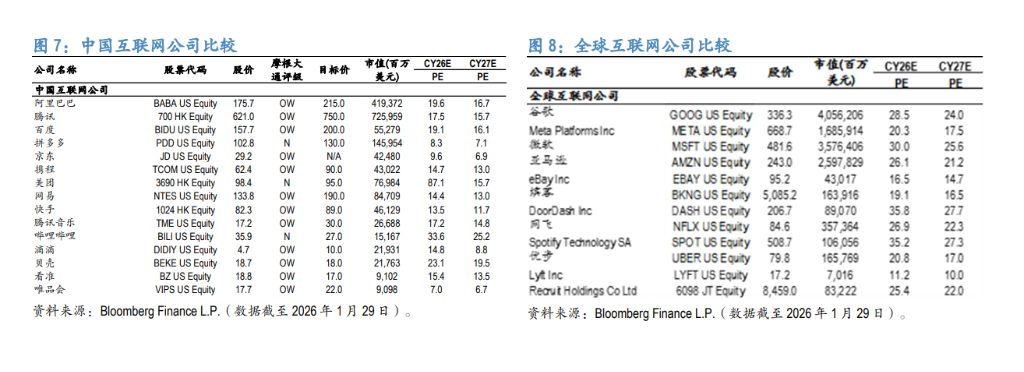
The report said that even after the recent recovery, the forward price-to-earnings ratios of China’s leading companies are still significantly discounted compared to their global peers.
-
Valuation comparison: Alibaba (20x forward P/E for calendar year 2026) vs. Google (29x) and Amazon (26x). PDD Holdings (8x) vs. eBay (17x).
-
Key perspectives: JPMorgan believes that as the AI narrative converges, “a narrowing of the individual ratings gap appears achievable.” This is beneficial for companies with a strong long-term narrative or those that have reached execution milestones.
This article is from WeChat official account “HardAI”. Learn more about AI Frontiers.


