

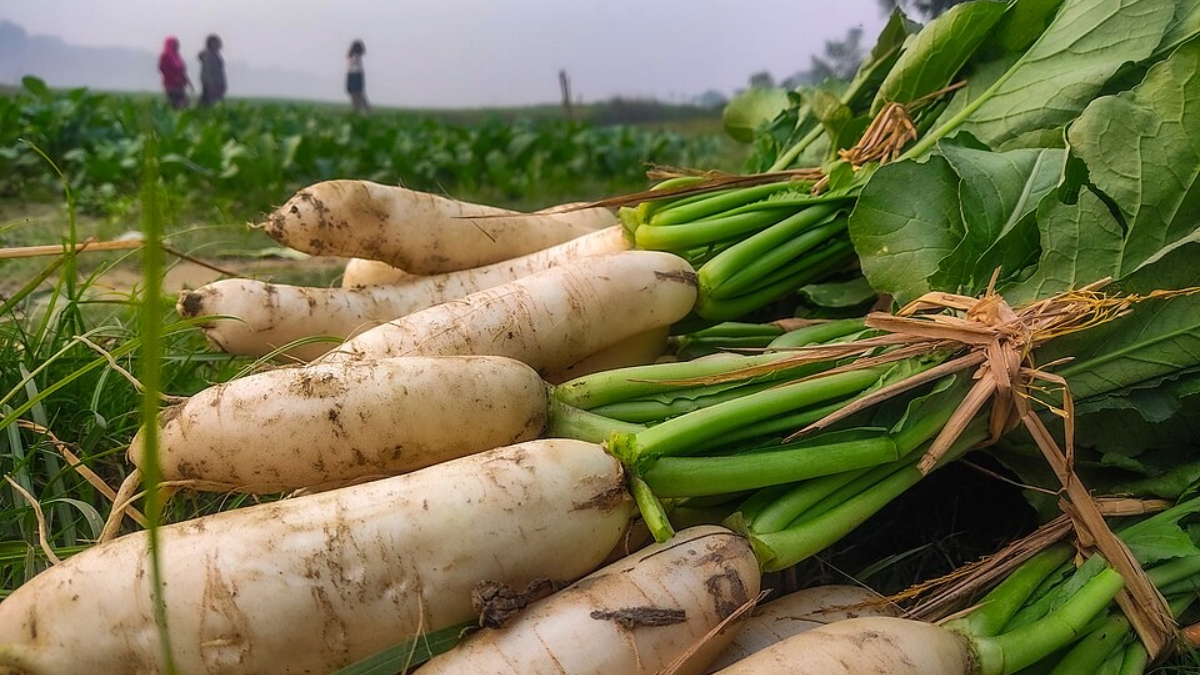
Radish farms in Southwest Asia. (Raffy)
The amount of water consumed by artificial intelligence could be hundreds of times lower than other sectors of the economy, such as agriculture. But this rapidly expanding sector, which uses as much water as Norway and Sweden combined, is a ticking time bomb.
Structural realities around freshwater availability, infrastructure, and geopolitics mean that AI will have a profound impact on water insecurity. Those who will suffer the most will be those who live near the massive infrastructure that powers this technological revolution.
The International Energy Agency estimates that the global data center capacity needed to train and run AI models has nearly doubled every five years since 2015.
Tech companies are tapping into precious water reserves to cool the servers behind their machine learning models. The amount of water involved is large. Cornell University researchers estimate that by 2027, AI-related water withdrawals could exceed 6 billion cubic meters per year. This is roughly equivalent to New Zealand’s total annual water use.
In this field, the numbers associated with health hazards are rising. This calculation may be an underestimate, as cooling needs vary depending on the data center operator, the location of the data center, and the types of tasks required of the AI. Many technology companies treat infrastructure data as highly sensitive, and there is limited transparency across the sector. As the number and size of AI facilities rapidly expand, actual water usage is likely to be even higher.
Still, some disclosures are trickling into public forums. In July, French large-scale language modeling (LLM) startup Mistral AI published one of the industry’s first environmental impact reports.
According to the company, 91% of water usage across the supply chain is accounted for by model training and inference (when LLMs use training to answer questions or make decisions). That water is primarily used as a coolant. Mistral estimates that producing one page of text using his model uses about the same amount of water as growing “a little pink radish.”
Applied to OpenAI’s more popular ChatGPT, that calculation puts CEO Sam Altman on par with a farmer harvesting a trillion radishes.
Nevertheless, water consumption by AI still pales in comparison to other sectors, such as the global agricultural industry, which accounts for 70% of all freshwater withdrawals. This equates to approximately 3 trillion cubic meters of water per year, or 600 times the Cornell University AI water requirement estimate.
At the current rate of expansion, it will take about half a century for the AI industry to catch up with agriculture’s water consumption. That will not be possible as global and regional food security will be the limiting factor. But what will happen during the volatile transition period as more water is depleted to sustain the AI boom?
While there is certainly an argument to start with industrial agriculture to address water scarcity issues, AI should not be ignored.
There are three reasons why AI will have a significant impact on efforts to build water resilience. It’s availability, location and politics.
Freshwater availability is already a global concern. By 2030, demand for fresh water will exceed supply by 40%. This means that water-dependent people increasingly rely on the extraction of non-renewable or unreliable water sources.
In essence, the data centers needed to power the AI revolution are drinking from an already dry faucet.
Some technology accelerationists argue that AI is not the cause of this crisis. They might point to other areas of need, or, more optimistically, new technologies such as closed-loop, non-evaporative cooling designs that increase water retention in data centers by stopping superheated water from entering the atmosphere. The World Economic Forum suggests that circular management systems can save 50-70% in water efficiency.
While these technologies are promising, they are not a panacea.
That takes us to a place. To reduce the risk of equipment corrosion from moisture and salt water, many companies build data centers in dry, inland areas. result? Water-intensive facilities in already stressed locations.
Bloomberg estimates that about two-thirds of data centers built or under development in the U.S. after 2022 will be in areas with high water stress, such as Illinois, Arizona, California, and Virginia.
And these data centers can be huge. Meta recently announced the creation of an AI lab (named Hyperion) in Louisiana, about the size of Manhattan.
To cool digital behemoths, companies often drill deep wells to pump groundwater. What could follow is that communities no longer have access to clean tap water as groundwater pools dry up and sediment from industrial activities contaminates the supply.
It may also feel like a flood of data centers would be better for local communities if it could provide jobs for local residents, similar to other industries, including agriculture, but such opportunities have not materialized so far.
There will also be an impact on the global environment. The unprecedented depletion and drying of terrestrial water resources is causing more sea level rise than polar snowmelt.
Many leading technology companies are working on becoming “water positive.” This means we plan to return more freshwater resources to the environment than we consume. However, it is unclear whether these efforts will return water to the same locations from which it was harvested.
Civilians losing access to water should be a concern for politicians. Politicians need only look into Bolivia’s Cochabamba water war. There, we need to understand the social conflicts that can arise when the privatization of municipal water supplies is followed by road blockades and riots, governments are forced to roll back reforms, and access to essential resources is restricted. But today, when AI users, companies, and infrastructure often cross national borders, political accountability is murky at best.
The Council of Europe’s Framework Convention on Artificial Intelligence and Human Rights, Democracy and the Rule of Law, the world’s first legally binding international treaty on AI, does not address the broader environmental impacts of AI, including water consumption and greenhouse gas emissions. Even if it were to happen, it is unlikely that it would be worth as much as the paper it was written on in the world of Trump 2.0.
In the US, the outlook at the federal level is less promising, with less regulation and more acceleration. In July, the White House released its latest AI action plan on “Winning the Competition.” Water is mentioned three times in the strategy. All three references focus on the federal Clean Water Act, which is seen as a barrier to AI deployment.
Politically, perhaps the rapid economic gains that can be made through the development and deployment of AI and digital infrastructure are more attractive than the slowly evolving environmental crisis brewing in the background.
And so many of the world’s most water-scarce countries are turning to land-based digital infrastructure. If former importers of virtual water (hidden water in products) start exporting it as AI products and services, there will be an incredible economic turnaround.
Microsoft launched Chili Central in June. This is a sovereign data center that the company claims will bring $3.3 billion in investment to Chile. The country has been suffering from drought for 15 years.
The Saudi Public Investment Fund has poured more than $40 billion into AI ventures as part of its grand economic strategy, Vision 2030. The foundation launched its artificial intelligence company, HumAIn, in conjunction with US President Donald Trump’s visit to Saudi Arabia. The World Resources Institute’s Risk Atlas lists Saudi Arabia as one of 25 countries facing extremely high water stress, and the kingdom plans to invest nearly $80 billion in desalination over the next 10 years as part of the same strategy.
It is understandable that countries would want to participate in the race for AI supremacy. But serious questions remain about whether countries are trading smarts for resilience, increasing their dependence on others for water and food security.
These are the predicaments in which democratic politicians operate. Their role is to balance the optimism of the companies and political parties that are inflating the AI bubble with the environmental needs of the constituencies that voted for them.
Environmentalists may find an unlikely ally in an influential local politician. In the words of far-right Rep. Marjorie Taylor Greene (R-Ga.), after getting the green light to build a 150-acre AI data center in her district, she said, “While I understand the many benefits promised by AI, I remain committed to protecting states’ rights, human jobs, human lives, human rights, the environment, and critical water supplies.”
This suggests a longer-term strategy for governing the trillion-radical challenge: state-led accountability and flexibility of power. This is already the case in California, where climate legislation will require big tech companies to disclose their greenhouse gas impacts.
Given the huge momentum behind AI, regional water scarcity is likely to get worse before it gets better. Sooner or later, governments and businesses will eventually have to take action. They might act sooner if a trillion radishes are delivered to distributors and company headquarters, but for now they seem content to talk while swimming.


