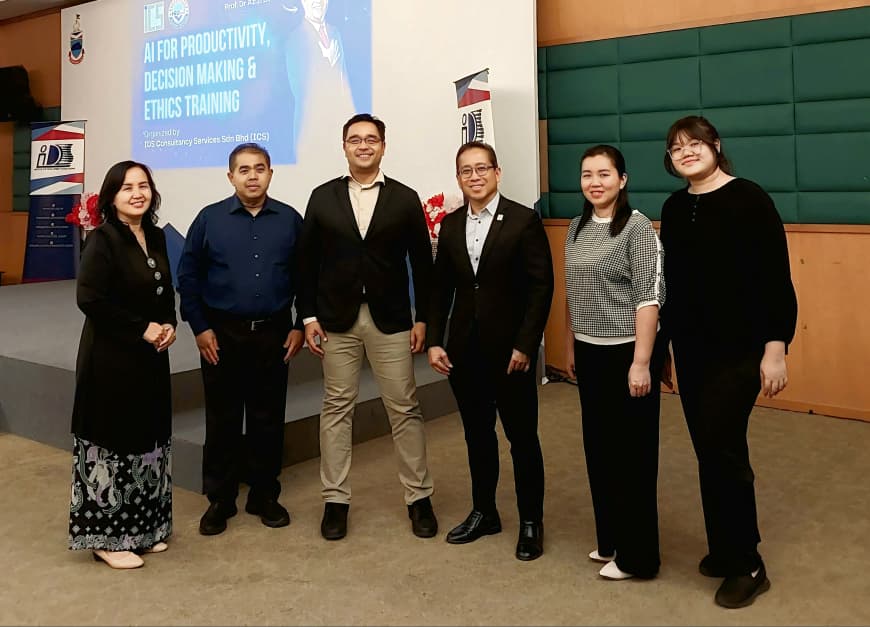

Columnist Dr. Azizi (3rd from left) with IDS Consulting Services management and staff: Jesse Majunki (General Manager), Azaharuddin Hasanuddin (Chief Consultant), Melanie Alban, and Samantha Hii.
 I recently attended the “Artificial Intelligence: Bringing AI to Everyone” course organized by IDS Consultancy Services Sdn Bhd and conducted by Dr. Azizi bin Abu Aziz from Universiti Utara Malaysia. Having worked in the investment industry for over 25 years, I believe that AI is a powerful tool to enhance decision-making, customer profiling, and behavioral analysis, areas that are closely related to my work and interests. What stands out is that AI is no longer limited to experts. Accessible and relevant to all professionals. This experience highlights the importance of remaining adaptable and embracing lifelong learning, while providing valuable insights that can be shared through talks, courses, and writing.
I feel these considerations are especially important now that AI is no longer a distant concept reserved for large technology companies and researchers. Rather, it is a force that is quietly but unmistakably reshaping Malaysia’s economic, social and administrative structures, and its influence is becoming increasingly pronounced even in areas with unique demographic and economic characteristics such as Sabah.
Artificial intelligence essentially refers to computer systems that perform tasks that require human-like intelligence. These tasks include recognizing patterns in data, interpreting images, understanding speech, predicting results from historical information, and generating new content in the form of text, images, or ideas. The basis of modern AI is machine learning, where algorithms learn by analyzing vast amounts of data. More advanced forms of AI, such as deep learning, rely on layered neural networks that mimic the structure of the human brain, allowing computers to decipher more complex patterns such as facial recognition, language translation, and real-time anomaly detection. The rise of generative AI has further expanded these capabilities by allowing systems to generate consistent text, summarize complex documents, and provide conversational assistance, making AI much more accessible to everyday professionals. This democratization of AI is consistent with my own experience during the course. The tools are within the reach of anyone who wants to learn, regardless of their field.
Malaysia’s evolving relationship with AI has taken on a more planned and coordinated character in recent years. A landmark development was the establishment of the National AI Bureau under the Ministry of Digital. The office was approved by the Cabinet in August 2024 and officially inaugurated by Malaysian Prime Minister Datuk Anwar Ibrahim in December 2024. The announcement served as a symbolic and strategic confirmation of the country’s commitment to incorporating AI into national development. By bringing AI governance and innovation under a central authority, Malaysia has signaled its intention to move from sporadic projects to a connected ecosystem that can guide policy, infrastructure investment, talent development and ethical oversight. With this institutional architecture in place, conversations around AI are becoming more practical, integrated, and future-oriented.
In the private sector, AI has already begun to transform business operations, and that transformation is becoming increasingly pervasive, if sometimes subtle. In the financial industry, where I have spent more than 25 years, AI has been deployed in risk assessment, fraud detection, compliance automation, and customer analytics. Machine learning models allow financial institutions to analyze a much larger volume of financial signals than human analysts can manage. These models identify behavioral patterns, assess creditworthiness, detect anomalies, and generate insights that help institutions design more personalized products and services. For investment professionals, AI supports scenario modeling, macroeconomic analysis, portfolio optimization, and sentiment assessment. These tools augment human judgment rather than replace it, supporting it by filtering out noise, highlighting risks, and uncovering opportunities that would otherwise take days or weeks of manual analysis. Malaysian hospitals and clinics are exploring diagnostic AI tools to help interpret medical images such as X-rays and CT scans. Predictive systems help predict patient flow and resource demands, and triage chatbots provide instant guidance to patients before contacting a clinician. Triage is the process of evaluating and prioritizing patients based on the urgency of their condition so that medical treatment can be provided efficiently. These solutions are particularly valuable in regions facing a shortage of professionals, a common challenge in some parts of Sabah. AI-assisted diagnostics allows clinicians to expand their capabilities without sacrificing accuracy, allowing rural and remote healthcare facilities to make more informed decisions. Researchers at Malaysian healthcare institutions are also experimenting with AI for disease modeling, early detection of chronic diseases, and personalizing treatment pathways based on patient data.
Although education is often slower to digitally transform than other sectors, it is also experiencing change. Teachers, instructors, and administrators are using AI-powered platforms to create personalized learning content, automate time-consuming processes like grading, and provide more adaptive and personalized instruction to students. These developments reduce the administrative burden on educators and allow them to focus on teaching, creativity, and guided learning. Universities are also updating their curricula to reflect AI literacy as a core competency, aligning Malaysia with global expectations that digital skills, particularly data and AI proficiency, will be essential for the future workforce.
Agriculture is perhaps the sector where the real-world impact of AI is most visible, especially in Sabah. Traditional agriculture has long been the backbone of Sabah’s economy, supporting the livelihoods of entire rural communities and forming the basis of food security. In recent years, the introduction of AI-enabled digital farming systems has begun to modernize this situation. More than 70 digital AgTech systems are currently in use across the state, leveraging sensors, satellite imagery, drones, and machine learning models to guide planting decisions, monitor soil health, and improve resource use. These systems collect real-time data on moisture levels, nutrient content, and crop health. Farmers can use mobile dashboards to predict rainfall, optimize irrigation schedules, and make evidence-based decisions to increase yields. The transition from intuition-driven farming to precision farming has the potential to significantly increase productivity, reduce waste, and reduce environmental risks.
Sabah’s aquaculture sector is also embracing AI-powered advances. Aquaculture farmers in coastal and inland areas use sensors and automated monitoring systems to track water quality, temperature, and oxygen levels, which are critical factors in maintaining healthy fish stocks. AI models interpret these data streams to predict the likelihood of disease outbreaks, recommend optimal feeding times, and adjust environmental conditions. The result is not only higher yields, but also greater resilience to sudden changes in weather and water pollution. Given that Sabah relies heavily on aquaculture as a source of livelihood and economic growth, these systems play a vital role in enhancing both food production and the financial stability of local communities.
Governments are similarly beginning to deploy AI to enable smarter city services. A Malaysian city is experimenting with an intelligent transportation system that analyzes traffic flow and adjusts the timing of traffic lights to ease congestion. Waste management operations use AI to optimize truck routes, reduce fuel consumption, and improve service efficiency. Digital kiosks and conversational AI systems help residents access services, reduce wait times, and improve interactions with local authorities. On the government side, AI supports document processing, urban planning analysis, and predictive maintenance of public infrastructure, allowing governments to proactively respond to community needs.
The Sabah State Government has expressed strong interest in establishing an Artificial Intelligence Center to support further digital transformation. The proposed center is expected to act as a hub for innovation, training and collaboration, supporting local start-ups, research institutes and public sector institutions. For a state that is geographically dispersed and has diverse industries, such an institution could play a key role in strengthening digital capabilities, developing local talent, and accelerating the adoption of AI systems that align with Sabah’s economic priorities, such as agriculture, tourism, logistics, and environmental management. The center will also act as a bridge between local communities and national-level efforts, ensuring that AI implementation in Sabah is comprehensive and strategically coordinated.
As Malaysia moves forward, several challenges still need to be addressed. The shortage of experienced AI specialists remains one of the most pressing issues. Although many young Malaysians are studying data science and computing, their expertise in implementing large-scale AI solutions and ensuring robust model governance is limited. Much of this talent is concentrated in the Klang Valley, leaving regions such as Sabah at a disadvantage in recruiting and retaining specialized professionals. Efforts to decentralize training, provide incentives, and strengthen collaboration between universities and industry are essential to closing this gap.
Data quality and governance issues are also barriers. AI systems require clean, structured, and interoperable data to perform effectively. Many organizations in Malaysia still maintain siled systems and outdated data management practices, limiting their ability to meaningfully implement AI. Addressing this challenge requires investment in data infrastructure, a clear governance framework, and a focus on responsible data management. Concerns about privacy, transparency, and bias also need to be carefully managed to maintain public trust.
SMEs, especially in Sabah, often struggle with resource constraints, limited digital readiness, and uncertainty about which AI tools are right for their operations. Without targeted support such as grants, training, and advisory services, the gap between technologically advanced organizations and latecomers can widen. This disparity reinforces the need for leadership development, cross-sector partnerships, and accessible platforms to demystify AI for small businesses.
Despite these challenges, the outlook remains decidedly optimistic. Malaysia’s deliberate steps, particularly the launch of the National AI Secretariat, demonstrate that Malaysia recognizes AI as central to its future competitiveness. Sabah’s growing digital agriculture efforts and aspirations for an AI center demonstrate how regional strengths can be amplified through technology. For professionals like me, AI offers an opportunity to expand our analytical capabilities, deepen our understanding of our clients, and enhance strategic decision-making. The course I attended reaffirmed that AI literacy is no longer just a technical discipline, but now a fundamental skill, not just for leaders, but in fact for everyone. The value of AI is not to replace human insight, but to enhance it and enable experts to act with greater clarity, precision, and foresight.
As Malaysia and Sabah progress in this technology evolution, the key to success lies in developing talent, building a robust data ecosystem, ensuring ethical governance and encouraging a continuous learning mindset. Ultimately, AI is a tool, but its economic, social, and institutional impact will depend on how wisely and comprehensively it is deployed. If managed carefully, AI can be a catalyst for improved public services, greater economic resilience, equitable growth, and a more innovative future for Malaysia and Sabah.
Dr. Richard A. Gontussan is a human resources skills training and investment consultant. Much of the information in this article comes from the public domain. His views expressed in this article are not necessarily those of The Borneo Post.