
image:
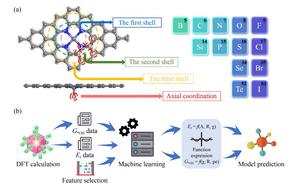
(a) Modification strategy of Fe-NC catalyst by in-plane doping and axial coordination. Shows 13 candidate elements for substitutional doping or axial coordination. (b) Schematic diagram of the workflow used for stability and ORR activity analysis of Fe-NC catalysts under doping and axial coordination modifications.
view more
Credit: Zongxuan Yang, Qingchen Wu, Hongwei Zhang, Cejun Hu, Junjie Ge, Xiaojun Bao, Pei Yuan.
Fuel cells serve as highly sustainable energy conversion devices and show great potential for the global transition to clean energy systems. However, its widespread use is currently limited due to the slow reaction rate of oxygen reduction reaction (ORR) at the cathode. Although platinum-based (Pt/C) materials are highly efficient in accelerating ORR, their high cost and susceptibility to poisoning severely limit their large-scale commercial use.
To overcome these barriers, Fuzhou University, Seiyuan Innovation Research Institute,and University of Science and Technology of China We published groundbreaking research in engineering energy. Researchers utilized an innovative combination of density functional theory (DFT) and machine learning (ML) to systematically study Fe-NC single-atom catalysts, which are abundant on Earth and serve as a very promising alternative to traditional platinum-based catalysts.
Historically, identifying the optimal modification strategy to enhance the activity and stability of Fe-NC catalysts through traditional trial-and-error procedures has been extremely difficult due to the vast combinatorial space of possible heteroatom types and doping sites. By creating 158 modified Fe-NC catalyst models, the team thoroughly investigated a “dual modulation” strategy that incorporates both in-plane heteroatom doping and axial coordination modifications.
This study successfully established a unified mechanistic and data-driven framework that significantly accelerates the design of high-performance electrocatalysts.
Key research highlights and findings:
- Axial ligands perform significantly better than in-plane dopants. This study reveals that bonding axial ligands on the Fe-NC face has a much more profound impact on ORR performance than substituting atoms in the carbon face.
- Electronic modulation mechanism: Axial ligands mainly optimize the catalytic performance by adjusting Fe d .z2 It extracts the electron density and effectively weakens the adsorption of *OH intermediates onto Fe centers.
- Machine learning accelerates discovery. By training a random forest ML model, the team extracted interpretable descriptors. for Catalyst stabilityelectron affinity and atomic radius of axial heteroatoms emerged as the most important factors. for ORR activitythe p-electron number and electronegativity of the axial ligand played a dominant role.
- Prediction of new highly active catalysts: Using a validated ML model, the researchers successfully screened 864 designed structures and identified a new doubly modified Fe-NC candidate that exhibited higher ORR activity than the original model.
- Fluorine as the ultimate axial ligand: Incorporating axial F into the Fe center was proven to effectively tune the ORR energy due to its high electronegativity and compact atomic radius. In particular, it is noteworthy that six new high-performance candidates (FeNC-O(4)-F, FeNC-N(4)-F, FeNC-P(2)-F, FeNC-P(4)-F, FeNC-S(2)-F, and FeNC-O(2)-F) sharing the axial fluorine coordination and combined with different in-plane dopants were identified and verified by DFT calculations.
The synergistic application of computational chemistry and artificial intelligence will precisely elucidate the complex interactions within doubly modified single-atom catalysts, paving the way for the development of cheaper and more efficient hydrogen fuel cells.
journal: engineering energy
Read the full article for free: https://rdcu.be/frN5f
cite this articleIn: Yang, Z., Wu, Q., Zhang, H. Others. Dual modulation of Fe-NC catalysts with axial and in-plane heteroatoms for oxygen reduction: A combined DFT and machine learning study.english energy 20, 10740 (2026). https://doi.org/10.1007/s11708-026-1074-0
journal
engineering energy
Research method
news articles
Article title
Dual modulation of Fe-NC catalysts via axial and in-plane heteroatoms for oxygen reduction: a combined DFT and machine learning study
Article publication date
June 15, 2026
Disclaimer: AAAS and EurekAlert! We are not responsible for the accuracy of news releases posted on EurekAlert! Use of Information by Contributing Institutions or via the EurekAlert System.


