
As artificial intelligence (AI) reshapes employment, organizations are finding that identifying skilled talent is becoming more difficult and time-consuming. According to research from talent solutions and business consulting firm Robert Half, 67% of U.S. HR leaders say reviewing AI-generated applications slows down the hiring process, with 20% reporting delays of two weeks or more.
AI complicates recruitment
The rapidly increasing use of AI tools by job seekers is creating new challenges for employers. 65% of recruiters report that the proliferation of applications, many of which are enhanced or generated by AI, has made it difficult to verify candidate skills. In some cases, generative AI tools fabricate or embellish work experience and skills, making it difficult for employers to distinguish between authentic experience and AI-generated content. In a market where there is already a shortage of highly skilled talent, recruiting increases time, risk and cost.
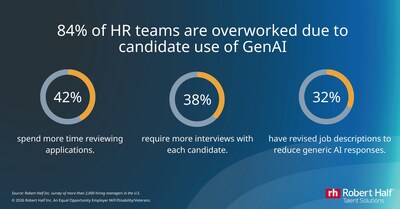
HR leaders in particular are feeling the strain, with 84% saying their team’s workload has increased. To validate candidates, many leaders are adding steps that can extend the hiring timeline even further:
- Spend more time reviewing applications (42%)
- Increase the number of interviews per candidate (38%)
- Update job descriptions to prevent common AI-generated responses (32%)
“AI has transformed recruiting at every step,” said Dawn Fay, director of operations at Robert Half. “Companies are looking to hire, but a surge in unverified applications is extending timelines and delaying important work.”
How can companies cut through the AI noise?
As organizations look for ways to maintain speed and accuracy in hiring, many are turning to external partners. Two-thirds (67%) of respondents say they use staffing agencies for recruitment support, and 89% report that these partners effectively address AI-related recruitment challenges primarily because:
- Leverage advanced tools to validate candidate materials
- Conducting targeted skills assessments
- Quickly bring pre-qualified professionals to high-priority roles
In addition, staffing firms like Robert Half rely on proprietary candidate performance data from previous engagements to source talent with proven skills and experience. This gives employers even more confidence in the quality of their candidates.
“These findings highlight the continued importance of human expertise in evaluating talent and mitigating recruitment risks,” Fay added. “While AI has made it easier to write applications, it has not made it easier to identify the right talent. In many cases, AI is doing the opposite, increasing the need for trusted experts who can validate skills and quickly provide qualified candidates.”
For more information, visit Robert Half’s career, employment and employer advice page.
FAQ:
Why does AI lengthen the hiring process for employers?
AI-generated resumes and an increase in the number of applicants enabled by AI are creating more work for recruiters. Hiring teams spend a lot of time validating skills, assessing credibility, and evaluating unqualified applicants.
Are AI-generated resumes always inaccurate or misleading?
Not all AI-generated applications are inaccurate or misleading. Many test takers are using AI responsibly to improve clarity and grammar. The challenge for employers is the volume of unverified applications and the difficulty in distinguishing authentic experiences from AI-fabricated content.
How can staffing agencies help employers meet the challenges of AI-powered recruitment?
Through proprietary performance data and candidate verification processes, staffing agencies can streamline candidate evaluation, reduce hiring risk, and verify candidate trustworthiness.

Thank you for reading CPA Practical Advisor.
Subscribe for free to get personalized daily content, newsletters, continuing education, podcasts, whitepapers, and more…
Subscribe
Already registered? Login
Need more information? Read our FAQ