Apple Music is introducing a new set of metadata requirements aimed at bringing transparency to the music industry regarding AI-generated content.
The platform has launched something called the Transparency Tag. This is a system of disclosure labels that record labels and music distributors can immediately begin applying to content distributed to Apple Music, and will be required to use when distributing new content in the future.
The move was announced in a newsletter distributed to industry partners this morning (March 4).
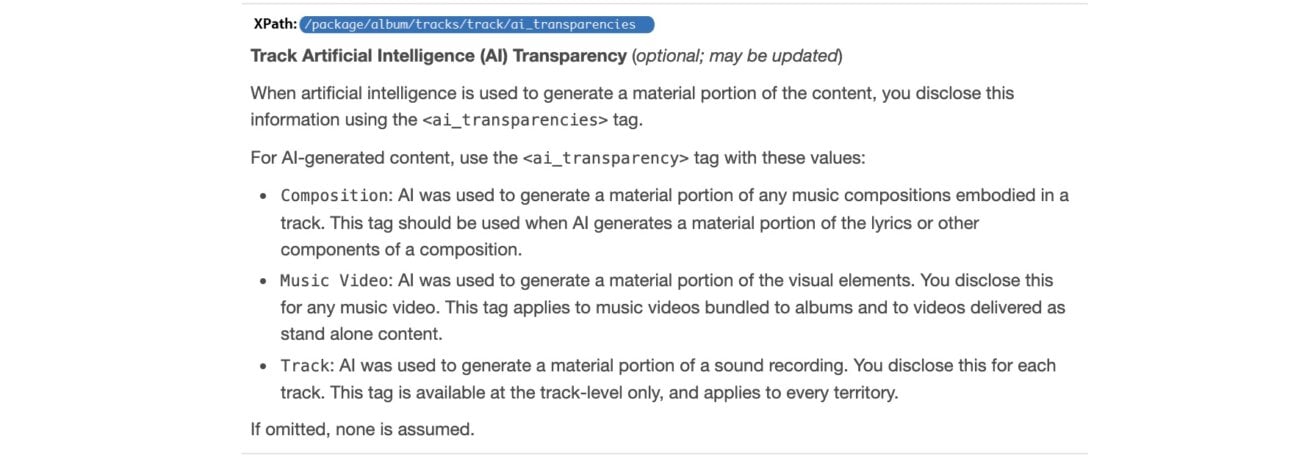
The new framework covers four main creative elements: artwork, tracks, compositions, and music videos. Artwork tags applied at the album level flag when AI is used to generate material parts of static or motion graphics artwork.
Track tags are only available at the track level and are used by the AI to generate the material portion of a sound recording.
Composition tags cover AI-generated lyrics and other compositional elements, while music video tags apply to any visual content, whether bundled with an album or distributed as a standalone.
Labels and distributors can apply multiple tags at the same time
Apple said in its newsletter that it leaves it up to content providers to decide what qualifies as AI-generated content, “as well as genre, credits, and other metadata.”
“Properly tagging content is the first step in providing the music industry with the data and tools it needs to develop thoughtful policies around AI,” Apple said in a newsletter. “We believe labels and distributors need to take an active role in reporting when the content they distribute is created using AI.”
The company added that the tagging requirements provide a “tangible first step toward the transparency the industry needs to establish best practices and policies that work for everyone.”
The announcement places the responsibility for disclosure directly on the content supply chain, rather than at the platform level, which is a marked departure from the approach being pursued elsewhere in the streaming industry.
For example, Deezer has spent the past year building its own AI detection infrastructure to identify AI-generated content through technical analysis rather than relying on self-reporting.
The contrast with Apple’s framework is striking. While Apple requires labels and distributors to declare AI content at the point of distribution, Deezer captures AI content independently at the platform level, with no upstream disclosure requirements.
The scale of what Deezer is detecting highlights why the industry is grappling with this problem now.
In January, the Paris-based platform currently 60,000 Fully AI-generated tracks every day – up from 30,000 in September 50,000 Just in November 10,000 When we first launched the detection tool in January 2025. Synthetic content currently accounts for about 39% of all music delivered to the platform each day, and Deezer says it detects and tags it. 13.4 million Total AI-generated tracks on the platform.
Importantly, Deezer’s data suggests that the primary driver of AI music uploads is fraud rather than creative intent.
The platform is up to 85% In 2025, out of all streams of AI-generated music, fraud will occur. 70% Those streams were then de-monetized and removed from the royalty pool. By comparison, streaming fraud across Deezer’s catalog accounted for 8% of all streams in 2025.
“We know that a large portion of AI music is being uploaded to Deezer for fraudulent purposes, and we continue to take action,” Deezer CEO Alexis Lanternier said in a statement.
Deezer has since moved on to licensing its detection technology to a broader industry, with French collection organization Sacem being one of the first partners to trial the tool. The company claims its system can identify 100% of AI-generated music from generative models such as Suno and Udio.
Apple’s transparency tag system does not include any visible enforcement mechanism or cross-validation process. Also note that the technical specs available here and below currently describe tags as optional, and assume nothing if omitted.
world music business