
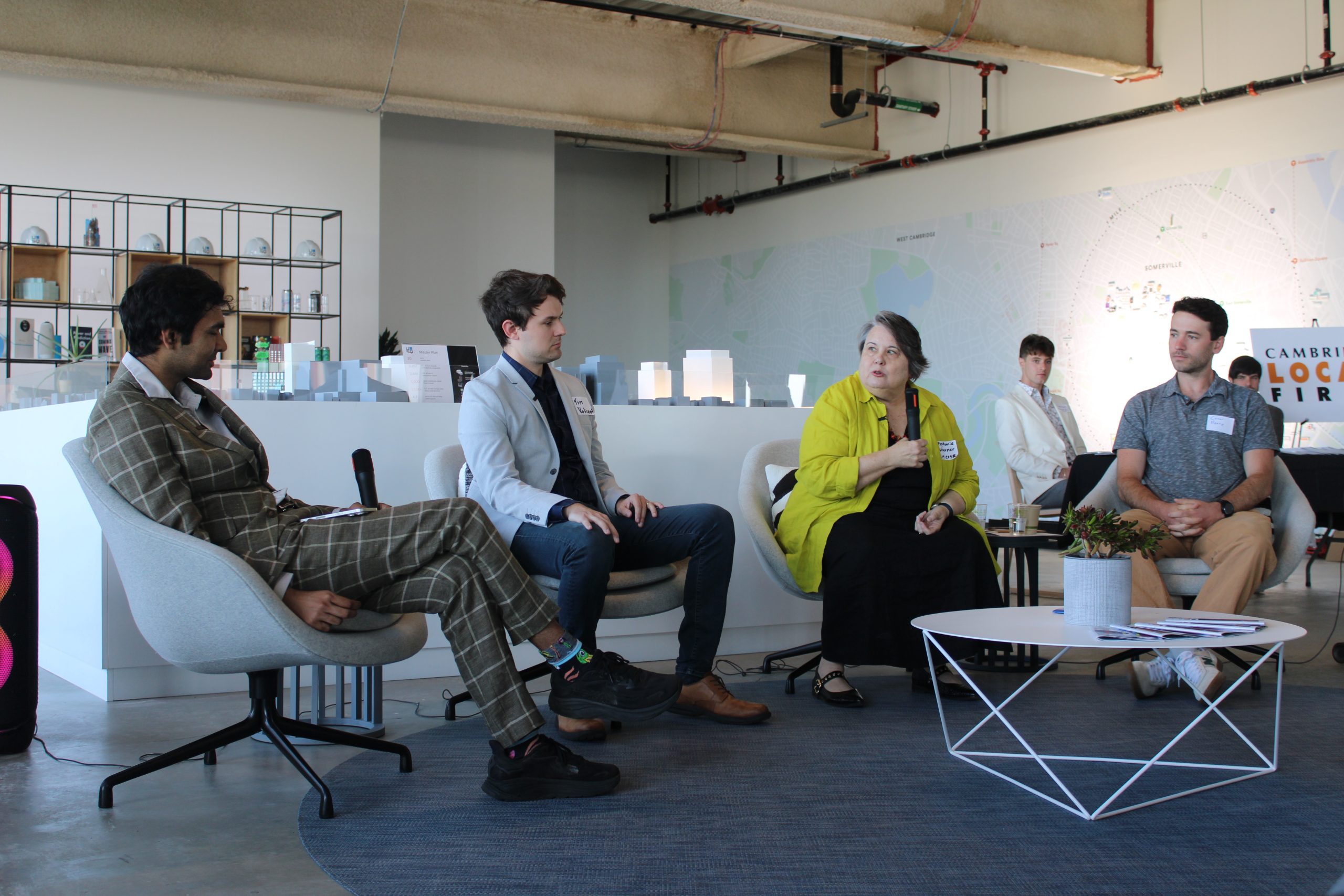
The second annual 617 Day Small Business Summit struck an optimistic tone, featuring panels geared toward helping local business owners succeed in the age of AI and Amazon.
617 Day is a small business holiday created by Cambridge Local First, a network of over 400 businesses. This represents both the traditional area code of Greater Boston and the date of June 17th.
About 60 people attended the event, held Wednesday at the USQ Building in Union Square. They saw panelists discuss how businesses can interact with AI, local media, and alternatives to e-commerce giants.
local AI
The first panel was on AI on Main Street, moderated by Cambridge Deputy Mayor Burhan Azeem, and focused the discussion on how business owners can leverage AI through process automation and innovation.

“Just dive in,” says Tim Valicenti, a lecturer at the Massachusetts Institute of Technology’s Sloan School of Management. Valicenti said even one night spent working with an AI engine is enough to gain useful knowledge. Valicenti also recommended that employers treat AI like interns, checking for mistakes and training them further to avoid future mistakes.
While many people fear or are confused by AI, the technology is allowing people to spend more time doing what they love and less time on paperwork and scheduling, said Connor Henry, product director at restaurant management platform Toast. He acknowledged that it could take 20 to 25 years for “the technology to really take hold,” but said now is the time for executives to start using AI and stay knowledgeable about the technology.
Panelists suggested having the AI send daily emails with statistics used at work (weather, interest rates, etc.) or setting reminders for daily tasks or bills that you might forget.

Find an area of business where “mistakes aren’t life-threatening,” says Stephanie Warner, director of MIT’s Center for Information Systems Research. “I also think we’re going to miss a real opportunity if we don’t think about how to use AI to do things that we don’t know how to do,” Woerner said. Connecting anonymized data to search engines and asking lots of questions to identify customer trends is a great way to start, she added.
And while there are concerns that AI will replace workers, Warner said companies should be able to find ways to leverage technology to “get the most out of their workforce.”
AI was also a hot topic in the second panel, “The Power of Local Media.” AI is used in some newsrooms to generate stories, but Cambridge Day editor-in-chief Michael Fitzgerald said it had real potential to do “things we can’t do”, such as covering the 60 monthly political meetings in Cambridge.
However, panelists said AI is not the main threat to journalism. Rather, it’s declining viewership, business models, and lack of media literacy.
“Our biggest challenge is getting people to understand what it takes to actually report,” Fitzgerald said.
The challenge for Cambridge Community Television President Matt Landry is knowing he doesn’t have the money to make up for the loss of revenue from declining cable subscribers.
Despite the decline in engagement, CCTV and other community access stations can help companies “tell their stories and elevate their brands” through media literacy education, Landry said. “For me, media literacy is not only about being able to understand the media messages you see, but also about being able to communicate those messages and get them out into the world.”

Although the internet is full of misinformation, people have a natural instinct for truth, which can be strengthened by “getting your news from trusted and trusted sources,” said Michael Gutierrez, arts editor at the Cambridge Somerville Independent.
For businesses looking to collaborate and connect with local media, Gutierrez pointed out that the media’s goal is to “find the real people” behind local business and arts events.
Local alternative to Amazon
The final panel, “Alternatives to Amazon,” looked at why consumers should shop local and how small businesses can compete with e-commerce giants like Amazon.
By not supporting local businesses, “we’re chipping away at empty lots on our own boulevards and isolation in our own neighborhoods” and trading connections with business owners “for cardboard boxes dropped on porches,” said Barbara Thomas, owner of Artifact Soapworks.
MJ Pullins, owner of Hubba Hubba, an adult entertainment store that closed in December, said a wholesaler was selling products at wholesale prices on Amazon. Overall, Pullins says it’s important to shop at small businesses whenever possible, otherwise you won’t have a store when you need it most.
Shopping local means 60 cents of every dollar spent is reinvested in the community, but you get 30 cents from big business sales and just a penny from Amazon, said panel moderator Theodora Skidas, head of AI Red Teaming and former executive director of Cambridge Local First.
Supporting local businesses is “as easy as supporting Amazon,” Thomas said.
And shopping locally doesn’t necessarily have to be done in person. Vermont-based e-commerce site Myti.com has created a browser extension that shows online shoppers local options for what they’re searching for at Target, Walmart, or other e-commerce sites.
Myti helps connect consumers with companies that are knowledgeable and passionate about their products, said founder Bill Calfee.
While consumers may be used to the convenience of next-day delivery, the benefit of shopping locally is that “you’re buying something of high quality, integrity, and longevity that actually outlasts expedited shipping alternatives,” Thomas said.
The festival also included networking opportunities. Katie Labrie, executive director of Cambridge Local First, said the key was to create a summit that offered “something for everyone who is passionate about and interested in thriving local economies”.
Related articles
more powerful

Please consider making a financial contribution to sustain, expand and improve. cambridge day.
We are currently a 501(c)(3) nonprofit organization and all donations are tax deductible.
Please consider making a regular donation.


