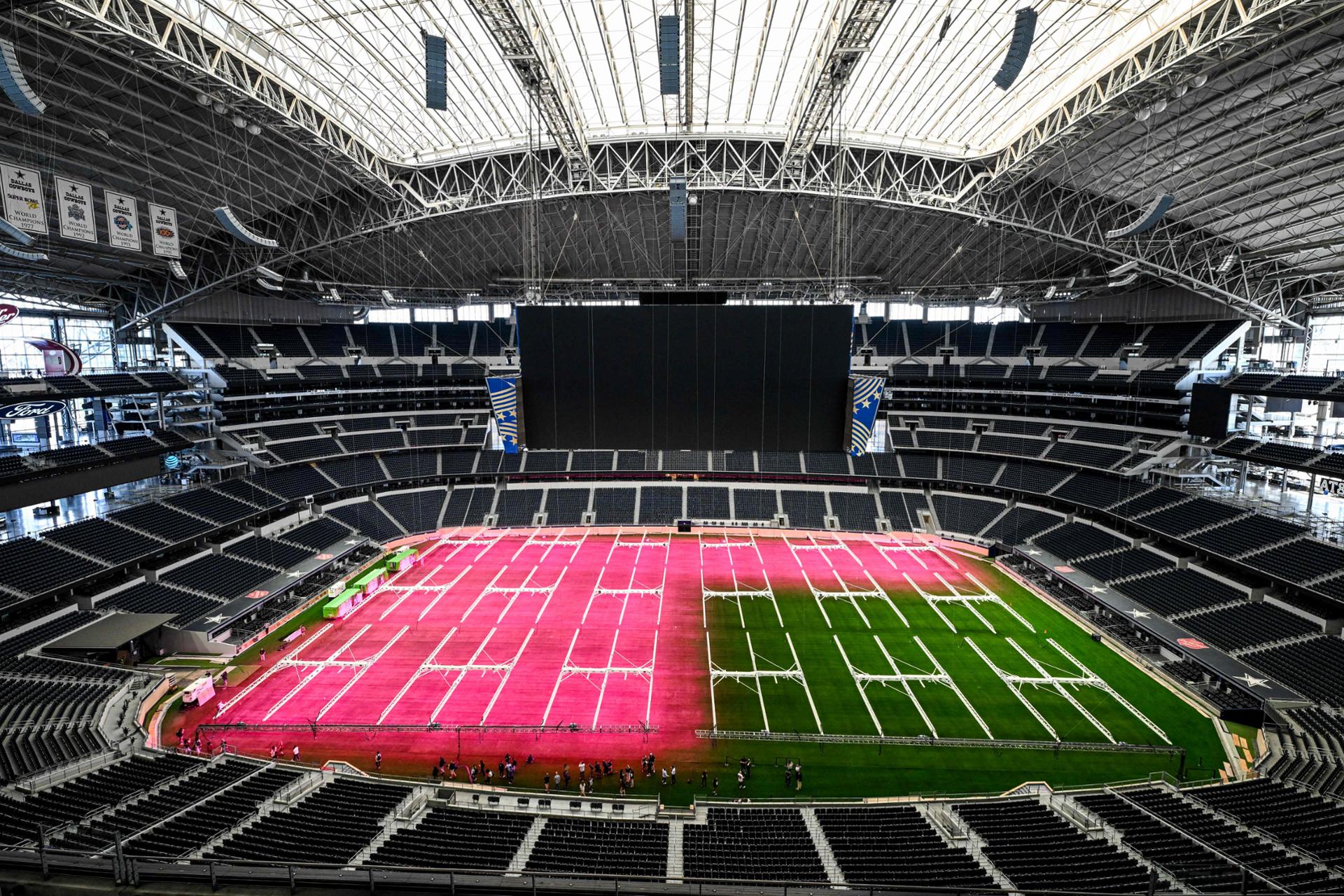

Lights are seen illuminating the field to encourage grass growth at Dallas Stadium in Texas, one of the stadiums for the 2026 FIFA World Cup, on Thursday. AFP-Yonhap News
HONG KONG — Artificial intelligence (AI) is set to debut at the 2026 World Cup, with the most-watched soccer tournament leveraging real-time data models and live 3D simulations to reshape match strategy and event management.
Each team has access to its own AI model, allowing analysts to compare play patterns through video clips and 3D avatars. Coaches will be able to assess how tactical changes will work against their next opponent, and players will receive individual match analysis.
The system, known as ‘Football AI Pro’, can analyze hundreds of millions of FIFA data points and process over 2,000 soccer-related metrics, including pressing, movement, tactics and transitions. It provides insights as text descriptions, graphs or short video clips and was developed by Lenovo, the tournament’s FIFA technology partner.
“While wealthy teams may have had an advantage in the past, in 2026 AI will democratize data and give everyone the same opportunities,” Bank of America Global Research wrote in a May 6 memo.
The 2026 FIFA World Cup, co-hosted by Canada, Mexico and the United States in 16 cities, will be played in an expanded format with 48 teams and 104 matches. The opening game is scheduled for June 11th.
At this mega-event, athletes will also be digitally scanned in about one second to create accurate 3D versions of their bodies. The technology is expected to make offside decisions more accurate and explainable, providing better information to referees and allowing fans to better understand decisions made by video assistant referees.
Each of the 16 stadiums will have a “digital twin” – a live virtual copy of the venue. Officials will be able to use the system to monitor crowd movements, security risks and player health data from wearable devices in real time.
SanDisk estimates that the tournament will generate more than 90 petabytes of data, approximately 45 times the amount generated during the 2022 World Cup in Qatar. When you include social media posts, selfies, mobile interactions, and other digital activity, the total can reach unprecedented levels. BofA predicts data volumes will reach a record 2 exabytes, which is equivalent to approximately 45,000 years of 4K video.
“The 2026 World Cup will be the first tournament in which data itself will be the primary deliverable,” the BofA research team said. “We are looking at large-scale real-time simulations where the physical world is mirrored into data at a rate of petabytes per week.”
As well as stadium technology, the tournament is expected to feature one of the most visible introductions of self-driving cars to date. Seven companies will operate robotaxis in 10 host cities, with self-driving ride-hailing services potentially available for some matchday journeys. Waymo plans to have the biggest presence, with public rides planned in seven host cities and testing in three other cities.
The introduction of humanoid robots and legged robots is also expected. Hyundai Motor Group will use Boston Dynamics’ Atlas and Spot robots in several U.S. host cities to support stadium operations, logistics, and fan engagement. Mexico plans to deploy robot dogs for stadium security and first responder duties.
The World Cup’s introduction comes as analysts expect the adoption of AI in sports to accelerate, although the use of AI is still in its early stages.
The Oakland Ballers recently became the first professional baseball team to use AI to support most game management decisions, including setting lineups and making substitutions during games. Norway’s Hamkam FC conducted a similar experiment using an AI head coach. In the NFL, coaches receive automatically filtered footage of relevant plays based on live game conditions such as downs, distance, and field position.
“The goal is not to replace the roar of a crowd or the instincts of a great coach; it is to refocus people on what they do best: inspire, lead, and connect people,” PwC wrote in a January note. “Far from destroying the appeal of sports, AI can make them even more attractive.”