

Artificial intelligence is rapidly changing the way Muslim travelers research, book and experience travel, according to the latest 2026 edition of Mastercard and the Global Muslim Travel Index (GMTI). crescent rating.
The 11th edition of the annual report evaluates 150 destinations that represent more than 98% of the world’s Muslim visitors. The 2026 findings suggest that the industry is entering a new phase where digital visibility becomes almost as important as physical tourism infrastructure.
Muslim tourists certainly continue to grow as a tourism force. According to data from CrescentRating, the number of international Muslim arrivals will reach 196 million in 2025, an increase of 11.3% compared to 2024. Total arrivals are expected to reach 208 million in 2026 and 262 million by 2030.
According to the report, 80% of travelers now use AI tools during the trip planning processThis marks a significant shift from traditional online search to AI-powered recommendations and personalized itineraries.
For destinations targeting the growing Muslim travel market, it is no longer enough to offer halal restaurants, prayer facilities, and Muslim-friendly accommodations. These services should be easy for the AI platform to discover and recommend.
Digital trust becomes a competitive advantage
According to the report, AI-powered travel assistants will increasingly help travelers find halal restaurants, nearby mosques, and prayer rooms, compare transportation options, receive customized recommendations, and navigate unfamiliar destinations..
As more travelers rely on AI-generated recommendations instead of manually searching multiple websites, tourism organizations are facing new challenges: We ensure that our Muslim-friendly services are digitally structured, accurate, and constantly updated.
The report warns that destinations with good ground facilities could be lost. When AI systems cannot easily access information, visibility is reduced.
master card It says digital trust will be at the heart of future travel decisions. Aisha Islam, Senior Vice President, Customer Solutions Center, Southeast Asia, Mastercardsays AI makes it easier for travelers to find reliable information, secure payments, and Muslim-friendly services throughout the booking process.
Regional travel gains momentum
The report also highlights continued geopolitical uncertainty, changing travel patterns amid rising airfares and flight disruptions.
Rather than canceling their vacation, many people muslim traveler People are choosing destinations closer to home, creating stronger regional travel corridors.
CrescentRating describes this trend as “mobility between home continents.” There, travelers prioritize nearby destinations that are easier to access, have less transportation complexity, and provide greater peace of mind.
Southeast Asia is emerging as one of the biggest beneficiaries of this change, thanks to extensive air connectivity, well-developed halal tourism infrastructure, and strong cultural attractions.
The report notes that intra-ASEAN travel continues to grow as travelers seek reliable and familiar destinations with established Muslim-friendly services.
Malaysia extends winning streak
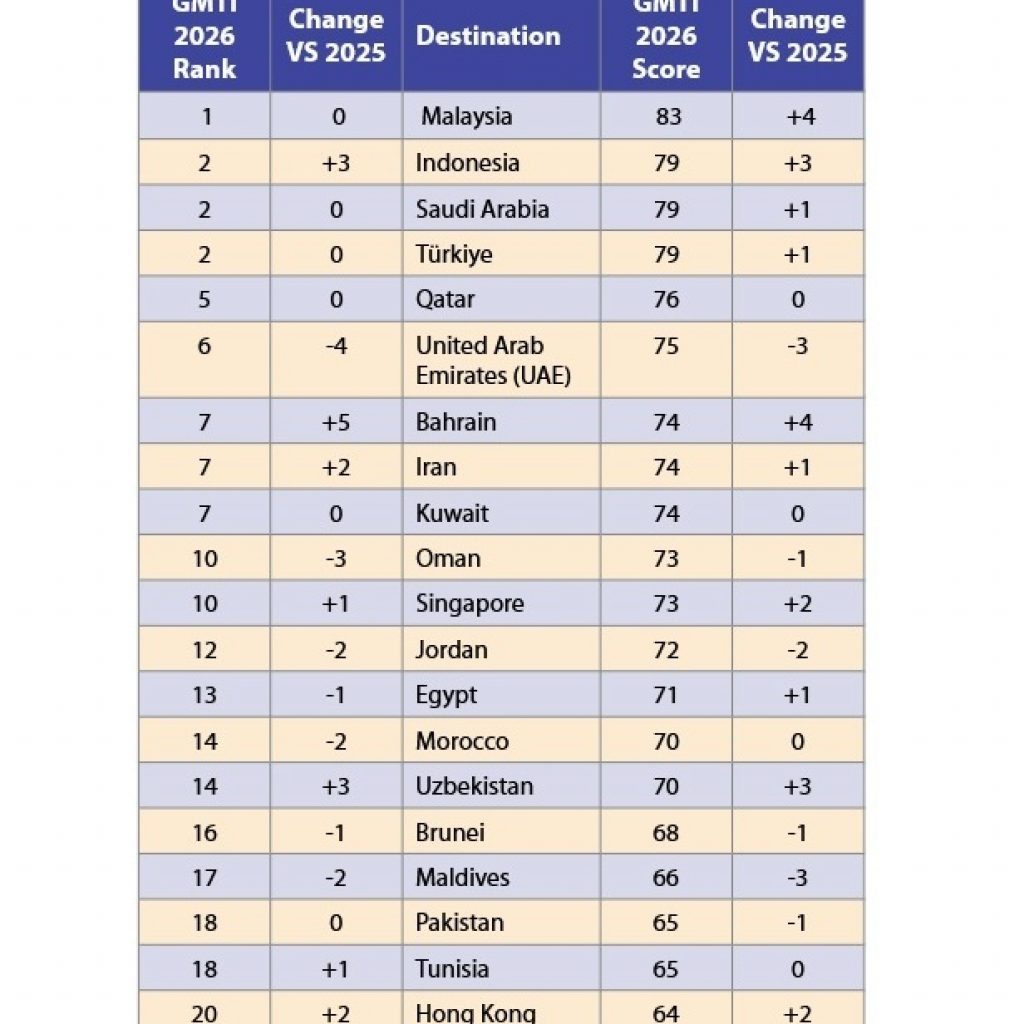
Malaysia claimed the title again World-class Muslim-friendly destinationshas been at the top of the rankings for 11 consecutive years.
The country received a score of 83This reflects the mature halal tourism ecosystem, extensive Muslim-friendly services, and ongoing preparations for the Visit Malaysia 2026 campaign.
Indonesia had the strongest rise in this year’s rankings, moving up three places to share second place with Turkey and Saudi Arabia, with each destination scoring 79 points.
Government investment, major halal tourism initiatives, and expansion of tourist services have helped improve Indonesia’s performance.
Among non-Organization of Islamic Cooperation (OIC) destinations, Singapore maintained its leadership position while also ranking 10th globally.
Hong Kong rose to second place among non-OIC destinations, with Taiwan and the United Kingdom sharing third place.
Elsewhere in Asia, the Philippines, Japan and South Korea have particularly improved their Muslim-friendly tourism credentials through continued investment in halal services, digital infrastructure and inclusive visitor experiences.
New framework measures destination readiness
GMTI 2026 introduces new features. destination activation stackis a combination of three rating models designed to measure how effectively a destination converts traveler interest into actual bookings.
The framework builds on the existing ACES model (Access, Communications, Environment, and Services) with the addition of RIDA, which measures responsible, immersive, digital, and authentic travel experiences, and TRUST, which measures traveler trust and digital discoverability.
The expanded approach reflects how Muslim tourism is evolving beyond basic amenities.
Today’s travelers increasingly expect destinations to offer seamless digital experiences, reliable information, sustainable tourism practices, and secure payment systems alongside traditional Muslim-friendly facilities.
Fazal Bahardeen, CEO of CrescentRating and HalalTrip, said destinations need to be more than just geared towards Muslim travelers, they need to be actively recognized and trusted across the digital travel ecosystem.


